The 2026 commercial property marketplace for the city of Charlotte is significantly influenced by a flight to quality and ongoing redevelopment in several urban districts. The Queen City is one of the key economic centers in the Sun Belt region and continues to attract institutional investment, particularly in growing submarkets such as South End and the University City research hub. Understanding the local market requires looking closely at absorption rates and the specific expertise of top brokerages in order to bypass today’s challenging interest rate environment. Additionally, many of these firms have been recognized nationally and ranked among the top 100 real estate companies in the USA.
For both investors and corporate tenants, the right firm for tenant representation or investment sales can help secure long-term value. The leading firms in the region do more than complete transactions. They also help clients understand submarket conditions and provide strategic advice on 1031 exchanges and large industrial development projects. Whether you look for Class A office space in Uptown or large-scale logistics facilities near the airport, these brokers serve as the first point of contact for off-market investment opportunities across North Carolina. Several of these firms have a strong reputation among the top real estate companies in North Carolina because of their development activity and regional expertise.
The current market conditions are characterized by an emerging trend towards mixed-use innovation centers and a strong retail market due to continuous population growth. With trophy properties being nearly fully occupied, the skill set of a commercial broker now includes digital marketing techniques and AI-based lead scoring to stay at the forefront of the competition. This overview has sought to identify the firms currently leading the Charlotte market, with the technical and local knowledge to effectively execute property acquisitions and lease transactions in today’s fast-paced market.
Most of the leading commercial brokerage teams in Charlotte have begun to use PropTech tools that support both transaction management and market insights for institutional clients. Top-performing brokerage teams utilize a commercial real estate CRM to track trophy asset pipelines and automate tenant follow-ups. AI-based lead management systems assist brokers with identifying high-value inquiries as well as managing long-term tenant retention programs.
See how a dedicated CRM helps Charlotte brokerages manage trophy asset pipelines, automate tenant follow-ups, and stay compliant across North and South Carolina regulations.
Explore CRM

This table highlights eight of the most influential commercial real estate firms operating in the Charlotte metropolitan area, ranked by market presence and specialized service offerings.
Charlotte’s commercial landscape is evolving at a pace that rivals other major financial centers. While investors often look toward the top commercial real estate brokers in Chicago for legacy industrial insights, Charlotte offers a fresh, high-growth alternative in the Sun Belt.
Furthermore, the local synergy between sectors is clear; while the top residential real estate companies in Charlotte manage the massive housing demand, commercial brokers are securing the infrastructure for the city's expanding workforce. These firms utilize strategies seen among the best real estate companies in the USA to maintain competitive edges.
Talk to a Charlotte commercial property expert
Quick Chat
1
JLL (Jones Lang LaSalle)
Website: jll.com
Headquarters: Chicago, IL (Major Charlotte Hub)
Local Footprint: 1,060+ employees
Core Services: Agency leasing, capital markets, and tenant representation
Market Impact: As the largest commercial firm in the region, JLL recently spearheaded major office leasing in NoDa and high-volume industrial sales in Conover.
2
CBRE
Website: cbre.com
Headquarters: Dallas, TX (Dominant Charlotte Office)
Local Footprint: 740+ employees and 40+ licensed brokers
Core Services: Strategic advisory, property management, and corporate relocation
Market Impact: Serving over 80% of the Fortune 100, CBRE recently managed the complex office relocation for PulteGroup into the Toringdon Office Park.
3
Cushman & Wakefield
Website: cushmanwakefield.com
Headquarters: Chicago, IL (Primary Charlotte Branch)
Local Footprint: 46 licensed brokers; 350+ total staff
Core Services: Valuation, advisory, and global occupier services
Market Impact: Known for having the highest concentration of licensed brokers in the city, they are the go-to firm for large-scale institutional valuations and integrated services.
4
Lincoln Property Co. (Lincoln Harris)
Website: lincolnharris.com
Headquarters: Charlotte, NC
Local Footprint: 245+ employees
Core Services: Full-service development and property management
Market Impact: A regional powerhouse heavily involved in Uptown’s transformation, most notably leading the Legacy Union project which secured the Honeywell headquarters.
5
Colliers
Website: colliers.com
Headquarters: Toronto, CA (Established Charlotte Presence)
Local Footprint: 120+ employees
Core Services: Investment sales and specialized multifamily brokerage
Market Impact: Expanded significantly in early 2025 by adding a dedicated multifamily team to address the rapid delivery of new apartment units across the metro area.
Charlotte enters 2026 as a top-five target for North American real estate investors, driven by a sustained population inflow of approximately 157 new residents per day. While the top residential real estate companies in Charlotte cater to the city's massive population inflow, the commercial sector requires a specialized approach to high-stakes asset management and institutional leasing. The market is transitioning from a heavy supply delivery phase into a period of strategic absorption. Key growth factors include:
- The flight to quality trend has nearly fully leased trophy assets in South End and Uptown, driving premium rents despite broader economic headwinds.
- Industrial absorption exceeded 6 million square feet recently, with demand concentrated in modern facilities built within the last decade.
- Superior interstate access in Gaston and Rowan counties has captured over 50% of the region's industrial occupancy gains.
- Major projects like The Pearl innovation district and the Wegmans development in Ballantyne are redefining mixed-use expectations.
Source: JLL Research, CBRE Market Insights, Zillow Business
Source: CoStar, Charlotte Regional Business Alliance
Talk to a Charlotte commercial property expert
Quick Chat
The Charlotte market offers specialized opportunities across diverse asset classes, each driven by unique economic catalysts. Firms like JLL and CBRE manage thousands of complex transactions annually. These market leaders often implement automated commission management and a robust real estate sales management platform to maintain transparency and agent satisfaction.
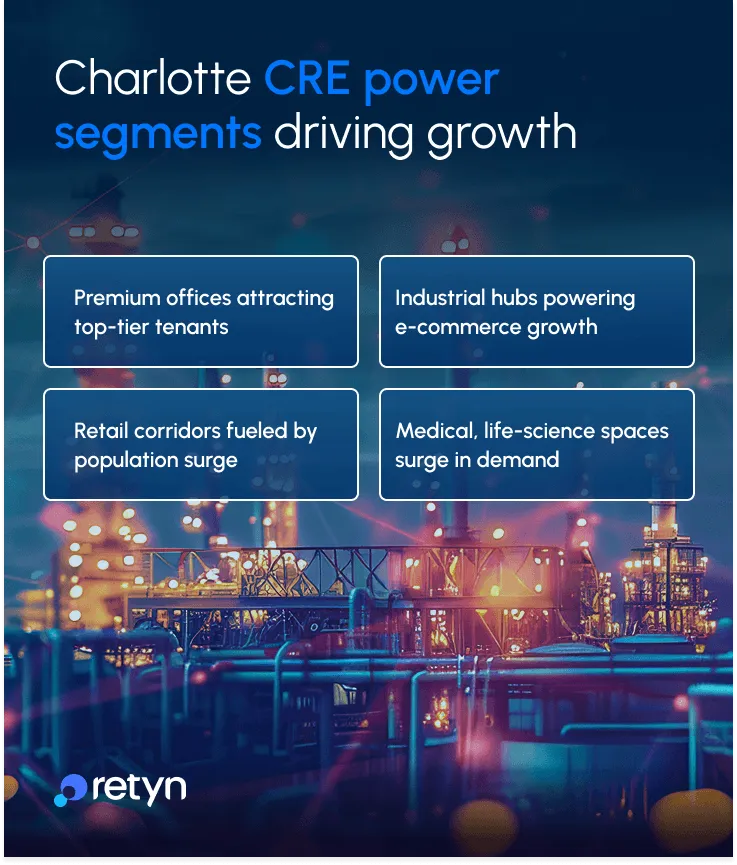
- Trophy office spaces in South End and Midtown continue to see high demand from tech and financial firms seeking premium amenities to encourage office re-entry.
- Industrial and logistics facilities near Charlotte Douglas International Airport and the I-485 loop remain critical for regional distribution and e-commerce fulfillment.
- Retail fundamentals are among the strongest in the nation, supported by rapid population growth and new mixed-use developments in Ballantyne and University City.
- Medical office buildings and life-science spaces are expanding rapidly, centered around the new Atrium Health and Wake Forest medical school innovation district.
Strategic investors are prioritizing Charlotte due to its business-friendly environment and consistent yield potential.
- North Carolina’s competitive corporate tax structure and local municipal incentives provide a lower barrier to entry for large-scale acquisitions.
- High net absorption in the industrial sector ensures stable cash flows and long-term appreciation for institutional-grade assets.
- Market diversification across banking, energy, and aerospace sectors provides a hedge against volatility in any single industry.
Rapid growth and shifting economic conditions present unique operational hurdles for local brokerage teams.
The rise of boutique brokerages has intensified the war for talent. Firms are now using bonus tracking management and an integrated compensation tracking platform to retain top producers. To reduce the strain on back-office staff, teams are adopting a digital deal pipeline tracker to visualize high-value closings.
- Increased competition for top-tier brokers has intensified as global firms and local boutiques vie for the same high-performing talent.
- Scaling transaction volume often strains manual administrative processes, leading to delays in lease executions and closing timelines.
- Managing multi-state compliance and varied zoning regulations between North and South Carolina requires rigorous oversight and data accuracy.
- The influx of new apartment and office supply requires brokers to provide more granular, real-time data to justify pro-forma rent projections.
Leading Charlotte commercial brokerages are increasingly adopting PropTech to streamline complex transactions and provide data-driven insights to institutional clients.
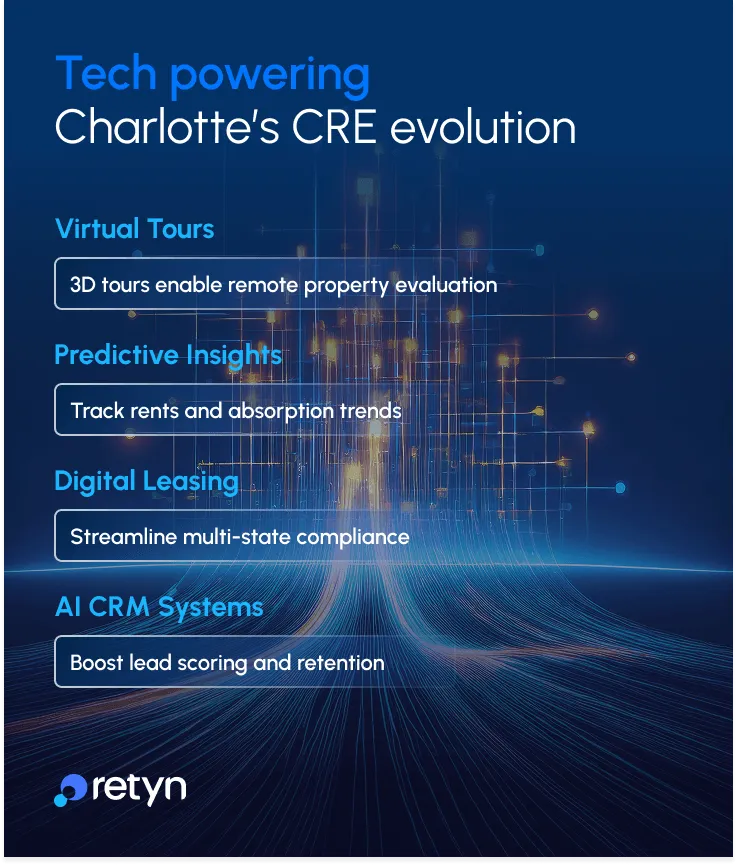
- Immersive 3D virtual tours of shell spaces and planned redevelopments allow out-of-state investors to vet properties without immediate travel.
- Predictive analytics platforms provide real-time dashboards on submarket absorption rates and trophy asset rent benchmarks.
- Automated lease management and digital signature workflows ensure compliance across North and South Carolina jurisdictions.
- AI-powered CRM systems automate lead scoring for high-value inquiries and manage long-term tenant retention programs.
The Charlotte commercial market is entering a sophisticated new phase where data and speed define the winners. Brokerage teams that embrace automation and modern client management tools will be best positioned to capture the ongoing flight to quality. By adopting scalable technology today, firms can ensure smoother closing processes and superior client service as the region continues its rapid expansion.
A real estate growth platform provides the infrastructure needed to personalize the investor experience, enhance regulatory compliance, and maximize portfolio ROI.
Empower your Charlotte brokerage to manage high-volume commercial deals with an AI-powered CRM.
Get CRM now
FAQs on Charlotte commercial real estate
As of early 2026, South End continues to be one of Charlotte’s top performing office submarkets. It has lower vacancy rate than many parts of the overall office market and has experienced more leasing activity. Much of the recent industrial space absorption has occurred in or around Gaston and Rowan counties, largely because of their access to major interstate highways.
In contrast to premium office properties in South End and Uptown, which are near full occupancy and seeing rising rents, older suburban office buildings have been facing increasing challenges as many tenants look for more updated space. In response, many landlords are exploring adaptive reuse projects or renovating these properties to attract tenants who prefer modern amenities.
Tenants should ask if a broker mainly represents landlords or tenants. This will help determine whether there could be any conflicts of interest. Also, ask for a case study where they were able to save a deal when negotiations stalled, to assess how well the broker can advocate for you.
There was a short-term surge in the delivery of new units in the multifamily sector, which resulted in an initial oversupply. This caused the market to soften through 2025. Multifamily occupancy rates will likely recover somewhat by 2026 as deliveries from the current pipeline slow. Retail in Charlotte remains strong because of rapid population growth.
Beacon Partners and Childress Klein are regarded as major developers in the industrial sector. Beacon Partners has developed more than 5.3 million square feet since 2019 and most of that space is industrial.
The Pearl is an innovation district housing both Atrium Health and the Charlotte campus of Wake Forest University School of Medicine. The project involves about $1.5 billion in investment and plays an important role in development in Charlotte’s urban core.
The major commercial brokerage companies such as JLL, CBRE and Cushman & Wakefield provide quarterly research reports for the Charlotte area. These reports cover several key indicators including vacancy rates, net absorption and rental trends.
Disclaimer: Retyn does not promote or endorse any company listed above. The firms mentioned are selected based on publicly available market data and recent performance metrics as of early 2026. Market conditions are subject to change.