Chicago, Illinois, remains a global economic powerhouse for commercial real estate through early 2026, with continued flight to quality demand and adaptive reuse of older buildings. The city's commercial real estate market continues to become more fragmented and so working within this market now requires specialized knowledge. Companies and investors are relying on experienced Chicago brokers to manage complex transactions such as investment sales, property valuations and site selection.
Commercial real estate brokers in Chicagoland are no longer focused only on transactions. Many now represent tenants or advise landlords during lease negotiations. Having a data-driven broker will help you maximize your portfolio ROI, especially with industrial property development occurring around O'Hare Airport and office spaces redevelopment in the Central Business District.
Many Chicago brokerages now use strategies similar to those employed by the best real estate companies in the USA. This guide highlights some of the most important commercial real estate companies operating in the city. Whether you are searching for boutique firms or large global brokerages, it is vital to understand the local market trends and broker specialities. Below is a list of leading brokerage firms in Chicago and a market snapshot for investors, tenants and landlords.
See how a dedicated CRM helps Chicago firms manage adaptive reuse projects, automate tenant follow-ups, and stay compliant with Illinois zoning regulations.
Explore CRM

This table highlights eight respected commercial real estate firms headquartered or operating in the Chicago area plus their key offerings.
Talk to a U.S. commercial property expert
Quick Chat
1
CBRE Chicago
Website: cbre.com
Headquarters: Chicago, IL
Established Year: 1906
Key Focus: Corporate and institutional leasing
Core Services: Full-service commercial brokerage, tenant representation, investment sales
Highlight: Consistently ranked as the top firm in Chicago by Crain's Chicago Business
2
JLL (Jones Lang LaSalle)
Website: us.jll.com
Headquarters: Chicago, IL
Established Year: 1999
Key Focus: Global investment management
Core Services: Corporate real estate, property management, capital markets
Highlight: The largest property manager in the greater Chicago area with over 46 million square feet
3
Cushman & Wakefield
Website: cushmanwakefield.com
Headquarters: Chicago, IL
Established Year: 1917
Key Focus: Industrial and office sectors
Core Services: Receivership sales, valuation, site selection
Highlight: Manages approximately 26 million square feet locally and dominates midwest industrial expansion
4
Colliers International
Website: colliers.com
Headquarters: Chicago, IL
Established Year: 1976
Key Focus: Workplace strategy and analytics
Core Services: Labor analytics, tenant representation, leasing
Highlight: Ranked among the top three for local square footage managed with over 22 million square feet
5
Chicagoland Commercial Real Estate
Website: chicagolandcommercial.com
Headquarters: Palatine, IL
Established Year: 2002
Key Focus: Local specialized brokerage
Core Services: Office, industrial, and medical space leasing
Highlight: A full-service firm with over $500 million in aggregate property sales
Chicago's central location, robust infrastructure, and shifting post-pandemic strategies underpin its commercial real estate demand in 2026. Key factors driving the market include:
- Adaptive reuse initiatives like the LaSalle Street Reimagined project are successfully transforming older vacant office buildings into highly desirable residential and mixed-use spaces.
- Fulton Market continues its reign as the primary destination for creative office tenants and high-end residential, creating spillover demand for flex space in the perimeter.
- The Elk Grove Village and O'Hare corridor is experiencing massive infrastructure investment cementing its status as the second-largest data center market in the United States.
- The I-80 and Joliet Corridor remains the top-performing industrial submarket securing millions of square feet in new leases for major logistics and consumer brands.
Source: Crain's Chicago Business, Commercial Real Estate Data
Source: RealTrends, Chicago Agent Magazine
Talk to a U.S. commercial property expert
Quick Chat
Diverse asset opportunities are available across the Chicagoland area to meet specialized institutional and investor criteria.
- The office market is highly bifurcated with prime Class A space becoming exceptionally scarce while older centralized assets undergo adaptive reuse conversions.
- The industrial sector has shifted from rapid speculative building to a sustainable build-to-suit model prioritizing heavy power availability for data centers and advanced manufacturing.
- Multifamily properties benefit from an incredibly tight rental market caused by a severe supply shortage and the lowest construction pipeline seen in years.
- Retail spaces in high-demand neighborhoods like Fulton Market and the Gold Coast are experiencing stabilization and strong rent growth due to limited new construction.
Smart commercial investors are leveraging the strategic shift toward adaptive reuse and the explosive growth of high-power infrastructure across the Chicagoland area.
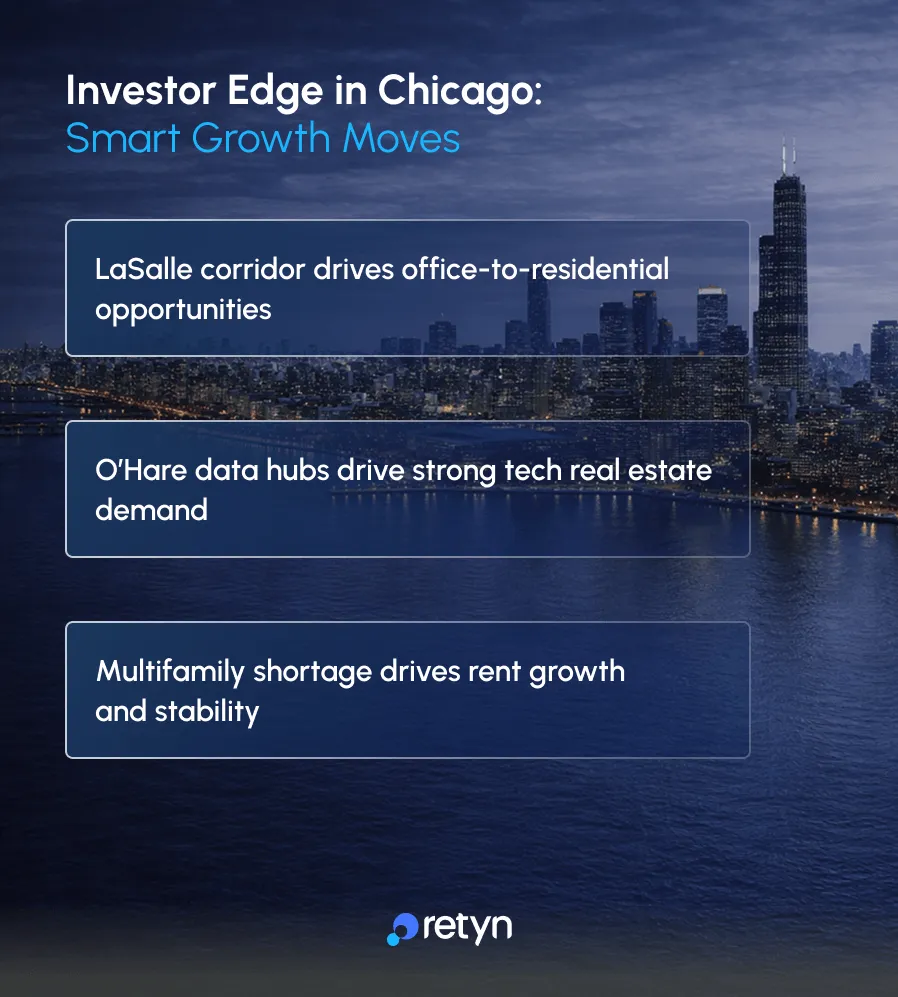
- Adaptive reuse initiatives along the LaSalle corridor offer unique repositioning opportunities for obsolete office assets to be converted into residential spaces.
- Unprecedented demand for data centers near O'Hare transforms traditional logistics parcels into high-yield technology hubs.
- A severe supply shortage in the multifamily sector guarantees strong rent growth and occupancy stability for existing property owners.
Navigating a transitional commercial market requires specialized expertise to overcome strict zoning limitations and shifting tenant demands.
- The highly bifurcated office market leaves overall vacancy elevated while creating intense competition for rare prime Class A blocks.
- Power availability has replaced square footage as the primary gating factor for industrial and cold storage site selection.
- The lowest multifamily construction pipeline in years creates extreme inventory shortages for buyers and institutional investors.
- Shifting workplace strategies force modern brokerages to provide complex labor analytics rather than simple transaction management.
Increasingly, Chicago commercial real estate companies are utilizing PropTech to automate complex transaction management and provide deeper market analytics for institutional clients.
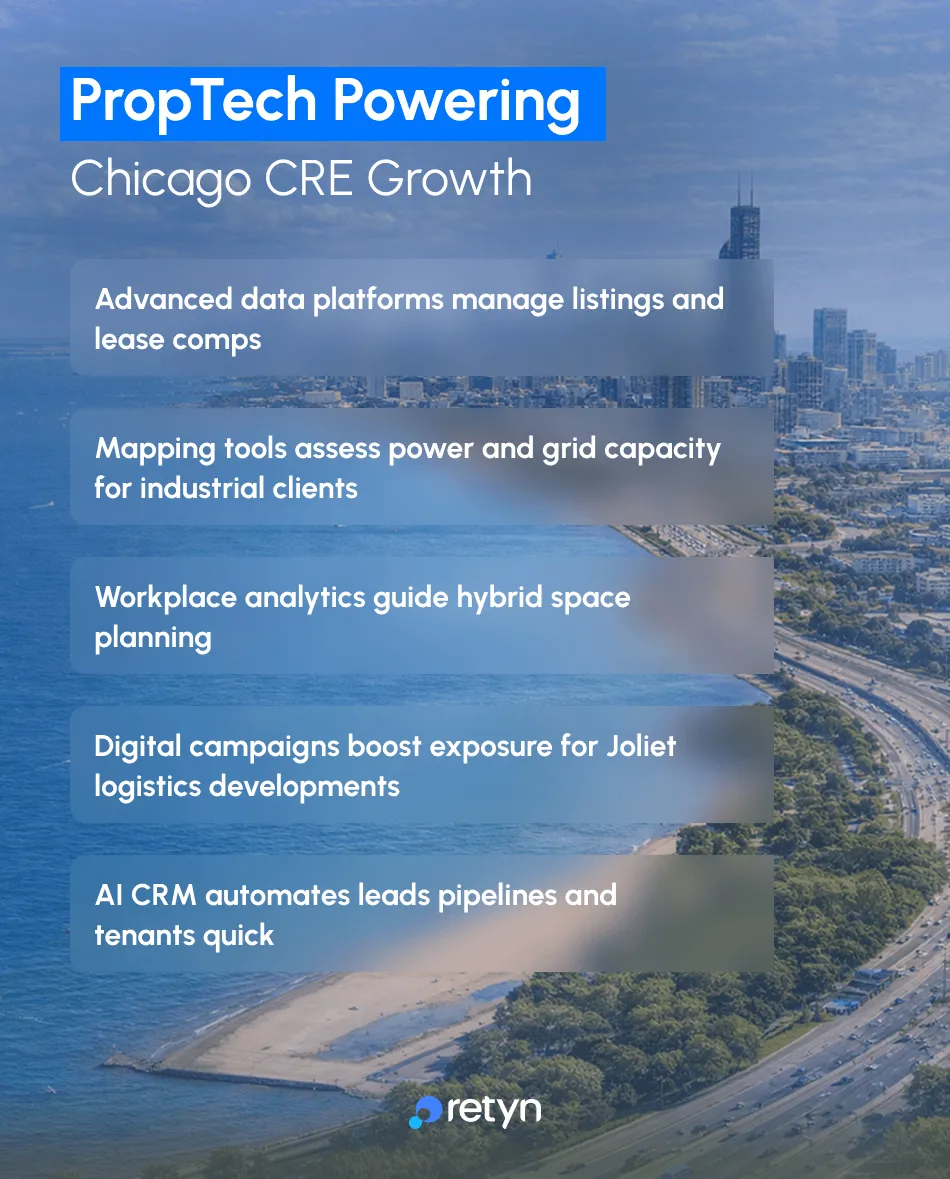
- Advanced data platforms like LoopNet, CREXi, and CompStak allow brokers to manage exclusive off-market listings and analyze real-time lease comps across the Central Business District.
- Specialized mapping software evaluates power availability and grid capacity for industrial clients seeking suitable land for data centers near O'Hare.
- Labor analytics and workplace strategy dashboards help corporate tenants determine precise square footage requirements for hybrid work models before signing long-term leases.
- Digital marketing campaigns targeting national logistics firms increase exposure for massive speculative developments along the Joliet Corridor.
The Chicago commercial real estate market is undergoing a massive structural shift, and brokerage teams who prepare for a data-driven future will dominate the landscape. The most effective way for commercial firms to secure high-value institutional clients and outpace competitors is by utilizing modern tools like specialized CRM systems and predictive market analytics. Teams that adopt automated transaction management today will navigate the complexities of adaptive reuse and industrial build-to-suits with much greater efficiency tomorrow.
A real estate growth platform offers comprehensive solutions tailored to commercial workflows, including personalizing tenant representation, enhancing regulatory compliance, and maximizing portfolio ROI.
Empower your Chicago commercial brokerage to convert complex inquiries into closed leases with an AI-powered CRM.
Get CRM now
FAQs on hiring commercial real estate brokers in Chicago
Brokerage commissions are normally paid by the landlord or property owner and can vary from four to six percent of the total lease value or sale price. Tenant representation is provided at no direct cost to the tenant.
The vacancy rate in Chicago’s central business district remains elevated, but the Class A office space is becoming increasingly limited. Tenant representatives rely on labor analytics, workforce data and proprietary property database to determine which options are available and negotiate better lease terms, including tenant improvement allowances.
LaSalle Street Reimagined is a City of Chicago program initiated in 2022 to transform the LaSalle Street financial corridor. Under this initiative the city provides financial incentives to encourage property owners and developers to repurpose underused office buildings into mixed-income residential housing. The program creates adaptive reuse opportunities for investors and developers who want to reposition their older office buildings through office-to-residential conversions or other mixed-use redevelopment projects.
Commercial real estate professionals are widely using platforms such as CompStak or CREXi for commercial market data, property research and prospect development insights. Through its Commercial Forum, Chicago Association of REALTORS® (CAR) provides members with exclusive access to research tools and private market information that may help identify potential off-market opportunities.
Strong logistics demand, along with a shortage of available space, are the two main factors behind the industrial growth around O’Hare. The vacancy rate in Elk Grove Village and O’Hare submarkets is less than 2% and airport accessibility, the availability of power and a scarcity of land have pushed up the values of industrial properties. Around 1.5 million square feet of industrial space is currently under construction.
Choosing between a global brokerage and a boutique firm in Chicago depends on your needs. Global brokerages such as CBRE or JLL have access to capital markets and advanced analytics and resources for large acquisitions. Boutique firm's in Chicago usually have a deeper knowledge of specific neighborhoods, niched asset expertise and more personalized guidance for targeted property searches in the city of Chicago.
CCIM and SIOR are two common designations in commercial real estate. CCIM is typically associated with investment analysis and deal structuring. SIOR is more common among brokers working in industrial and office transactions. Both designations require formal training and proven deal experience. They can be helpful when dealing with Chicago’s zoning, tax and leasing complexities.
For a broader perspective, you can also review real estate companies in Illinois and the services they offer across different markets.
Disclaimer: Retyn does not promote or endorse any company listed above. The commercial firms and market metrics listed above are selected based on publicly available data and recent market performance as of early 2026. Data is compiled from publicly available market sources and may change without notice.