As of 2026, navigating Seattle's commercial real estate market will require an acute sense of the rapidly changing, highly transitional nature of the market. Seattle remains one of the premier global gateways for institutional investors. At the same time, the central business district is undergoing a structural shift in how office space is being used due to changes in work patterns. Therefore, success for participants will be contingent upon identifying and partnering with brokerage firms that have extensive knowledge about this local marketplace and possess the technological capabilities necessary to advise clients through the complexities of managing a variety of asset types throughout the Puget Sound region. Many of these firms are considered among the top real estate companies in Washington because of their strong local networks and their ability to provide institutional-level advisory services.
Current market dynamics show a striking contrast between sectors with the office market at historically high vacancy levels and multifamily and industrial properties experiencing a strong comeback. Leading brokers in Seattle have evolved beyond traditional site selection to provide advisory services that help clients reduce risk through lease restructuring, value-add acquisitions and expansion into emerging life sciences corridors. These firms are using advanced data analytics to track net absorption and effective rent rates, which provide them with a competitive edge in today's low-inventory environment. Most of the top-tier firms are listed among the top 100 real estate companies in the USA, giving them the scale needed to support major commercial real estate CRM implementations.
From the high-density tech hubs of South Lake Union to the logistics networks of Kent Valley, the role of a commercial broker increasingly requires technical expertise and regulatory compliance. If you are an institutional investor seeking stabilized income-producing assets or a corporate tenant negotiating rent concessions, this review provides guidance to help support informed capital investment decisions. These companies utilize data-driven platforms and local market research to support client transactions and position them for long-term returns on investment within one of the state's most active economic markets.
See how a dedicated CRM helps Seattle firms manage high-volume industrial leases, automate tenant follow-ups, and stay compliant with Washington state disclosure laws.
Explore CRM

This table features the most prominent commercial brokerages operating in the Puget Sound region, ranked by their local market share, transaction volume, and specialized service offerings. Understanding the regional landscape is critical, especially when comparing these firms against the top 100 real estate companies in the USA to gauge their national reach and resource depth.
Furthermore, for stakeholders managing assets across the Washington market, viewing this list alongside an analysis of the top real estate companies in Washington provides the necessary context for statewide portfolio growth.
Talk to a U.S. property expert
Quick Chat
1
CBRE Group
Website: cbre.com
Regional Headquarters: Seattle, WA
Licensed Brokers: 275
Key Focus: Class A office leasing and global capital markets
Core Services: Corporate occupier services, investment sales, property management
Market Insight: Currently dominates the high-end downtown office sector with a tech-enabled transformed workplace strategy.
2
Kidder Mathews
Website: kidder.com
Headquarters: Seattle, WA (Regional)
Licensed Brokers: 133
Key Focus: Industrial properties and local market intelligence
Core Services: Brokerage, valuation, advisory, and property management
Market Insight: Recognized as the largest independent commercial firm on the West Coast and a primary source for regional vacancy research.
3
Marcus & Millichap
Website: marcusmillichap.com
Regional Office: Seattle, WA
Licensed Brokers: 55
Key Focus: High-volume investment sales
Core Services: Multifamily, retail, and hospitality asset brokerage
Market Insight: Despite a smaller broker count, they lead the market in transaction volume, handling over 32 million square feet in 2024.
4
JLL (Jones Lang LaSalle)
Website: us.jll.com
Regional Office: Seattle, WA
Licensed Brokers: 65
Key Focus: Tech-driven tenant representation and life sciences
Core Services: Sustainability consulting, integrated facility management, and leasing
Market Insight: A major competitor for high-end downtown assets, specifically catering to major technology and research firms.
5
Cushman & Wakefield
Website: cushmanwakefield.com
Regional Office: Seattle, WA
Global Presence: 60 countries
Key Focus: Global occupier services and downtown office inventory
Core Services: Agency leasing, asset services, and tenant representation
Market Insight: Known for handling complex portfolio sales and high-profile downtown office negotiations during shifting vacancy periods.
Seattle’s commercial dominance is built on a foundation of high-tech innovation, global trade through the Port of Seattle, and a rapidly expanding life sciences sector. While the market faces headwinds in the office sector, several key factors sustain its long-term institutional appeal:
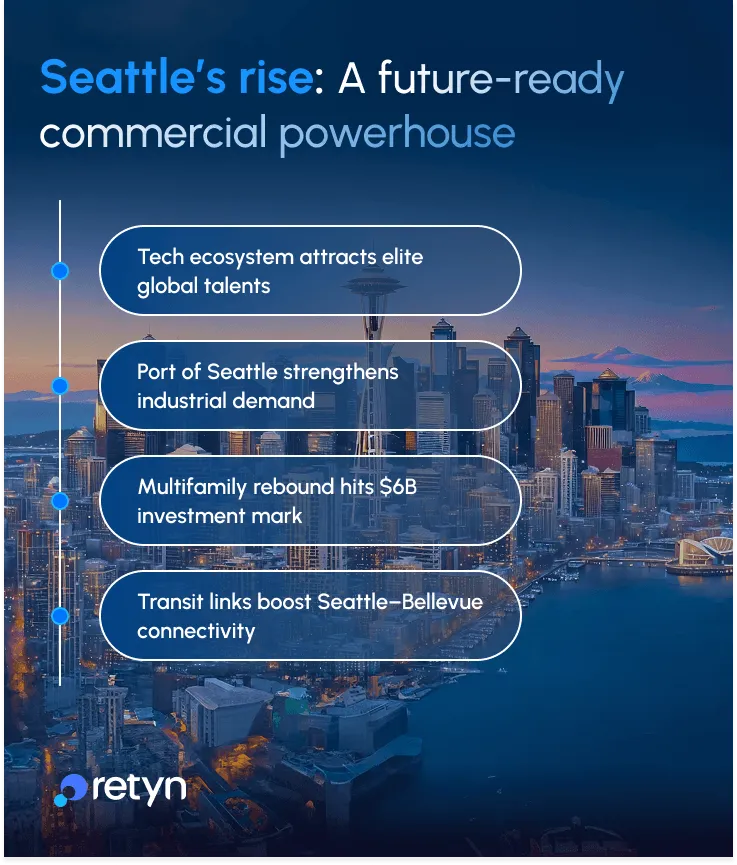
- The presence of global tech anchors continues to attract a highly skilled workforce, driving demand for innovative office and research environments.
- Port logistics and the expansion of last-mile delivery hubs in the Kent Valley fuel a robust and resilient industrial market.
- A significant rebound in multifamily investment, reaching $6 billion in transaction volume, reflects strong confidence in urban density.
- Major infrastructure projects and transit-oriented developments improve connectivity between Seattle, Bellevue, and the surrounding submarkets.
Source: Kidder Mathews, CBRE, JLL Research
Source: Cushman & Wakefield, Seattle Office of Economic Development
Talk to a U.S. property expert
Quick Chat
The Seattle metropolitan area offers specialized opportunities across diverse asset classes, each driven by unique economic catalysts in 2026. Seattle's role in the Pacific Northwest tech corridor is best understood by comparing its data with the top companies in Portland and tech hubs like the top firms in San Francisco. Utilizing an analytics software platform allows brokers to visualize these regional shifts in real-time.
- Office tenants seeking Class-A space are currently benefiting from record-high concessions in the Central Business District, allowing for high-spec build-outs at lower effective rents.
- The industrial sector remains the region’s star performer, with last-mile distribution centers in SoDo and the Kent Valley seeing sustained rent growth due to Port of Seattle activity.
- Multifamily investors are aggressively targeting value-add opportunities in neighborhoods like Capitol Hill and Ballard as borrowing costs stabilize and rental demand rebounds.
- Life sciences development continues to expand beyond South Lake Union, with specialized lab space seeing low vacancy rates and institutional-grade tenant interest.
Sophisticated investors prioritize Seattle for its long-term appreciation potential and a tax environment that favors large-scale capital deployment.
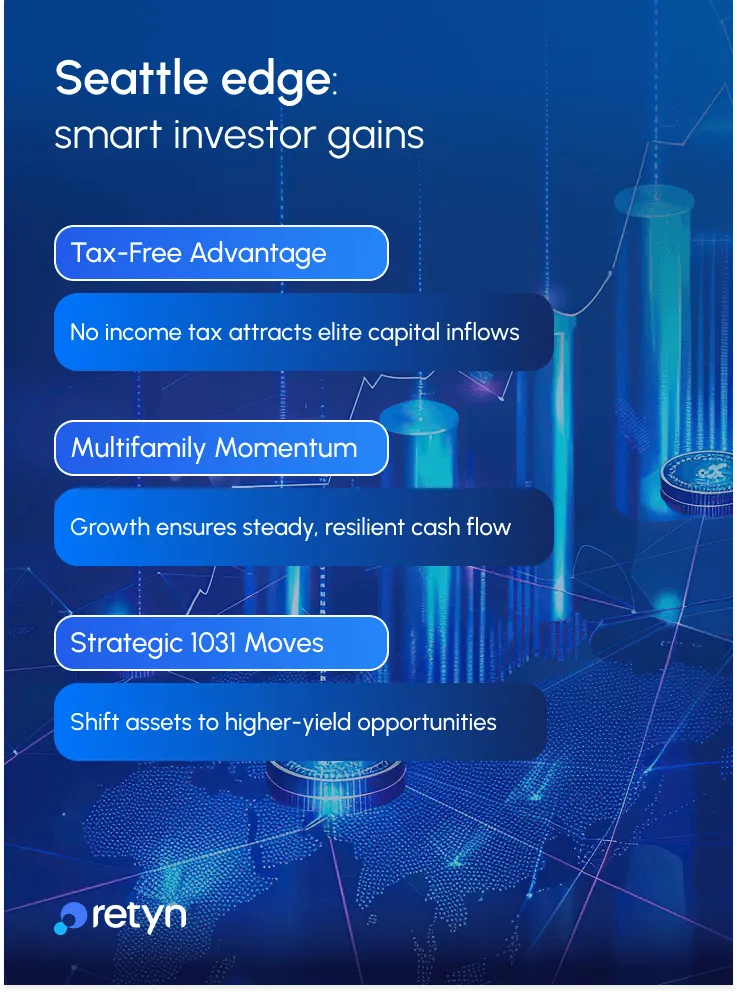
- Washington’s lack of a personal income tax continues to attract high-net-worth investors and corporate executives, fueling the local investment ecosystem.
- Strong year-over-year multifamily volume growth indicates a resilient market where stabilized assets offer reliable cash flow amidst urban densification.
- Strategic 1031 exchanges are frequently utilized by local owners to transition from underperforming office assets into high-demand industrial or retail properties.
Even in a premier gateway city, brokers must navigate complex regulatory and economic hurdles to close significant transactions in 2026.
- High office vacancy rates have shifted the broker's role toward strategic mitigation and lease restructuring rather than simple space acquisition.
- The complexity of life science and industrial zoning requires brokers to possess deep technical knowledge of utility requirements and environmental compliance.
- Consolidation among global mega-firms puts pressure on boutique local brokerages to provide hyper-specialized data and personalized advisory services.
- Limited inventory in the retail sector, with vacancy near 3.9%, creates intense competition and bidding wars for prime storefronts in Ballard and Capitol Hill.
Seattle commercial brokerages are increasingly adopting PropTech to navigate high vacancy rates and provide institutional investors with real-time data transparency.
- Virtual 360-degree walkthroughs of Class-A office shells allow global tech tenants to plan tenant improvements remotely without a site visit.
- Digital transaction management platforms with built-in Washington state commercial addenda allow for faster lease executions and secure document handling.
- Real-time market pulse dashboards provide granular insights into net absorption and effective rent rates across specific Seattle micro-markets.
- Targeted digital campaigns utilizing LinkedIn and specialized CRE platforms increase exposure for high-value industrial and life science listings.
The Seattle commercial market is undergoing a structural shift, and brokerages that adapt to these new realities will lead the next cycle of growth. Success in 2026 requires more than just local knowledge; it demands modern tools like automated CRM systems and advanced data analytics to provide value to sophisticated clients. Firms that embrace digital transformation today will be better equipped to manage the complexities of the Emerald City’s evolving skyline.
A real estate growth platform offers modern solutions for personalizing the client experience, enhancing compliance, and maximizing transaction ROI.
Empower your Seattle brokerage to convert every inquiry into a closing with AI-powered CRM.
Get CRM now
FAQs on the Seattle commercial real estate market
Downtown Seattle office vacancy is projected to be around 35.6% in 2026. With availability at this level tenants generally have more negotiating power and landlords are often willing to offer rent concessions or flexible lease terms to secure occupants.
Multifamily and industrial sectors are currently two of the most active areas of the Puget Sound commercial real estate market. Strong tenant interest for industrial space is being driven by demand from logistics users (such as Amazon) to be located in areas like Kent Valley. Multifamily property investors have also shown a resurgence in their willingness to invest in the region. Transaction volume over the last twelve months was approximately $6 billion.
Yes. The reason commercial investors find Washington attractive is primarily due to the lack of a state-imposed income tax on its residents. Many commercial property owners also use 1031 exchanges to defer capital gains taxes when exchanging one asset class for another.
Most tenants choose to hire specialized brokerage firms such as Hughes Marino which have practices specifically focused on tenant-only representation. In this type of model, the broker does not represent landlords at any time. As a result, potential conflicts of interest during lease negotiations or concession negotiations are avoided.
Demand for lab and research space is driving new development beyond the traditional South Lake Union core. Thus, brokers need to identify zoning regulations that support laboratory and research operations, including high utility requirements and environmental compliance standards that may apply to different types of medical research facilities.
No. Retail is currently the strongest sector in Seattle. The vacancy rate for retail space is approximately 3.9%. In Ballard and Capitol Hill, prime retail locations are commanding higher rents because inventory levels are very low and many lifestyle and hospitality retailers are competing for limited space.
Leading brokers are utilizing virtual 360-degree tours for Class A office shell properties and real-time market dashboard data. They also use AI-based CRM platforms to identify institutional investor leads most likely to close and to automate parts of the contract-to-closing process for multi-million-dollar transactions.
Disclaimer: Retyn does not promote or endorse any company listed above. The companies listed are selected based on publicly available data and recent market performance as of early 2026. Data is compiled from publicly available market sources and may change without notice.