The Orlando commercial real estate market in the first quarter of 2026 is reflecting broader trends in commercial real estate in Florida, specifically a growing flight-to-quality trend in the office sector and tighter availability of industrial space. As both the I-4 corridor and Lake Nona continue to grow as major hubs for medical and technology industries, the Central Florida market is becoming more competitive. Successful participants in this environment rely on experienced brokers with strong local networks and the ability to manage complex transactions.
Currently, institutional capital and private investors are prioritizing their investments in high-performing assets such as Class A office space and logistics facilities that offer long-term stable cash flows. Because industrial vacancy rates are around 7.2% and there is significant competition for quality distribution properties, it is more important than ever that acquisition strategies include off-market deal flow. Using data-driven site selection and real-time market data allows stakeholders to identify undervalued opportunities before they reach the broader public market.
In an ever-changing environment in Central Florida, commercial real estate brokerage firms are using digital systems that automate follow-up communications and provide support for regulatory compliance as Florida’s regulatory framework continues to evolve. The efficiency of this new generation of platforms enhances each firm’s ability to move transactions from contract to closing on behalf of clients who engage in 1031 exchanges or manage large multifamily property portfolios. As a result, top commercial real estate agents in Orlando have developed a combination of local market knowledge and enterprise-level technology to meet the transparency and speed requirements of today’s capital partners.
Commercial real estate firms in Orlando are also embracing digital platforms used by best real estate companies in the USA to manage their transaction activity. We have provided a directory of leading commercial brokerages in the area to help you identify the right partner for your next acquisition, lease or development project, along with an overview of the Orlando market in 2026. To be successful in this competitive market, investors and occupiers often rely on partnerships with brokers who use analytics software platforms and commercial real estate CRM software to understand vacancy trends and build strong client relationships.
See how a dedicated CRM helps Orlando firms manage industrial supply crunches, automate high-volume leasing, and stay ahead of Florida regulatory changes.
Explore CRM

This table features eight powerhouse firms dominating the Central Florida commercial market, ranked by recent transaction volume and specialized local expertise.
Talk to an Orlando property expert
Quick Chat
1
CBRE Orlando
Website: cbre.com
Headquarters: Orlando, FL (Regional Office)
Established: Global leader with decades of local presence
Key Person: Brandon Delanois – Executive Vice President
Core Services: Advisory and transaction services, asset services, and investment sales
Market Impact: Consistently ranked as the top firm by total dollar volume in Central Florida, leading in large-scale industrial leasing and retail acquisitions.
2
Cushman & Wakefield
Website: cushmanwakefield.com
Headquarters: Orlando, FL (Regional Office)
Established: Established market powerhouse
Key Person: Wanda Riley – Managing Principal
Core Services: Capital markets, tenant representation, and valuation advisory
Market Impact: Dominates the Central Florida office sector and institutional industrial sales, managing high-profile assets across the downtown core.
3
Marcus & Millichap
Website: marcusmillichap.com
Headquarters: Orlando, FL (Regional Office)
Established: Local office established 1990s
Key Person: Paul Tesdal – Regional Manager
Core Services: Investment brokerage, financing, and 1031 exchange advisory
Market Impact: The premier firm for private client investment, specifically focused on multifamily assets and shopping center sales throughout the I-4 corridor.
4
Colliers Central Florida
Website: colliers.com
Headquarters: Orlando, FL (Regional Office)
Established: Strong Florida-wide footprint
Key Person: Alex Evans – Executive Managing Director
Core Services: Corporate tenant advisory, retail research, and project management
Market Impact: Recognized for deep data analytics and research-driven strategies that assist corporate occupiers in navigating Orlando's tight retail market.
5
Berkadia Orlando
Website: berkadia.com
Headquarters: Orlando, FL (Regional Office)
Established: Specialized institutional leader
Key Person: Cole Whitaker – Senior Managing Director
Core Services: Mortgage banking, investment sales, and servicing
Market Impact: A specialized leader in the institutional multifamily space, handling some of the largest apartment complex transactions in the Central Florida region.
Orlando’s strategic position as a global logistics node and a burgeoning tech center underpins its long-term commercial demand. Key factors driving the market include:
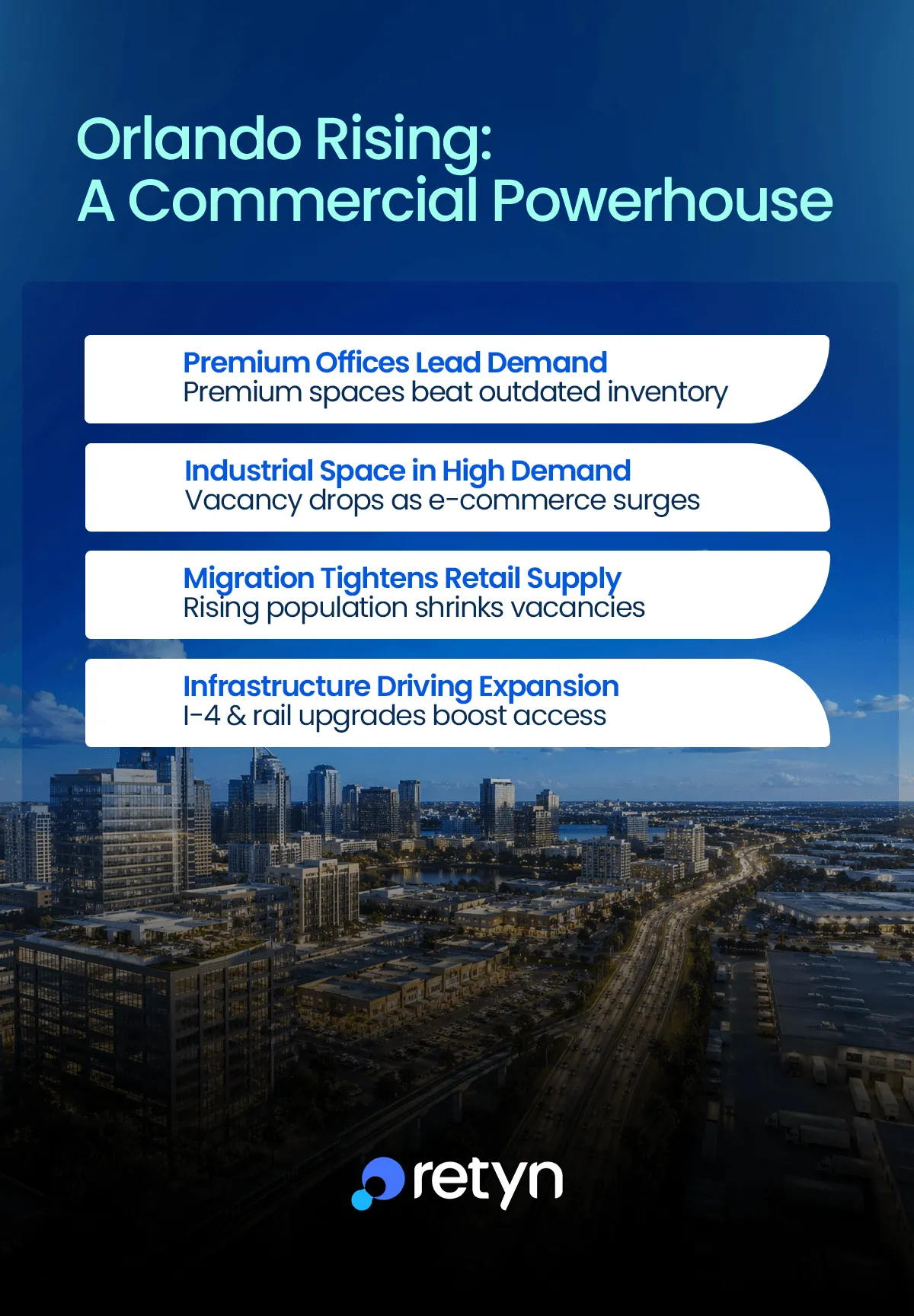
- The flight to quality trend sees Class A office spaces in Winter Park and Downtown significantly outperforming older inventory.
- Industrial vacancy fell to 7.2% in early 2026, driven by massive e-commerce fulfillment needs and port-to-rail logistics.
- Steady population in-migration fuels a tight retail market with vacancy rates hovering near historic lows.
- Ongoing improvements to the I-4 corridor and Brightline rail expansions ease regional trade and commuter access.
Source: Orlando Business Journal, CoStar Group, Yardi Matrix
Source: REALTOR.com Commercial, Local Market Data
Talk to an Orlando property expert
Quick Chat
The Central Florida market offers diverse opportunities across several high-performing asset classes to meet institutional and private investor goals.
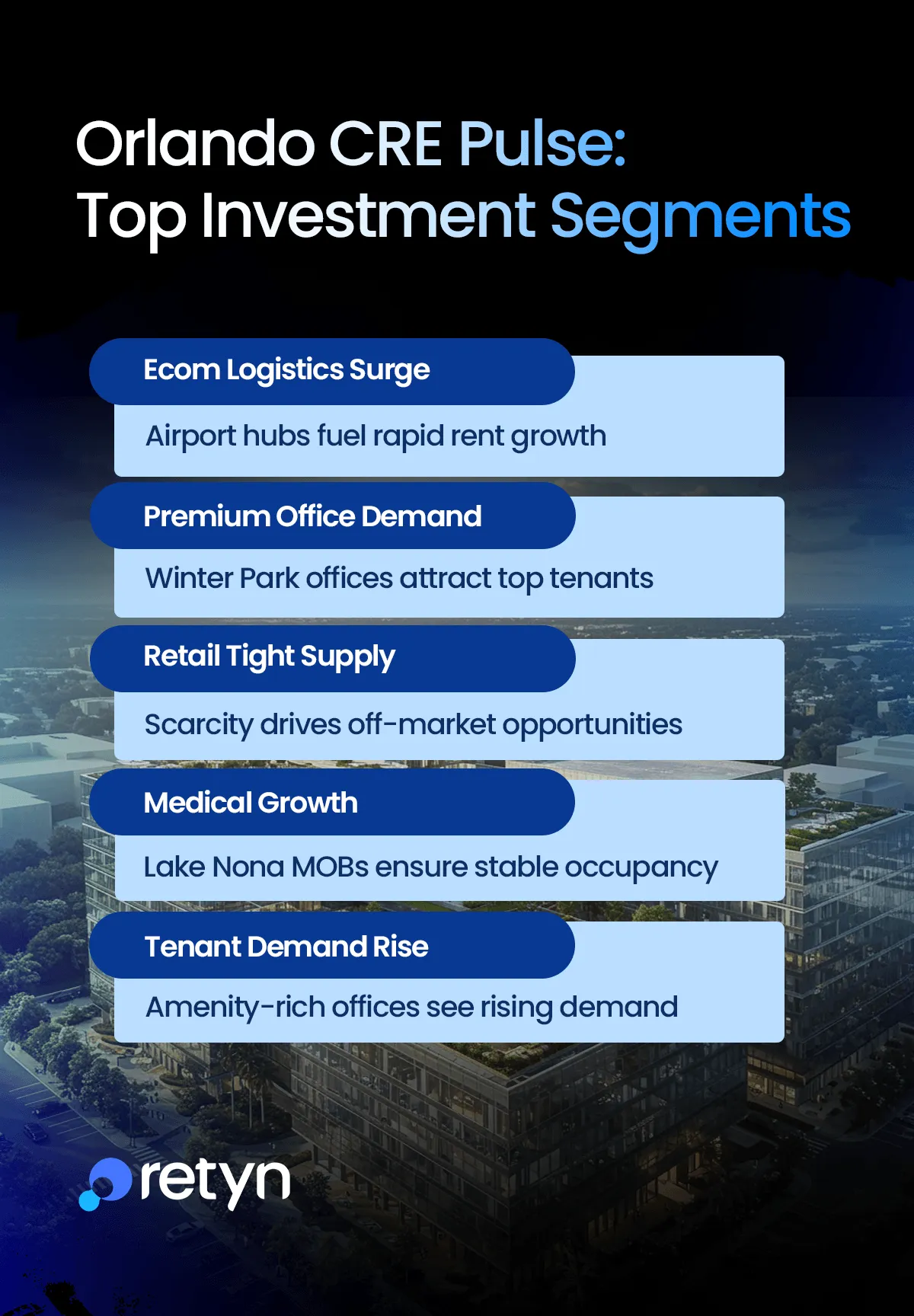
- Logistics and distribution hubs near the Orlando International Airport continue to see record rent growth due to the expansion of regional e-commerce networks.
- Class A office spaces in submarkets like Winter Park are thriving as tenants prioritize amenity-rich environments to encourage a return to the workplace.
- Retail inventory in high-growth corridors remains extremely limited, making off-market acquisitions the primary vehicle for new market entries.
- Medical office buildings in Lake Nona benefit from a specialized ecosystem of healthcare providers and research institutions, ensuring stable, long-term occupancy.
- Specialists in tenant representation are seeing increased demand for amenity-rich Class A office spaces in Winter Park.
Strategic investors are prioritizing Orlando due to its robust economic diversification and favorable fiscal environment. Investors comparing Central Florida to other hubs can gain insights from our analysis of the top commercial real estate brokers in Chicago or review the competitive landscape of the top real estate companies in Charleston for coastal comparisons.
- The absence of state income tax in Florida enhances overall yield and attracts significant out-of-state capital.
- Triple Net lease properties remain highly sought after by 1031 exchange investors looking for passive income with minimal management responsibilities.
- Sustained population growth provides a built-in consumer base that supports rising commercial rents and property valuations.
Rapid market compression creates significant hurdles for firms managing high-stakes commercial transactions.
- Extremely low inventory in the retail and industrial sectors requires brokers to rely heavily on proprietary data and deep local relationships to find opportunities.
- Shifting workplace dynamics make the valuation of older Class B and C office assets increasingly complex during the underwriting process.
- The arrival of global firms has intensified the competition for experienced tenant-rep brokers and local market specialists.
- Evolving land-use regulations and zoning changes in the urban core can lead to unexpected delays in the development and closing phases.
Leading Orlando brokerage firms are increasingly leveraging PropTech to manage high-velocity industrial leasing and provide transparency to out-of-state capital partners.
- High-definition 3D virtual walkthroughs allow global institutional investors to inspect Class A office assets without the need for immediate travel.
- Predictive analytics and real-time market dashboards enable brokers to forecast rent growth in micro-submarkets like Lake Nona and Maitland.
- Automated lease abstraction and digital signature platforms significantly reduce the time required to move from letter of intent to fully executed contract.
- Targeted digital campaigns utilizing AI-driven lead scoring CRM help firms identify high-intent occupiers looking for specialized industrial or medical space.
- Executing personalized omnichannel drip campaigns allows firms to nurture out-of-state institutional prospects over long-term acquisition cycles.
The Orlando commercial real estate market remains a high-growth environment for those who adapt to its rapid evolution. To stay competitive, brokerage teams must move beyond traditional networking and embrace sophisticated tools that streamline the transaction lifecycle. Firms that integrate automation and data-driven insights today will be best positioned to capitalize on the continued expansion of the Central Florida economy.
A real estate growth platform provides the infrastructure necessary to scale operations, maintain compliance, and deliver superior results for sophisticated commercial clients.
Empower your Orlando brokerage to manage complex commercial pipelines and close deals faster with AI-powered CRM.
Get CRM now
FAQs on Orlando commercial real estate
Office vacancy in Orlando was around 17.6% at the start of 2026. Leasing activity exists across all three classes of office space, but most leasing activity occurs in Class A buildings, as many corporations want to lease newer, higher-quality buildings.
Vacancy rates are currently around 7.2%. Tenants are actively searching for large warehouse space, and Orlando continues to function as an important logistics location for Florida and the Southeast. New construction starts were significantly lower toward the end of 2025, so fewer high-bay warehouse properties are coming to the market. Demand for modern warehouse facilities remains strong.
- The absence of a Florida state personal income tax means that income generated from an investment can increase the net yield (or cash flow) of an investor or LLC member.
- Investors can defer paying capital gains taxes through Federal 1031 exchanges by investing their proceeds into like-kind real estate.
- Florida has a business-friendly environment that is designed to encourage investment, growth and development.
Lake Nona Medical City is one of the major areas in Orlando to develop medical and life sciences offices. The district brings together multiple hospitals, various research organizations, several universities and many health-care companies, providing the necessary components for an environment that supports medical research and clinical care.
Retail rents in Orlando are continuing to rise in 2026. With a low number of vacant retail spaces, less than 6%, there is increased competition among tenants looking for space in high-traffic tourist and residential corridors.
First, you need to check their recent transaction history in your specific submarket, such as Maitland or Winter Park. Second, verify whether they represent tenants exclusively or also act as landlord brokers. This will help avoid potential conflicts of interest during negotiations.
Yes, Triple Net leases continue to be extremely popular among 1031 exchange investors. The use of Triple Net leases is particularly widespread in the retail segment with nationally recognized tenants. They provide a very stable, low-management income source, as the tenant is responsible for property taxes, insurance and maintenance.
Disclaimer: Retyn does not promote or endorse any company listed above. The firms featured are selected based on publicly available data and market performance metrics as of March 2026. Data is subject to change based on market fluctuations.