The Florida commercial real estate market shows an upward trend in the Southeast region. With transaction volume reaching a total of $16 billion in 2025, the market points toward continued activity in 2026. Many of the firms are now utilizing the same high-growth strategies as those used by the top 100 real estate companies in the USA in order to manage this rising tide of institutional investment.
The elimination of the business rent tax in Florida will reduce operational costs for businesses. This makes it easier for them to stay competitive and grow through hiring, investment and expansion. It is also helping draw companies from Northeast markets to cities like West Palm Beach and Tampa. In the current market, access to off-market deals and strong execution on capital markets strategies can give investors an edge when growing their portfolios. Successful market participants are increasingly working with brokerages that offer strong local market knowledge and data insights, especially to manage risks from rising insurance costs and changing zoning regulations.
Leading regional brokerage firms are expanding their role in the real estate transaction process from simply brokering deals to providing full advisory services. Whether you are looking at retail opportunities in Jacksonville or growth market such as Ocala, it's important that you choose a partner who has strong experience in tenant representation and landlord services. This guide provides an analysis of the top commercial brokerage firms operating in Florida and offers key insights to help investors and occupiers gain a competitive advantage.
Increasingly, Florida's real estate firms are utilizing commercial real estate CRM software that are designed to automate asset management and monitor real-time occupancy rates.
See how a dedicated CRE CRM helps Florida firms manage complex lease renewals, automate Florida business rent tax compliance, and track off-market industrial inventory.
Explore CRE Solutions

The following table identifies eight powerhouse commercial real estate firms currently dominating the Florida market, categorized by their primary sector expertise and regional headquarters.
Talk to a Florida commercial property expert
Quick Chat
1
Cushman & Wakefield
Website: cushmanwakefield.com
Florida Lead: Wanda Riley – Managing Principal
Established Year: 1917 (Global presence)
Market Strength: Dominated Tampa Bay with over $6 billion in volume and South Florida with $4.7 billion in 2025.
Core Services: Capital markets, valuation advisory, and industrial landlord representation.
Key Achievement: Consistently ranked as the top brokerage by transaction volume in major Florida metros.
2
CBRE
Website: cbre.com
Florida Lead: Michael DiBlasi / Brandon Delanois
Established Year: 1906
Market Strength: Strongest footprint in Orlando with $2.11 billion and Tampa with $2.69 billion in 2025 transactions.
Core Services: Global occupier services, retail investment sales, and debt/structured finance.
Key Achievement: Managed some of Florida’s largest 2025 office acquisitions exceeding $200 million per deal.
3
Marcus & Millichap
Website: marcusmillichap.com
Florida Lead: Paul Tesdal – Regional Manager
Established Year: 1971
Market Strength: Facilitated $1.43 billion in Orlando sales and remains a dominant force in Central Florida investment properties.
Core Services: Specialized investment brokerage and financing for retail and multifamily assets.
Key Achievement: Recognized as a leading specialist for mid-market private client investment sales.
4
Blanca Commercial Real Estate
Website: blancacre.com
Florida Lead: Tere Blanca – Founder & CEO
Established Year: 2009
Market Strength: Holds a significant 30% market share in Miami's competitive office sector.
Core Services: Boutique advisory, tenant representation, and landlord agency leasing.
Key Achievement: Top independent advisory firm in Florida, competing successfully against global powerhouses.
5
Berger Commercial Realty
Website: Website: bergercommercial.com
Florida Lead: Lloyd Berger – Founder & President
Established Year: 1998
Market Strength: Managed a massive 7 million square foot portfolio as of late 2025 and is consistently recognized as one of the largest independent, privately owned commercial firms in South Florida.
Core Services: Landlord and tenant representation, institutional-grade property management, receiverships, and capital advisory.
Key Achievement: Distinguished as a NAIOP South Florida "Brokerage Team of the Year" finalist and highly regarded for providing "boutique-level" personalized service with the resources of a global network (CORFAC).
The Florida commercial market is currently outperforming national averages due to a unique combination of tax migration and aggressive infrastructure expansion. Key growth drivers for 2026 include:
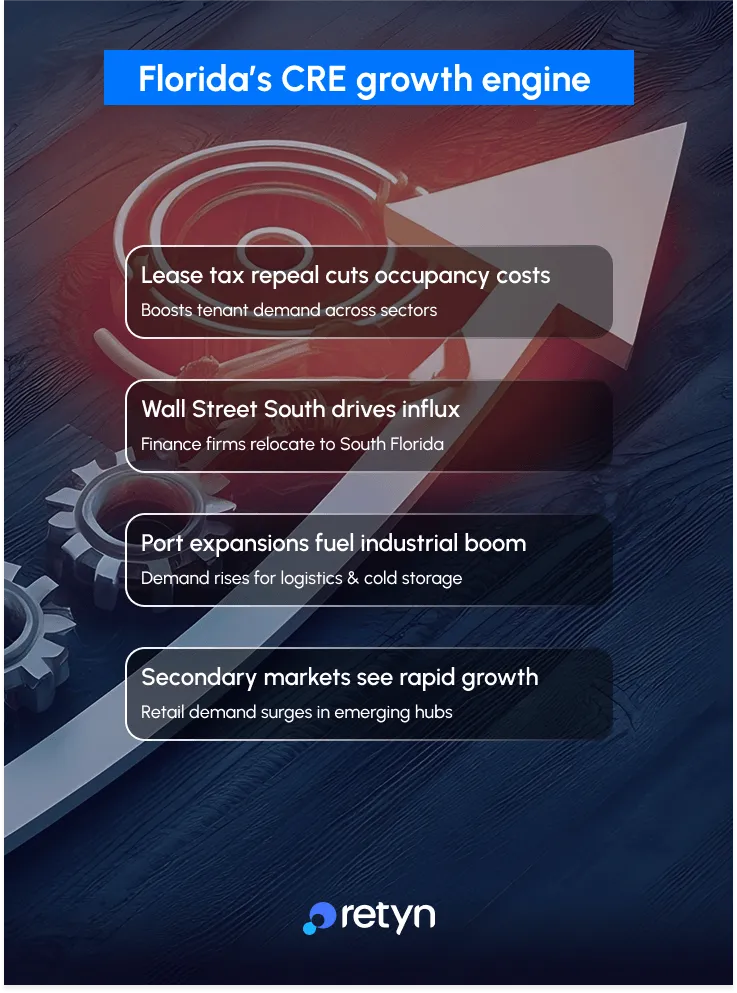
While individual cities like Miami and Tampa lead the charge, our comprehensive analysis of the top real estate companies in Florida shows a statewide trend toward trophy office and industrial dominance.
- The 2025 repeal of state sales tax on commercial leases has significantly lowered the total cost of occupancy for new tenants.
- The Wall Street South movement continues to draw high-net-worth financial firms from the Northeast to Miami and West Palm Beach.
- Port expansions in Jacksonville and Everglades fuel a critical need for Class-A industrial and cold storage facilities.
- Secondary markets like Ocala are experiencing record population growth, creating new opportunities for necessity-based retail developments.
Source: Cushman & Wakefield, CBRE, Florida Dept. of Revenue
Source: Avison Young, Marcus & Millichap
Optimize your Florida portfolio with local market intelligence
Quick Chat
The Florida market offers specialized opportunities across diverse asset classes, each requiring a tailored brokerage approach to maximize returns.
Smart investors leverage real-time performance analytics to track cap rate compression and ensure their portfolios remain resilient against rising operational costs. Many are also transitioning to a dedicated CRM for investors to source off-market deals more effectively.
- Institutional investors are prioritizing Class-A multifamily developments in Orlando and Tampa due to sustained high occupancy and strong rent growth driven by inward migration.
- The industrial sector remains dominated by demand for last-mile distribution centers near major logistics hubs like Port Miami and the Jacksonville intermodal terminals.
- Trophy office spaces in Miami and West Palm Beach are attracting global financial firms, leading to record-breaking lease rates that defy national downward trends in the office sector.
- Necessity-based retail, particularly grocery-anchored centers in suburban growth corridors, continues to provide stable yields for private equity and REITs.
Sophisticated investors leverage Florida's pro-business environment to enhance portfolio performance through specific local benefits.
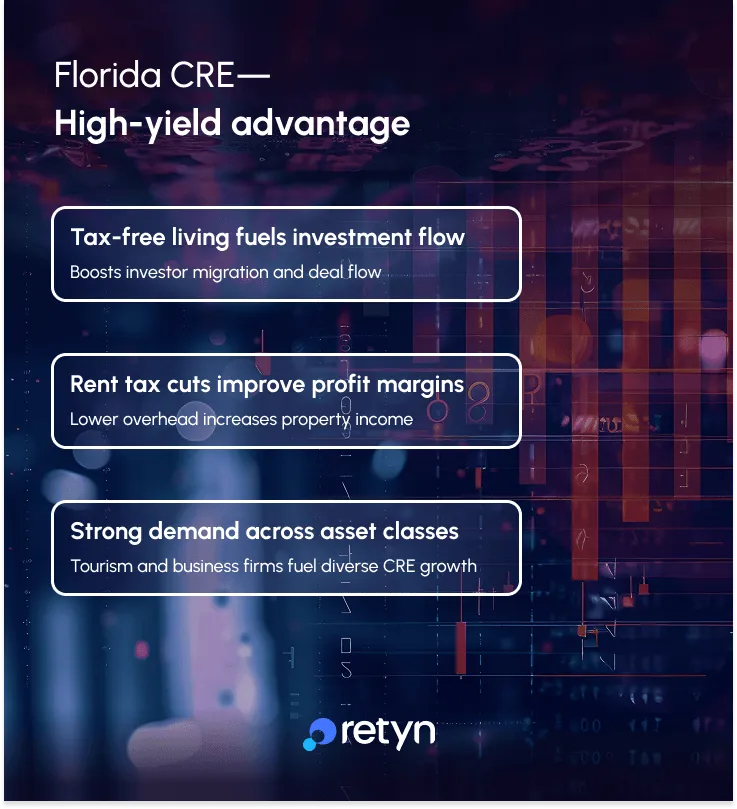
- The absence of state personal income tax makes the region a primary destination for high-net-worth investors relocating capital through 1031 exchanges.
- Legislative changes to the business rent tax have significantly reduced the overhead for commercial tenants, increasing the overall net operating income for property owners.
- Robust tourism and corporate growth provide a dual-stream of demand that supports diverse commercial uses from hospitality to high-end medical office space.
Operating in a high-velocity market requires awareness of specific regional operational and financial hurdles.
- Escalating property insurance premiums, particularly for wind and flood coverage, require rigorous underwriting and proactive risk management strategies.
- The rapid pace of development has led to complex zoning and entitlement processes, necessitating local brokerage expertise to navigate municipal approvals.
- Institutional competition for prime assets is intense, often resulting in compressed cap rates and the need for off-market deal sourcing.
- Infrastructure lag in fast-growing secondary markets can impact the long-term accessibility and valuation of new commercial projects.
In 2026, Florida’s leading commercial brokerages are increasingly deploying PropTech to streamline complex acquisitions and manage high-volume leasing portfolios.
- Virtual reality site tours allow institutional investors from New York or California to conduct initial walkthroughs of industrial parks without leaving their offices.
- Advanced digital closing platforms now include built-in compliance checks for Florida’s specific commercial lease tax regulations.
- Predictive market analytics help brokers identify emerging sub-markets like Ocala before they reach peak pricing.
- Automated data dashboards provide real-time updates on net absorption and vacancy rates across major Florida metros.
- AI-driven CRM systems allow firms to manage deep databases of off-market pocket listings and historical transaction data.
The Florida commercial market remains a primary engine of American economic growth. Success for investors and brokers alike depends on navigating a bifurcated market with precision and speed. By leveraging professional brokerage expertise and modern technology, participants can capitalize on the massive migration of capital to the region.
A real estate growth platform provides the infrastructure needed to scale operations, manage high-value client relationships, and maintain regulatory compliance in this fast-paced environment.
Empower your Florida brokerage to dominate the commercial market with AI-powered CRM and automated workflow solutions.
Get CRM now
FAQs on Florida commercial real estate brokerage
As of October 1, 2025, Florida has repealed the state sales tax on commercial rent. The removal of both state tax and local taxes will reduce your tenant occupancy costs by around 2 to 3.5%. This change will also improve the overall cost structure of leasing commercial space in Florida and enhance the state's business environment.
The main benefit of a Triple Net Lease is that all of the responsibilities regarding property taxes, insurance, and maintenance fall upon the tenant. In today's Florida commercial real estate market, this is very favorable for the landlords. The increasing cost of property insurance premiums are passed through to the tenant resulting in a more stable NOI for the landlord.
Yes. Many investors use 1031 Exchanges to defer paying capital gains tax on profits from the sale of their property in high-tax states like California or New York, so they can reinvest in like-kind real estate investments in Florida. .
There are two types of areas that investors can look at in this market. The primary area is Miami. It has a high level of investor interest and fairly stable performance. Secondary markets such as Lakeland and other Central Florida submarkets also continue to see growing demand from users due to their proximity to major logistics routes, including I-4 and I-75.
The "Wall Street South" trend has influenced both Miami and West Palm Beach, with many financial and legal service businesses moving into South Florida. These types of tenants seek Class A trophy buildings with luxury amenities. The increased demand from these tenants has caused an imbalance in office space supply and demand, thereby pushing office rents in the Brickell above $100 per sq. Ft.
When insurance costs for a property increases due to flood or wind risks it will reduce the Net Operating Income. As investors begin to include climate risk and resiliency research in their due diligence process they factor these long-term operational costs into underwriting process. This can cause cap rates to rise and prices to decrease for properties impacted by flood or wind risk.
Yes. Multifamily demand and absorption continue to be supported by Orlando’s strong population growth. As such, investors are increasingly focusing on selective opportunities in suburban submarkets that exhibit steady demand, while being less affected by new supply pressures compared to urban core areas.
Disclaimer: Retyn does not promote or endorse any company listed above. The companies listed are selected based on publicly available data and market performance as of early 2026. Data is compiled from publicly available market sources and may change without notice.