Columbus has become a major destination for industrial and technology investment in the Midwest. Through 2026, Columbus is expected to see increasing investment in large-scale industrial and technology properties, supported by Intel’s semiconductor project and the development of hyperscale data centers. To navigate such a dynamic growth market for corporate occupiers and investors require a strong understanding of local land-use policies and the rapid infrastructure in both Licking County and the Rickenbacker submarket is required.
The market is currently showing a flight to quality, with premium class A office space and modern industrial flex buildings outperforming older inventory. Successful site selection today is not just about getting the right location. It also depends on access to real-time data on power grid capacity, logistics connectivity and proximity to the growing tech talent pool. Whether you are managing a portfolio of multi-tenant retail centres or seeking specialized laboratory sites, the most important factor in mitigating risk for your investment is working with a brokerage that has strong local zoning expertise. Many of the top real estate companies in Ohio highlight the importance of local market knowledge when advising investors and corporate occupiers.
Leading commercial brokerages leverage deep local market knowledge alongside advanced global data and analytics platform to navigate increasingly conservative real estate conditions. Many of these brokers use similar high-performance strategies used by the best real estate companies in the USA to manage complex site selection processes and changes in the capital markets. Whether your project is a high-density mixed-use development or a logistics center, it is imperative that you have the right partner.
See how a dedicated CRM helps Columbus brokerages manage complex industrial leases, track Intel-related lead-routing, and stay compliant with Ohio licensing laws.
Explore CRM

The following table identifies eight leading commercial real estate firms operating in Central Ohio, categorized by their primary service strengths and market presence as of early 2026.
Talk to a U.S. commercial property expert
Quick Chat
For institutional investors, comparing the Columbus landscape to other Midwestern hubs is essential for capital allocation. While firms here lead in local market share, their service models are often benchmarked against the top commercial real estate brokers in Chicago to ensure global standards in tenant representation and advisory.
1
Colliers | Greater Columbus Region
Website: colliers.com
Headquarters: Columbus, OH
Established Year: 1910
Key Person: Shenan Murphy – CEO & Principal
Core Services: Industrial leasing, office sales, investment services
Key Insight: Oversees more than 26 million square feet of commercial space in Central Ohio, leading the market in property management volume.
2
CBRE Inc.
Website: cbre.us
Headquarters: Dallas, TX (Major Columbus Hub)
Established Year: 1906
Key Person: Michael Copella – Managing Senior Director
Core Services: Advisory, capital markets, tenant representation
Key Insight: Relocating to a high-profile Arena District office in summer 2026 to better serve the urban core and high-end corporate occupiers.
3
NAI Ohio Equities
Website: ohioequities.com
Headquarters: Columbus, OH
Established Year: 1971
Key Person: Mike Simpson – President
Core Services: Industrial brokerage, office leasing, property management
Key Insight: A top-tier local staple for over 50 years, frequently securing the largest industrial transactions in Franklin County.
4
CASTO
Website: castoinfo.com
Headquarters: Columbus, OH
Established Year: 1926
Key Person: Bill Casto – Chairman
Core Services: Retail development, shopping center management
Key Insight: Dominates the Midwest retail landscape, managing nearly 7.5 million square feet of experiential and grocery-anchored centers.
5
JLL (Jones Lang LaSalle)
Website: us.jll.com
Headquarters: Chicago, IL (Major Columbus Hub)
Established Year: 1783
Key Person: Dan Wendorf – Executive Managing Director
Core Services: Logistics, industrial supply chain, facility management
Key Insight: Manages the highest total square footage in Central Ohio at over 33 million square feet, with a heavy focus on industrial logistics.
The central Ohio commercial landscape is undergoing a massive transformation driven by unprecedented industrial investment and a resilient corporate sector. Several key pillars support this sustained growth:
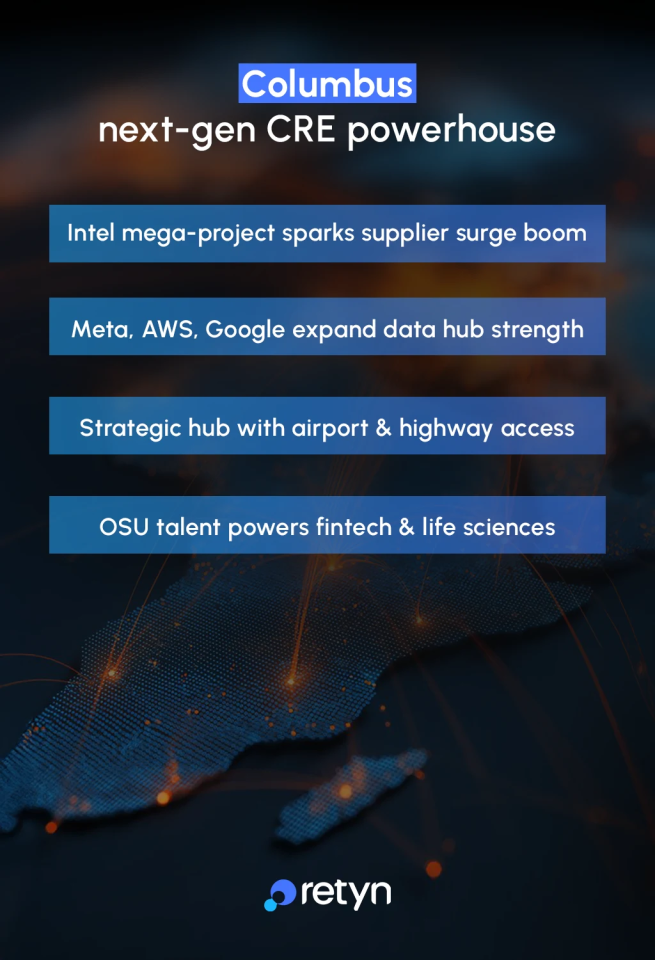
- The silicon heartland effect from the Intel semiconductor project is driving a massive wave of Tier-1 supplier requirements.
- Major hyperscale data center expansions by Meta, AWS, and Google are diversifying the regional tax base and utility infrastructure.
- Proximity to Rickenbacker International Airport and the I-70/I-71 junction keeps the region as a top-five U.S. logistics hub.
- A steady pipeline of specialized talent from the Ohio State University fuels the burgeoning life-sciences and fintech corridors.
Source: Colliers, CBRE Research, Columbus Business First
Source: NAI Ohio Equities, JLL Market Pulse
Looking for a specific site selection report?
Quick Chat
The Columbus market offers specialized opportunities across diverse asset classes, each reacting differently to the 2026 economic landscape.
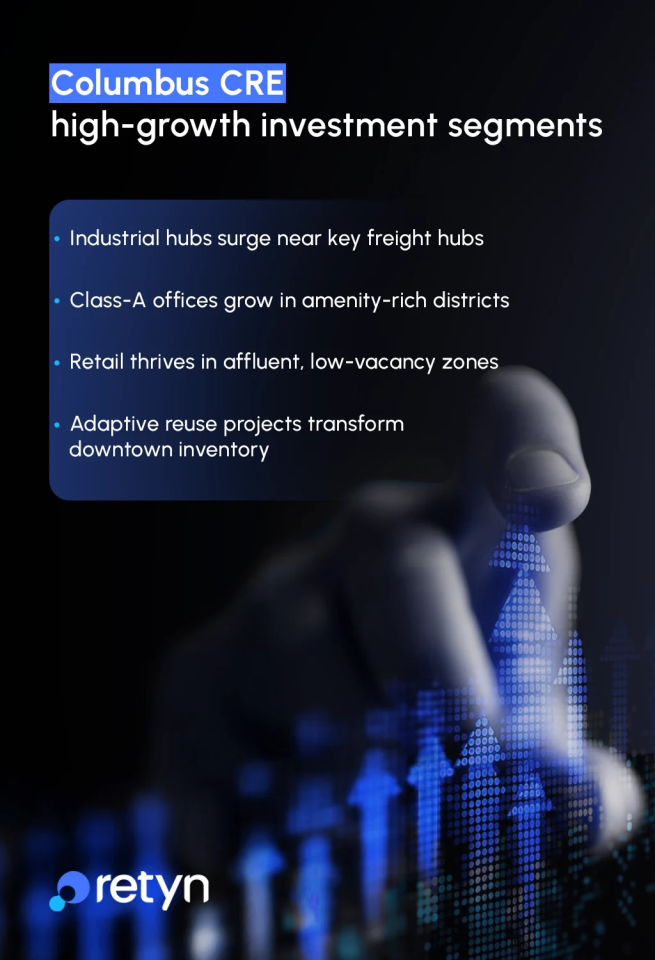
- Industrial and logistics remain the dominant sector, with high demand for 100,000+ square foot shells near the Rickenbacker Intermodal for e-commerce distribution.
- Class-A office assets in the Arena District and Bridge Park are seeing positive absorption as employers prioritize high-amenity spaces to support hybrid work models.
- Experiential retail and grocery-anchored neighborhood centers in affluent submarkets like Upper Arlington and New Albany maintain historically low vacancy rates.
- Adaptive reuse projects, specifically office-to-residential conversions in Downtown Columbus, are gaining momentum through city-backed incentives and tax credits.
Sophisticated investors choose Columbus for its yield stability, diverse employment base, and favorable regulatory environment compared to coastal metros. Compared to high-cost coastal or sunbelt markets, Central Ohio provides superior yield stability. Investors often pivot to Columbus after evaluating the Charleston real estate sector or checking the Savannah property landscape for port-driven growth, ultimately finding that the Ohio market offers a more diversified industrial base than the Atlanta commercial sector.
- Ohio’s lack of a traditional corporate income tax, replaced by the Commercial Activity Tax (CAT), offers a predictable tax structure for property-holding entities.
- The rise of Sale-Leaseback transactions allows local owner-occupiers to unlock capital while providing investors with long-term, stable credit tenants.
- High liquidity in the mid-market segment makes Columbus a preferred destination for 1031 exchange buyers looking to transition out of high-tax states.
Rapid industrialization and shifting work habits have introduced new operational hurdles for brokerage firms in the region.
- Increasingly complex zoning and annexation processes in Licking and Delaware Counties can extend development timelines for new manufacturing sites.
- The reliance on manual data entry for large-scale property management can lead to information silos in high-volume firms.
- The influx of national boutique firms has intensified the competition for senior brokers who possess hyper-local land-use expertise.
- A shortage of move-in ready medical office and specialized laboratory space is causing tenant frustration in the growing life-sciences corridor.
Leading Columbus commercial firms are increasingly adopting PropTech to compress transaction cycles and provide institutional-grade transparency to out-of-state investors. Leading Columbus commercial firms are increasingly adopting PropTech to compress transaction cycles. By integrating a specialized real estate CRM platform, agencies can automate lead scoring for industrial inquiries and provide institutional-grade transparency to out-of-state investors.
- Interactive 3D digital twins of industrial shells allow global tenants to plan equipment layouts and logistics workflows before a single brick is laid.
- Real-time site selection dashboards integrate utility capacity, labor demographics, and transit proximity for rapid-response manufacturing requests.
- AI-enhanced underwriting tools provide instant lease-comp analysis for micro-markets within the I-270 outerbelt.
- Advanced CRM platforms automate lead-scoring for high-value industrial inquiries and ensure seamless communication across multi-disciplinary deal teams.
The Central Ohio commercial market is entering a new era of institutional maturity. Brokerage teams that integrate modern data tools with their local zoning expertise will define the next decade of growth in the Silicon Heartland. As transaction volumes increase near major tech campuses, the shift from manual spreadsheets to automated deal-flow management is no longer optional for firms aiming to maintain market share.
A real estate growth platform provides the technical infrastructure required to scale operations, enhance regulatory compliance, and maximize investor returns in a competitive Midwest landscape.
Empower your Columbus brokerage to manage high-volume industrial deal-flow and complex compliance with AI-powered CRM.
Get CRM now
FAQs on Columbus commercial real estate
The 1,000-acre semiconductor mega-site being developed by Intel in Licking County is projected to be a hub for an expansive network of suppliers and other business partners. As such, it is anticipated that this new development will create a greater demand for industrial land, as well as shovel-ready sites across the surrounding region.
Vacancy levels for commercial property remain very tight in Columbus and have been reported to be about 3.58 % in recent retail market reports. Experiential retail space at street level, where demand is particularly high, such as the Short North Arts District or Bridge Park, can sometimes experience some of the lowest vacancy levels in the overall market.
- Community Reinvestment Area (CRA) tax abatements are available for qualified renovations.
- State and Federal Historic Tax Credits are available for older properties in the Capitol Square area.
- TIF financing from the city can be used for public infrastructure improvements around the site.
- Tax incentives for residential development can help create a higher density of residents living in an urban area.
When a broker represents both the landlord and the tenant in the same transaction, this is referred to as ‘dual agency.’ This creates a potential conflict of interest in the high-stakes Columbus market. Therefore, many institutional occupiers prefer working with exclusive tenant-rep brokers to ensure objective negotiation of lease terms, including rent levels and tenant improvements.
Currently, the Arena District, Grandview Yard and Dublin are seeing the most absorption. These area also provide upscale amenities and flexible floor plates that today’s corporate headquarters need to support a hybrid workforce.
Large logistics warehouses can be found along the Rickenbacker International Airport corridor, but finding smaller industrial flex space is often much tougher. The limited availability of small-bay units contributes to increasing rents for service-oriented businesses and contractors across the Columbus industrial market.
Closing periods vary based on entitlement needs:
- Shovel-ready sites: 60 to 90 days.
- Sites requiring rezoning or annexation: 6 to 12 months.
- Complex infill projects: Often 12 months plus due to environmental and municipal reviews.
Disclaimer: Retyn does not promote or endorse any company listed above. The firms were selected based on publicly available data, transaction volume, and market reputation as of early 2026. Data is subject to change without notice.