How to start an NFT marketplace business in Dubai 2026: 12 steps to blockchain profits and regulatory win
How to start an NFT marketplace business in Dubai 2026: 12 steps to blockchain profits and regulatory win
Navigate Dubai's VARA licensing, smart contract integration, UI/UX design, and monetization strategies for your Web3 NFT platform in the UAE's crypto hub.
Vincy Amirtharaj
58 post
Senior Business Setup Consultant, Dubai
You’ll enter a highly advanced digital economy if you’re planning to launch an NFT marketplace in Dubai. The Emirate has made a bold statement with its Dubai Metaverse Strategy, aiming to create in excess of 40,000 new jobs in the virtual space by 2030. Many countries are still operating within legal grey areas while Dubai is providing a roadmap for Web3 entrepreneurs. This clarity has helped solidify Dubai’s position as a leading global destination for blockchain innovation and digital asset trading.
In order to be successful in today's increasingly competitive marketplace, more than strong technical execution is required. It is also important to ensure that all virtual asset regulatory activity aligns with VARA prior to commencing operations. Additionally, obtaining a VASP license is paramount to establishing a relationship with institutional investors and creating credibility amongst retail users. Whether you are launching a generative art platform, a GameFi exchange or a tokenized real estate hub, navigating the regulatory specifics of an NFT marketplace business in Dubai will ultimately define your business viability in the long term.
The complete guide walks you through the challenges of NFT business setup costs in Dubai, smart contract audits and corporate banking hurdles. This guide also covers which free zones are best suited for your needs, such as DMCC Crypto Centre or Meydan and explains the practical considerations between custodial and non-custodial wallet structures. Together, these insights outline what it takes to build a fully compliant and forward-thinking NFT marketplace by 2026.
Typical 12-16 week setup timeline
Week
Authority / Task
Key output
1-2
DET/Free Zone (e.g. DMCC)
Initial approval ✓ | Trade Name Reservation ✓
3-4
DET
Initial Disclosure Questionnaire (IDQ) submission
5-8
Tech Auditors
Smart Contract Audits & Security Review
9-12
VARA / Free Zone
VASP Licence issuance & Full Operation Approval ✓
13
Corporate Bank
Fiat Account Opening (Wio / Traditional)
14
GDRFA
Investor / Team Residence Visas
15
Compliance
AML/KYC Framework implementation
16
VARA & Insurer
Final Go-Live Approval - Launch!
Note: Timelines depend heavily on VARA's "MVP" phases and the complexity of your custodial wallet architecture.
"Dubai will become one of the top 10 metaverse economies in the world and a global hub for the metaverse community... ensuring a safe and secure environment for users."
- HH Sheikh Hamdan bin Mohammed bin Rashid Al Maktoum
Intellectual property rights and streaming revenue tokens.
Curated Drops / Launchpad
Exclusive "minting" platforms for high-end brands.
Sports Fan Tokens
Utilities and memorabilia for sports clubs.
"Phygital" Marketplace
NFTs acting as digital twins for physical luxury goods.
Pro tip
Clarify whether you are Custodial (you hold user keys) or Non-Custodial (users trade P2P via Metamask). VARA requirements are much stricter for custodial platforms.
Step 2: Choose a Web3 trade name
Pick a unique, future-proof name that resonates with the crypto community. Reserve it with the Free Zone (e.g., DMCC Crypto Centre) or DED. Secure the matching .com, .io, or .xyz domain immediately—trust is currency in Web3.
This step ensures your brand identity is locked in before you finalize the legalities of your business setup in Dubai.
Quick Fact
Dubai's Metaverse Strategy aims to support 40,000 virtual jobs and add $4 billion to the economy by 2030, making it the premier jurisdiction for NFT and blockchain startups.
Source: Dubai Future Foundation
Step 3: Draft a Whitepaper & Business Plan
Tokenomics & Revenue
Minting fees, royalty % split, and utility token models.
Discord moderation, Twitter/X growth strategy, and influencer roadmap.
Pro tip
VARA requires a detailed "Technology Risk Assessment" as part of your business plan, outlining how you handle smart contract vulnerabilities.
Cost snapshot · 2025
VARA Application Fee: ~AED 10 000 - 40 000 *
Initial Approval: ~AED 1 000
Trade-name reservation: AED 620
Free Zone Licence (DMCC/IFZA): AED 12 000 - 25 000
Smart Contract Audit (Est.): from USD 3 000
Cyber Insurance: from AED 15 000 / year
Compliance Officer (Outsourced): Varies
*VARA fees vary significantly based on whether you are "Non-Custodial" (cheaper) or "Custodial" (higher capital requirements).
Setup-cost estimator (AED)
Estimated setup cost: —
Get detailed breakdown on WhatsApp
*Includes indicative VARA NOC fees + Free Zone license.
Tech audits, legal opinions & paid-up capital vary—chat with us for an exact quote.
Step 4: Select a business structure
Pick the corporate vehicle that fits your liability appetite and decentralization goals:
Free Zone LLC (DMCC/DIFC)
The gold standard for Web3. 100% foreign ownership, crypto-friendly banks.
Mainland LLC
Required if you plan to open physical crypto-OTC counters or retail stores.
Foundation / DAO Wrapper
Ideal for decentralized projects needing a legal entity to sign contracts.
Branch of Foreign Company
Extend an existing global exchange (e.g., Binance, Bybit) into UAE.
Pro tip
VARA permits are linked to the specific legal entity. A DAO usually cannot hold a license directly; it needs a "legal wrapper" (Foundation or LLC) to act as the licensee.
Evaluating whether Dubai is the right base for your NFT platform?
Get a practical breakdown of regulatory scope, setup steps and ongoing requirements for NFT marketplaces operating from Dubai.
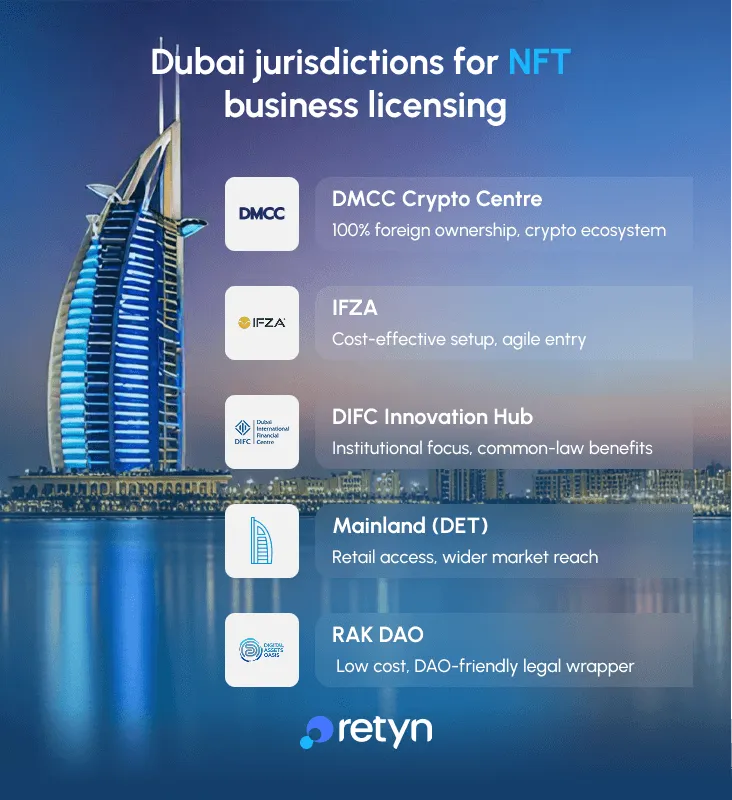
Select the zone that aligns with your target market and regulatory needs. Dubai has specific "Crypto Centres" designed to fast-track Web3 startups.
Mainland (DET)
Required if you plan to have a physical retail presence or trade directly with UAE retail consumers outside of a free zone wrapper.
Requires DET licence and full VARA (Virtual Assets Regulatory Authority) approval.
Mandatory non-objection certificate before license issuance.
Physical Office
Mainland VASP licenses usually require a verified physical office (Estidama).
Local Audit Partner
Appointment of a UAE-approved auditor for financial reporting.
Free Zones (Crypto Hubs)
Most NFT marketplaces choose Free Zones for 100% foreign ownership and specialized ecosystems.
DMCC (Crypto Centre) and IFZA are the most popular choices for non-financial crypto activities.
Home to 500+ crypto firms, ecosystem partners (Bybit, Binance), and incubator programs.
DIFC Innovation Hub
Common Law framework (English law), ideal for institutional-grade platforms regulated by DFSA.
IFZA
Cost-effective setup for digital creators.
Quick Fact
The DMCC Crypto Centre crossed 700 companies following a 38% year-on-year increase and taking the total number of tech companies within the district to over 3,300.
Source: DMCC
Step 6: Register & obtain VASP Licence
This is a multi-stage process involving both the commercial licensor (Free Zone/DET) and the sector regulator (VARA).
Stage 1: Initial Approval
Initial Disclosure Questionnaire (IDQ)
Submit your business model, founders' CVs, and source of funds to VARA.
Free Zone Initial Approval
Basic KYC checks on shareholders to reserve the trade name.
Stage 2: MVP & FMP Licence
Approval to Incorporate (ATI)
Allows you to begin legal setup and hiring, but not trading.
MVP Licence (Minimum Viable Product)
Allows operations with restricted retail segments or qualified investors.
FMP Licence (Full Market Product)
Full authorization to serve retail mass market after proving compliance.
Obtain your establishment card and register for WPS. Dubai offers specialized "Golden Visas" and "Green Visas" for coders and digital talent, making it easier to attract top developers.
Banks are cautious with crypto. Provide your VASP license, AML/CFT policy, Source of Funds, and smart contract audit reports. Digital banks (like Wio) are often more agile than legacy banks.
VASP / Trade Licence
Final license issued by VARA/FZ.
Transaction Monitoring
Proof of tools used (e.g., Chainalysis, Elliptic).
UBO Background
Clean financial history of all Ultimate Beneficial Owners.
Beyond your license, you need specific operational registrations:
goAML Registration
Mandatory registration with the FIU (Financial Intelligence Unit).
VARA Marketing Approval
All crypto advertising requires compliance with VARA's marketing regulations.
Data Privacy (DPL)
Compliance with UAE Federal Decree-Law No. 45 on Data Protection.
If your NFT acts as a security (fractionalized investment), you may also need clearance from the SCA (Securities and Commodities Authority).
Step 10: Arrange insurance & guarantees
Investors demand safety. Secure Cyber Liability Insurance (hacks/breaches), Directors & Officers (D&O) cover, and Commercial Crime insurance (theft of digital assets).
While often overlooked, securing comprehensive coverage is a critical phase in the process of starting a business in Dubai to protect your capital and professional reputation.
Step 11: Stay compliant—audits & reporting
Web3 regulation is active, not passive. Log these recurring tasks:
VARA / FZ Licence renewal
Annual supervision fees & paperwork.
Cyber Insurance renewal
Re-assessment of security protocols.
UBO, ESR & Corporate Tax
Annual filings at MOF portal (9% CT applies).
VAT returns
Complex for crypto—consult a specialist (generally 5% on fees).
Smart Contract Audits
New audits required for every major protocol upgrade.
Travel Rule Reporting
Compliance with FATF transaction reporting standards.
Penetration Testing
Regular "Pen-Tests" to identify vulnerabilities.
Pro tip
Use a compliance calendar to track VARA reporting, audit deadlines, and wallet screening updates.
Free 2025 Web3/Crypto Compliance Calendar (Excel)
Never miss a VARA filing, VAT deadline, or audit renewal. Tap below and we'll WhatsApp the Excel sheet instantly.
If you plan to hold user funds or NFTs (Custodial Wallet), you are effectively a digital bank.
VARA mandates strict cybersecurity standards to prevent hacks like the Ronin or FTX exploits:
Multi-Sig Wallets
Require multiple keys (e.g., 3-of-5) to authorize withdrawals.
Cold Storage Standards
90%+ of client assets must be kept offline (air-gapped) in cold wallets.
Penetration Testing
Quarterly "ethical hacking" tests mandated by VARA rulebooks.
Proof of Reserves (PoR)
On-chain verification that user assets actually exist 1:1.
Pro tip
Consider using a third-party qualified custodian (like BitGo or Copper) to hold assets.
This lowers your insurance premiums and simplifies VARA compliance significantly.
Expert insight: The shift from "JPEGs" to "Utility" in 2025
The initial frenzy surrounding NFTs has faded. In 2026, Dubai's marketplace is evolving toward The initial frenzy surrounding NFTs has faded. In 2026, Dubai's marketplace is evolving toward utility NFTs and real-world assets (RWA). Smart contracts are no longer merely a means of representing digital art. They are increasingly being used to represent physical assets like real estate, logistics bills of lading and membership access.
Successful luxury marketplaces increasingly focus on phygital experiences that connect the metaverse with physical luxury goods. This shift aligns with the broader objectives of Dubai’s Metaverse Strategy, which seeks to strengthen the Emirate’s digital economy by supporting platforms that deliver sustainable business models, innovation and measurable economic value.
RWA Tokenization and Real Estate
Platforms that enable users to invest in Dubai real estate through tokenized ownership are expected to grow rapidly, as fractionalizing property ownership through NFTs unlocks liquidity for global investors.
Note: In order to legally operate in this space, you must receive approval from VARA and the Real Estate Regulatory Agency (RERA). Only those that successfully build the regulatory bridge will have the opportunity to lead the marketplace.
Cross-Chain Interoperability
The current siloed NFT marketplace model is rapidly becoming outdated. Future NFT marketplaces will likely enable cross-chain interoperability through LayerZero or CCIP technology, which will make it possible to use an NFT purchased on Solana in applications that run on the Ethereum blockchain.
Major Web3 gaming studios are moving into Dubai. Marketplaces centered around in-game asset trading are showing higher user interaction rates than platforms focused on the purchase or sale of static digital art.
Carbon Credit NFTs (ReFi)
COP28 hosted by the UAE will accelerate the application of blockchain for greater transparency, auditing and credibility of environmental markets. Blockchain technology has been utilized on a global scale in tokenizing carbon credits and other sustainable linked financial instruments with the goal of improving tracing, life cycle monitoring and validation of the same.
The Dubai Carbon Center of Excellence (DCCE), a leading institution of sustainability and carbon management in Dubai, continues to advance carbon and sustainability-related frameworks. The evaluation of blockchain-based verification systems and digital registries is part of broader efforts to evolve climate finance infrastructure.
Pro tip
Bake ESG targets and KYC/AML protocols
into your whitepaper; institutional investors now demand "clean crypto"
compliance before deploying capital.
Decision snapshot – Web3 License Comparison
Jurisdiction
Crypto Ecosystem
Retail Access*
Setup Speed
Bank Ease**
Primary Use Case
DMCC Crypto Centre
⭐⭐⭐⭐⭐
No (Global only)
3-4 weeks
Medium
Exchange / NFT Hub
IFZA (Dubai Silicon Oasis)
⭐⭐⭐
No
1-2 weeks
Medium
Metaverse Service Provider
DIFC (Common Law)
⭐⭐⭐⭐
Limited
8-12 weeks
High
Institutional DeFi / Funds
Mainland (DET)
⭐⭐
✓ (Yes)
8-16 weeks
High
Crypto OTC / Retail
RAK DAO (Ras Al Khaimah)
⭐⭐⭐
No
1-2 weeks
Low
DAOs / Foundations
* “Retail Access” means ability to market directly to UAE residents in AED.
** “Bank Ease” reflects willingness of UAE banks to open accounts for crypto firms.
Risk & penalty matrix – Web3 Non-Compliance
Offence
Fine (AED)
Consequence
Marketing Virtual Assets without VARA approval
AED 20k - 500k
Website block & public warning
Operating without a VASP Licence
Up to AED 500,000
Immediate closure & criminal case
Failure to report suspicious transactions (goAML)
AED 50k - 5M
License revocation & imprisonment
Figures are based on VARA's Administrative Order No. 02/2022.
Always check latest circulars before launching marketing campaigns.
Starting to market your token before receiving the MVP license (VARA tracks IP addresses).
Assuming a "Marketing" license allows you to run an Exchange (it doesn't).
Using personal bank accounts for crypto P2P (banks will freeze accounts instantly).
Neglecting the Travel Rule: You must identify the sender/receiver for crypto transfers > AED 3,500.
Failing to declare Ultimate Beneficial Owners (UBO) accurately.
Web3 regulation & news updates · 2026
Virtual AssetsNew AML law tightens compliance obligations for token and NFT platforms - 24 November 2025
The law introduces stricter requirements around customer due diligence, beneficial ownership, transaction monitoring, governance and penalties.
ComplianceVARA tightens targeted financial sanctions controls for NFT and token platforms - 21 November 2025
VARA instructed NFT and token-sector VASPs to align sanctions screening, freezing controls, and reporting with updated guidelines and laws.
TokenisationDMCC–VARA partnership opens pathways for token and NFT-based assets - 8 October 2025
The collaboration lays the groundwork for regulated, commodity-backed digital tokens and NFTs by establishing clear standards.
ComplianceNFT and token platforms must register payment-token activity with CBUAE - 23 July 2025
NFT and token-sector VASPs offering fiat-backed payment token functionality fall under the CBUAE Payment Token Services Regulation.
PropTechDubai launches MENA’s first licensed tokenised real estate platform - 25 May 2025
DLD launched tokenised property investment pilot, enabling regulated real estate tokenisation under joint oversight with VARA and the CBUAE.
TaxNFT and token platforms face upcoming crypto tax reporting under OECD CARF - 10 October 2025
VARA opened a public consultation that require NFT and token platforms to identify users and report taxable crypto transactions automatically.
Glossary of Web3 Acronyms
VARA - Virtual Assets Regulatory Authority
VASP - Virtual Asset Service Provider
DAO - Decentralized Autonomous Organization
AML/KYC - Anti-Money Laundering / Know Your Customer
NFT - Non-Fungible Token
UBO - Ultimate Beneficial Owner
OTC - Over The Counter (Trading)
FAQs on starting an NFT Marketplace in Dubai
Minimal capital required under VARA’s virtual asset licensing regime varies greatly depending upon your planned activities.
Exchange services — higher of AED 800,000 or 15% of overheads
Licenced Virtual Asset Service Providers must also maintain net liquid assets with an amount equal to 1.2 times their monthly operational costs. Where applicable reserve assets equivalent to 100% of customer liabilities must also be held to ensure long-term financial sustainability.
Generally, no. Standard free zone companies can use flexi-desk arrangements, but VASPs generally require a physical office in the UAE to provide a sufficient level of substance, host compliance staff and protect sensitive equipment.
Yes. VARA requires all smart contracts that handle customer assets to be audited by a credible third party, such as CertiK or Hacken. Most NFT marketplaces that allow transactions, deploy smart contracts or expose customers to operational or custodial risks require an audit report prior to receiving an operating licence or proceeding to the Minimum Viable Product (MVP) stage.
Yes, the law permits Decentralised Autonomous Organisation (DAOs) and decentralized governance structures. Where a VASP adopts a DAO-based or decentralized governance model, full disclosure to VARA is required as part of the licensing process. This includes explaining the rationale for adopting a DAO, the relationship between the VASP and the DAO, how decentralized governance does not impede regulatory compliance and whether the DAO or any related entities are legally recognized in other jurisdictions.
Traditional banks remain cautious. However, digital-first banks such as Wio Bank, along with select branches of commercial banks like Zand, are beginning to onboard VARA-licenced companies. Approval typically requires a comprehensive AML/CFT policy and clear source-of-funds documentation.
If you trade NFT's (i.e. minting fees, royalty income, trading spreads) as a business, then it would be classified as 'business income'. If your net income exceeds AED 375,000 annually, then it would be subject to 9% corporate tax. On the other hand, personal capital gains from individual traders are typically exempt.
According to the Financial Action Task Force (FATF) and the Virtual Assets Regulatory Authority (VARA), the Travel Rule requires that any cryptocurrency transaction exceeding approximately USD $1,000 or AED 3,500 include the identity of the sender (originator) and the receiver (beneficiary). Therefore, a platform’s wallet infrastructure must be capable of automatically transmitting this information with each transaction.
Disclaimer: This content is for informational purposes only and does not constitute financial or legal advice. Crypto regulations in the UAE evolve rapidly—always consult a qualified consultant.
Need help navigating the VARA licensing maze?
Book a free Web3 consultation with our team for step-by-step guidance.