How to start a business in Dubai: A 12-step guide for a successful launch in 2026
How to start a business in Dubai: A 12-step guide for a successful launch in 2026
Complete compilation of all information needed for efficiently setting up your Dubai business.
Vincy Amirtharaj
58 post
Senior Business Setup Consultant, Dubai
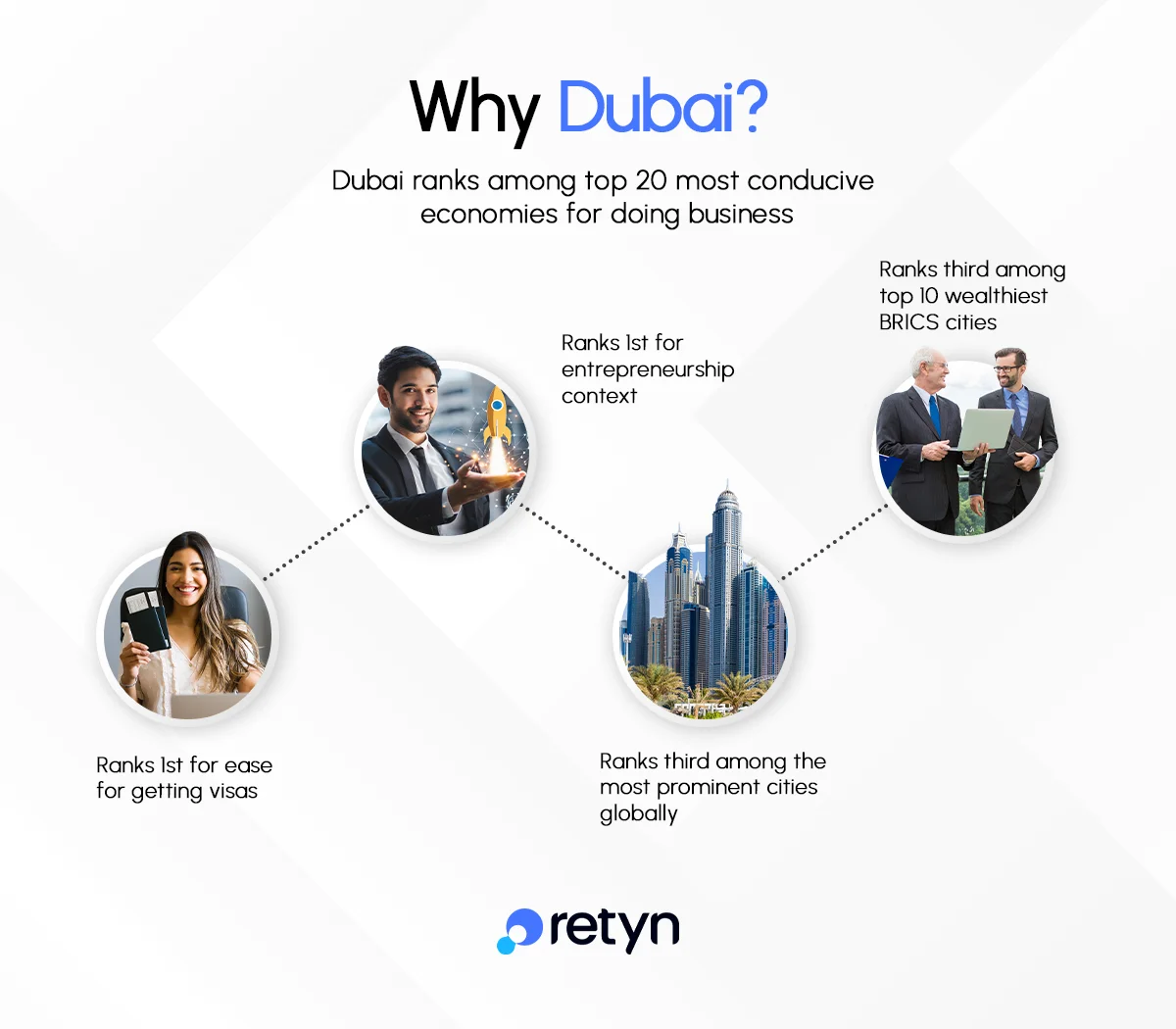
The most modern Emirate in the UAE, Dubai, has become an integral part of the world business map today.
Openness to international investment is now defining Dubai’s economy, and it’s no surprise that the city
has experienced a GDP of AED 119.7 billion in the first quarter of 2025, up by 4% in the same period in
2024, according to the Dubai Data and Statistics Establishment.
This city welcomes investors and companies around the world with a stable regulatory framework,
tech-infused infrastructure, government support and easy access to global markets. All these are reasons
enough to encourage entrepreneurs to explore newer avenues here in the Emirate.
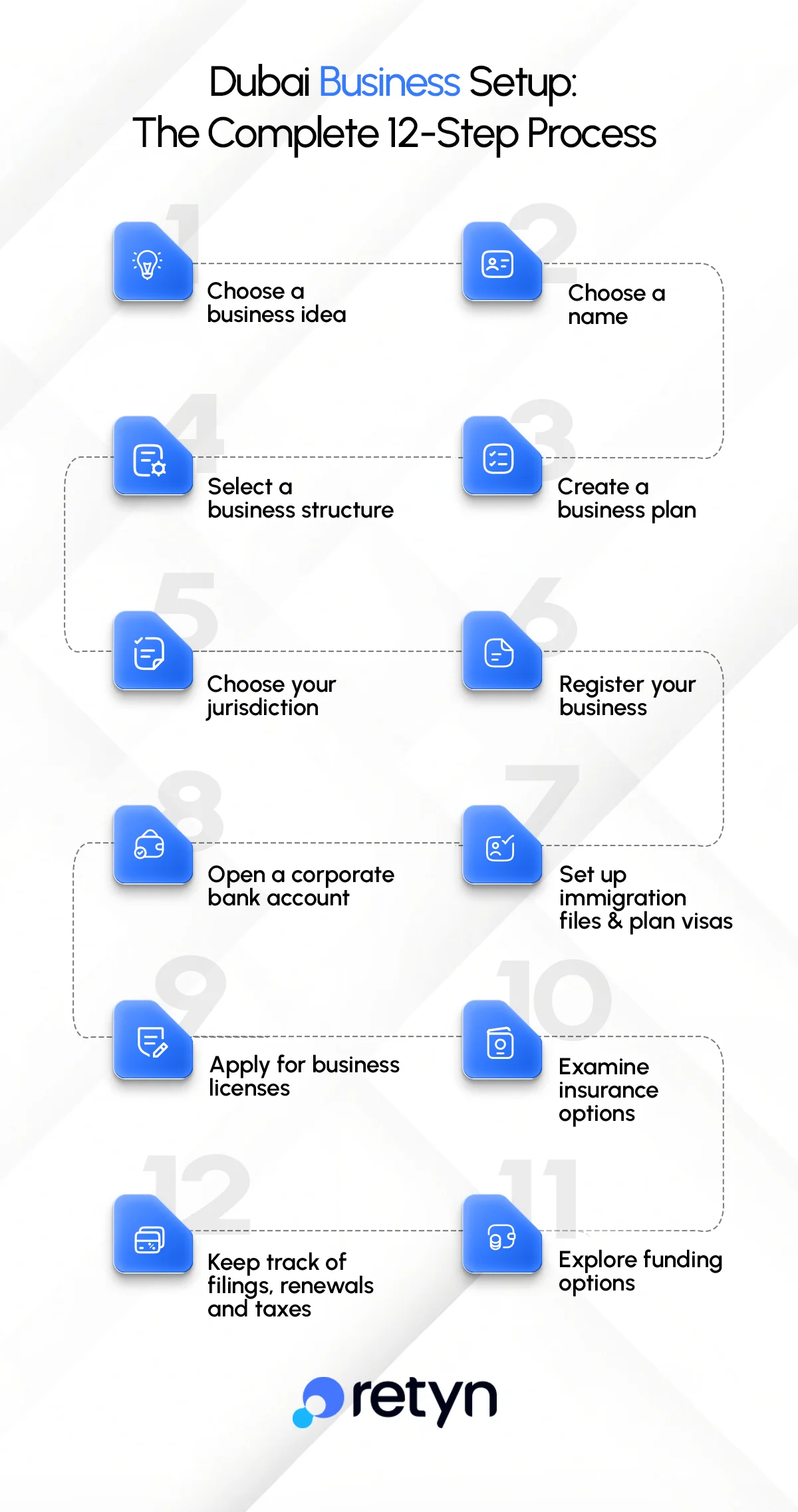
So, we have designed this guide for entrepreneurs to take their first step toward business setup in
Dubai in the right direction with the right information.
Take the First Step Toward Your Dubai Business Setup!
Our experts will guide you through licensing, legal structure, and setup, and offer a free consultation
to help you get started.
The first step is to gather a complete understanding of Dubai’s business climate, which will help you
decide and define the business activity that you intend to undertake. You need to get your business
objectives right and straight while choosing because the UAE is home to more than 2,000 economic
business activities. All these activities fall into different groups and so determine the type of
license you’re applying for from the most common types offered by the Dubai mainland:
Industrial License: Manufacturing or industrial activities
Commercial License: Trading activities or the buying and selling of goods
Professional License: Service-oriented businesses and professionals such as consultants and
doctors
Tourism License: Operating in the travel and tourism industry
Agricultural License: Engaged in farming and other agricultural activities
Prepare a checklist that includes all essentials such as your business model with target audience, sales
channels you prefer the most and regulatory requirements that vary with each sector. Once you have your
idea set in stone, next draw out the pricing strategy, sales volume estimate, operating costs and an
annual cash flow plan. Knowing the approximate amount required for your business setup
in Dubai will help you plan your budget likewise.
Pro tip
Before finalizing your business idea, check whether it’s approved under Dubai’s official list of
economic activities. For mainland setups, refer Dubai Department of Economy & Tourism (DET), and for
free zones, review chosen free zone authority’s activity list to ensure a proper license match.
Step 2: Choose a name
The right name speaks more about your brand identity, builds trust and helps people remember you. Have a
good grasp of the UAE business naming laws before registration of the final name.
You must avoid names that go against UAE culture, public morals or national values, as these are
strictly forbidden.
Personal names are allowed, but a surname alone without the first name is not.
The legal name must include a legal suffix when required, that indicates the company's legal
structure (LLC, FZE, FZ LLC, PJSC, etc.)
Choose a name that matches your brand activity and check copyrights and availability in your chosen
jurisdiction.
Pro tip
Check domain availability and social media handles before finalizing your business name. Having a
consistent brand identity across all digital platforms will strengthen your online presence.
Step 3: Create a business plan
Make a business plan to clearly state your main activity and any future additions you plan to pursue.
Because an inconsistent business plan means incomplete documentation and delays in approvals and banking
processes. Inclusion of company profile, go-to-market strategies, staffing plans that fit right with
your visa allocations and office space solutions in Dubai makes it presentable.
Let the list also carry your financials related to setup and running costs, and a note on compliance
checkpoints such as VAT rules, corporate tax, UBO/ESR filings and any industry-specific approvals you
might need.
“Dubai has always been—and will remain—a hub for leadership and talent, a catalyst for positive change,
and a global model for excellence and innovation”
- His Highness Sheikh Mohammed bin Rashid Al Maktoum, Vice President and Prime Minister of the UAE and
Ruler of Dubai
Step 4: Select a business structure
The legal structure of your company becomes part and parcel of your further business conduct as it
factors in your control over the company and the legal and financial liabilities associated. The choice
narrows down to the nature of your business.
Limited Liability Company (LLC)
The liability of shareholders is limited to the extent of their investment and so, their
personal assets are protected.
Most suitable for companies in the line of trading and services.
Sole Establishment
A legal venture with a single owner, who bears all debts of the business (personal assets
included).
Good for professional and consultancy activities.
Public Joint Stock Company (PJSC)
The company’s shares can be publicly traded on the stock market.
Suits well for large businesses that raise funds via public investments.
Private Joint Stock Company
Unlike PJSC, the shares are traded privately.
Suitable for all types of commercial and industrial activities.
Branch/Representative Office
An outlet of a parent company with a branch in the UAE and has no separate legal status.
Activities similar to those of the parent company.
Free Zone Company
Offers benefits like 100% customs tax exemption, no currency restrictions and capital and profit
repatriation.
Approvals from relevant free zone authorities and DET are required to expand operations into the
mainland.
Ready to Learn More About Setting Up Your Dubai Business?
Discover how our team simplifies the setup process, supports compliance, and delivers ongoing solutions
for your success.
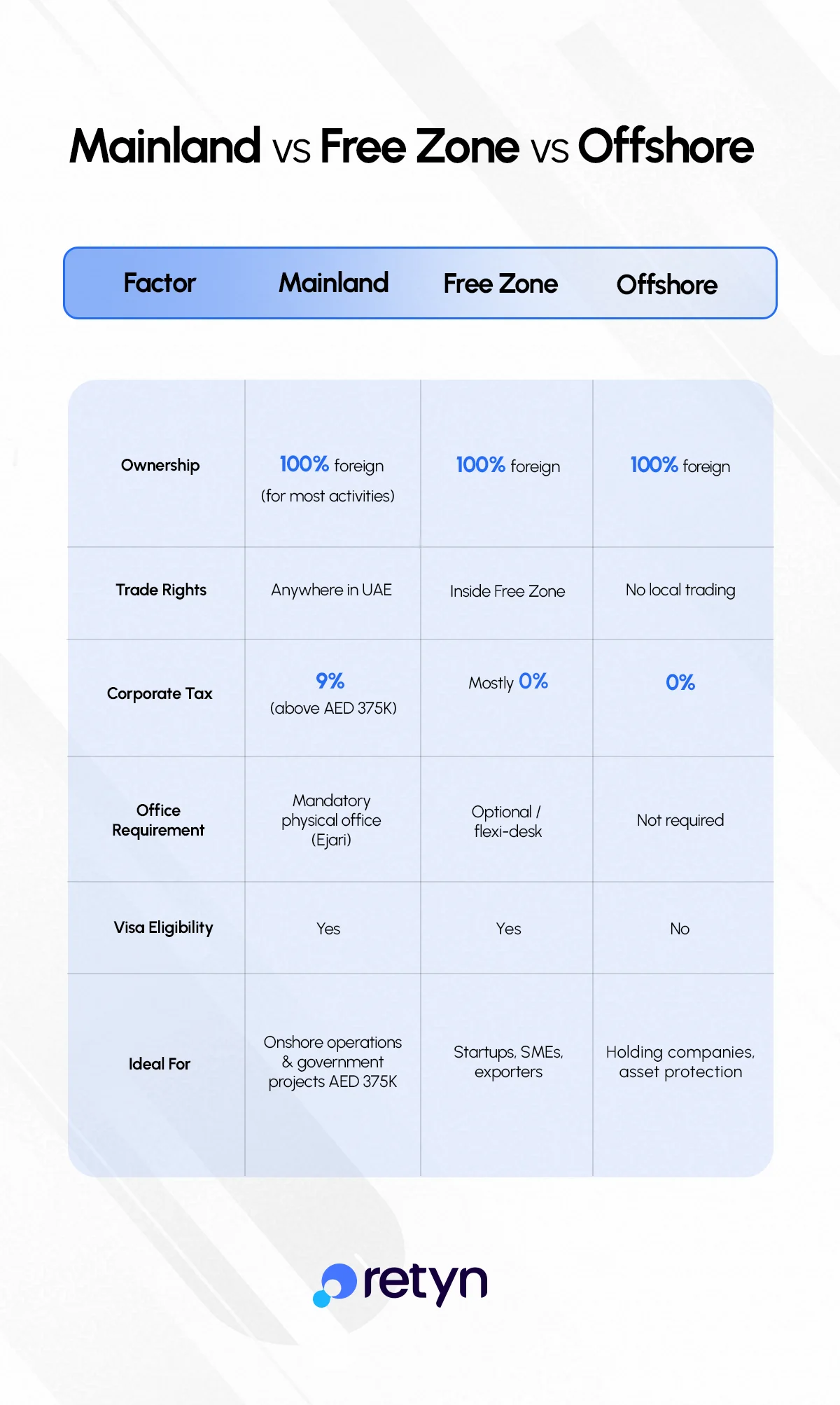
Step 5: Choose your jurisdiction: Mainland vs free zone vs offshore
Each jurisdiction that the UAE offers has its own benefits and limitations that need to be taken into
consideration beforehand. Mainland, free zone and offshore are the three important routes that you get
to pick for your business setup in Dubai.
Mainland benefits
Activities: Strong in sectors like real estate, tourism, construction, technology and finance.
Advantages offered: Allow 100% foreign ownership (as of 2020 amendments, but Emirati partner needed
in some cases) and can take on government projects.
Mainland company formation
A mainland company is an entity registered with the Department of Economy & Tourism (DET). Once
established, you’ll face no restrictions on where you can trade within the UAE, and get easy access to
markets throughout Europe, Asia, the Middle East and Africa. This is the right onshore to use if you’re
planning to be active in the UAE market. Though for mainland company formation in Dubai, you’ll have to deal with more
bureaucracy, and will be subject to UAE’s new corporate tax (9% on profits if profits exceed AED
375,000). Mainland companies must have a physical address to operate and the size of the office will
affect the number of employee visas you can apply for.
Free zone benefits
Activities: Welcomes diverse business activities like consulting, media, tech, ecommerce, logistics
and trading, among others.
Important jurisdictions: As of 2025, 20+ free zones are scattered around the country, like DMCC,
DSC, DIC, DHCC, DSO and many more.
Advantages offered: Each one offers 100% foreign ownership, no tax and customs privileges.
Free zone company formation
Free zone is often a right point for entrepreneurs wanting to set up a base in the UAE. The process of
acquiring a license is quite simple here, with the option to have an office space and obtain residence
visas. But there are certain requirements with regard to the initial share capital that is needed for
your free zone company formation in Dubai. For example, if forming in
DMCC, the minimum share capital is AED 50,000 per company and AED 10,000 per shareholder. But if your
setup falls under the general trading license, then you should have a minimum of AED 1 million share
capital. You must show solvency, so a bank account can be opened in the name of the company in any
licensed UAE bank.
Offshore benefits
Activities: Perfect for holding overseas investments and owning property without setting up a full
onshore business.
Important jurisdiction: JAFZA Offshore.
Advantages offered: Levies no corporate or income tax, no visa and no office needed.
Offshore company formation
The concept of an offshore company stands for flexibility and a mixture of features. Though an offshore
company is registered within the free zone itself and gets similar perks, there are some major
differences. That is, after the offshore company registration in Dubai, you cannot have business
activities inside the country. And you do not need to worry about the minimum capital that needs to be
deposited before incorporation unlike a free zone company. An offshore company is light on paperwork and
gets ample amount of privacy.
Pro tip
Free zones are beneficial if most of your revenue is generated from outside the UAE or through
digital exports. Mainland will be your go-to if directly selling within the UAE or if needed access
to government tenders.
Step 6: Register your business
Once you reach this stage, it’s time to apply for initial approvals to make sure the company gets off to
a stable and sound start. Starting with the initial approval from the D Department of Economy & Tourism
(DET), which is the government’s no-objection status for your business setup in Dubai. For example, DET
in Dubai offers an Instant License service that grants trade licenses in just five minutes for
activities that do not need external approvals.
Trade license is within your reach, once you have
Attested all the constitutional documents like the Memorandum of Association (MoA) as per legal
structure
Registered office lease (differs with flexi-desk or Ejari office or warehouse space)
Obtained all the required approvals for activities from specific government bodies
Your company is now officially up in Dubai.
Pro tip
If your business activity doesn’t require external approvals, apply for DET’s Instant License to get
your trade license in minutes and start operations
Step 7: Set up immigration files and plan visas
The next important requirement to operate in the UAE is to apply for and procure visas. This begins with
getting an establishment card to prove that your company is duly registered and authorized to operate in
Dubai. The establishment card is required to move forward with the visa processing in Dubai. Here, the number and type of visas
you’ll need might differ with your chosen business activity and office space.
Investor/Partner visas, valid for 5 or 10 years, through which investors can bring business
partners and family.
Employment visas are issued as per quota which is linked to your leased space and zone rules.
Family sponsorship if planning to relocate your family.
Mandatory health insurance for residents in Dubai.
Wage Protection System (WPS) for payroll compliance once you start hiring.
Pro tip
The Golden Visa is a more stable and flexible residency option that certain investors, entrepreneurs
or skilled professionals can apply for.
Visa Types
Features
Golden Visa
For investor entrepreneurs and talented professionals
Green Visa
For skilled individuals, freelancers or the self-employed
Virtual work visa
One-year visa for remote-work employees
Retirement visa
For those aged 55+ wanting to retire in Dubai
Blue Visa
A newly launched visa for those involved in environmental work
Get a quick consultation!
Our experts will guide you through licensing, legal structure, and setup, and offer a free consultation
to help you get started.
To start your company in Dubai, you will need to open a corporate bank account. This can be a bit
complicated for international businesses due to the Emirate's strict due diligence and regulations. So,
you need to choose the best corporate banking assistance in Dubai to keep all the
documents in order, get past account rejection fears and exhibit your bank readiness.
Keep in mind that you produce the following documents:
A business plan and company profile that explains your activity, structure, financial
projections and further plans.
A completed KYC narrative for all UBOs or directors by providing a valid passports, shareholder
information and proof of business activity.
Details regarding your facility, website, branded email and initial contracts.
Certified company documents and agreements.
These necessities might differ depending on the bank you are likely to choose from the many bank options,
local and international. For example, Emirates NBD (local bank), HSBC (international bank) and plenty
others in the list.
Pro tip
A 2-3 page “bankable dossier” version that comprises your company profile and flow forecast might
make account opening simpler.
Step 9: Apply for business licenses, permits and external approvals
We’ve seen how requirements for a license can vary with the business activity you’ve selected. So, in
such situations, you’ll have to get approvals from relevant authorities to ensure compliance with
regulations governing the particular activity. For example, sector approvals like RERA for real estate
brokerage, media councils for media-related activities and customs clearance for exports and imports.
Municipality approvals are also needed for certain sectors such as food handling, construction and
professional services.
“At a time when businesses, investors, and entrepreneurs are seeking stability and certainty, Dubai’s
sustained and diversified economic growth continues to underscore its global appeal. ”
- His Excellency Hadi Badri, CEO of Dubai Economic Development Corporation (DEDC)
Step 10: Examine insurance options in the UAE
Insurance not just prepares your company well ahead of all the uncertainties but also ensures the
well-being of your employees. Banks and landlords often expect you to have insurance coverage during
your business setup in Dubai. Common insurance policies for UAE business include public liability,
professional indemnity, workmen’s compensation, product liability and cyber insurance, to name a few.
The UAE also provides financial support to employees who have lost their jobs through the ILOE
(Involuntary Loss of Employment) scheme. Employees may also be enrolled in unemployment insurance (ILOE)
per UAE rules.
Step 11: Explore funding options
The UAE offers a plethora of funding initiatives and options within reach to ease the entrepreneurial
journey. A few of them include
Bootstrapping for entrepreneurs to start from scratch with minimal capital or self-financing
options.
VCs with large funding amounts for tech startups in the UAE.
Angel investors that target startups in their earliest stages and provide hands-on guidance.
Government funding programs that are like official backing with access to non-dilutive funding.
Bank facilities once you have a good credit history and financial position.
Having said this, you need to collect details and research on suitable fund options like grants, loans
and sponsorships. Once you are well familiar with the options available, you will be in a better
position to respond quickly when the need for funding comes up.
Step 12: Keep track of filings, renewals and taxes
The UAE rewards all those businesses that embrace compliance. Successful businesses are those that don’t
take regulations as a burden or just a paperwork process. You will have to submit the updated documents
and pay the relevant fees to avoid the risk of non-compliance.
Start monitoring from day one regarding these updates:
License renewals
UBO register updates
VAT registration, if taxable supplies and imports exceed AED 375,000
Corporate tax bookkeeping maintenance and returns filing
Audited financials for certain free zones and activities
Payroll and WPS handling
Economic Substance Regulations filings
Sector-wise renewals like RERA cards, municipal permits, warehouse HSE (Health, Safety, and
Environment), etc.
Pro tip
You can start maintaining an internal compliance calendar for relevant laws, licenses, certifications
and reporting standards and save your business from costly errors.
Decision snapshot (what to choose, at a glance)
If your priority is…
Likely fit
Selling to UAE customers and government tenders
Mainland LLC
Lean, export-led, digital services or trading
Free Zone FZ-LLC/FZE
Holding IP/assets, group structuring
SPV / Holding (Free Zone or financial center)
Testing the market with minimal cost
Free Zone with flexi-desk option
Additional tips
Get started with the right activity codes as they directly impact approvals, banking and payment
gateway access.
Prepare a bank-ready file that carries all the essentials like your website, domain email,
contracts, UBO chart and complete company profile.
Let your office type selection fit perfectly with your visa plan.
Keep a calendar for tracking compliance, including VAT, corporate tax, UBO/ESR, audits and
renewals.
Nurture a visionary (12-18 months ahead) mindset and add probable activities now to avoid
amendment downtime.
Regulation & News updates · 2026
CompliancePermit required for location-based tech - 09 Oct 2025
Businesses using GPS, geofencing or other geospatial tools must now obtain a special permit.
ComplianceSeven-year record-keeping rule - 27 Aug 2025
Entities must preserve accounting and tax records for at least seven years.
BankingTougher checks on business bank accounts - 08 Sep 2025
Central-Bank decree raises KYC/AML evidence for opening UAE business accounts.
Tax100 digital “zero-bureaucracy” measures - 08 Oct 2025
FTA adds self-service features to EmaraTax, eliminating paperwork for VAT and CT filings.
Tax9-month Corporate-Tax filing deadline - 24 Sep 2025
Returns and payments must reach FTA within nine months of a company’s financial year-end.
TaxMore freezones qualify for 0% CT - 03 Sep 2025
MoF widens “qualifying activities,” letting extra freezone entities access the zero rate.
TaxREIT investors taxed on 80% income - 06 May 2025
FTA confirms CT applies to 80% of UAE property income earned via exempt REITs.
LicenseFreezone “One Passport” introduced - 22 Jul 2025
Single digital passport lets companies operate across multiple Dubai freezones.
LegalLegal advice restricted to licensed lawyers - 21 Apr 2025
Federal law tightens penalties for unlicensed individuals providing legal advice.
FAQs about setting up a company in Dubai
No, you do not always need a local partner or shareholder, as the UAE offers provisions for
full foreign ownership (following the enactment of the Commercial Companies Law of 2020).
This newer framework is applicable for both the mainland (for most commercial and industrial
activities) and most free zones. But some strategic or tightly regulated activities may
still sit under some special rules and approvals.
Yes, if a free zone company wishes to sell inside the UAE, it has to do so via authorized
channels like appointing local agents or distributors, obtaining specific permits or using
dual licensing or branches where available. For direct onshore retail or service activities,
getting a mainland license is often the best and easiest route.
Timeline for setting up your business in Dubai differs based on the jurisdiction, activity,
approval duration and the completion of all the requirements. Usually, trade name
reservation and initial approval can take a few days, and license issuance can take between
days to a couple of weeks. More time is needed for opening a bank account, but if all the
relevant documents are in order, then the process moves faster. Visas generally are issued
once your immigration file is active.
You will usually require premises from which to work, and it varies with each zone and
activity.
Free zones often allow flexi-desk options for carrying out light operations.
Mainland activities generally demand an Ejari-registered office.
Offshore businesses need to register as a virtual company with no office requirements.
You can register for VAT once your taxable supplies and imports exceed the threshold of AED
375,000 or voluntarily if it supports your supply chain. Make sure to have compliant
invoicing and bookkeeping right from the start.
Disclaimer: This content is for informational purposes only and does not constitute legal
advice. Business setup regulations can change. Always consult with a qualified professional for your
specific needs.
Take the First Step Toward Your Dubai Business Setup!
Our experts will guide you through licensing, legal structure, and setup, and offer a free consultation
to help you get started.