How to establish a holding company in Dubai 2026: 12 essential steps for asset protection and subsidiary control
How to establish a holding company in Dubai 2026: 12 essential steps for asset protection and subsidiary control
Unlock tax exemptions, 100% foreign ownership, and streamlined investment holding in UAE free zones like DMCC or IFZA—ideal for real estate, IP management, and global business structuring.
Vincy Amirtharaj
58 post
Senior Business Setup Consultant, Dubai
The Emirate of Dubai is one of the world's most investor-friendly markets that openly welcomes private wealth and international capital. Starting a holding company in Dubai can be the right call for entrepreneurs who value asset protection and are looking to diversify their investments. The strategic arrangement allows businesses to consolidate global assets, starting from local real estate portfolios to international subsidiary shares, under a single legal umbrella.
Strong legal and structural advantages for holding companies in Dubai are offered one and the same if establishing as a Mainland Limited Liability Company (LLC) for direct property ownership or a specialized Special Purpose Vehicle (SPV) in financial free zones like DIFC or ADGM. These entities allow for 100% foreign ownership and are designed for maximum tax efficiency. The current UAE Corporate Tax regime may allow holding companies to benefit from corporate tax exemptions on dividends and capital gains via the Participation Exemption (subject to certain conditions). This establishes them as effective investment vehicles that safeguard ROI.
A Dubai holding structure provides long-term stability for you and your family and is considered an effective way for tax-efficient wealth structuring in the UAE. You may also qualify for the highly successful UAE Golden Visa that grants 10-year residency to shareholders. Using the strong asset protection system and legal frameworks like DIFC Foundations offers you high levels of asset protection and succession planning. The objective is to ensure your legacy is protected by distributing the inheritance to the beneficiaries as per your wishes.
Quick fact
UAE is projected to attract the highest number of millionaire migrants globally, that is, a net influx of more than 9800 high-net-worth individuals (HNWIs) in 2025 alone. The increase in inward migration creates a richer pipeline of opportunities, raises asset values and boosts local wealth.
Note: SPVs (Special Purpose Vehicles) in DIFC/ADGM can be set up faster (2-3 weeks), but bank account opening (Weeks 6-7) often takes longer due to strict compliance checks.
"Dubai is firmly established as a leading international financial centre... providing a stable environment for capital and wealth preservation."
- Insight from Dubai International Financial Centre (DIFC)
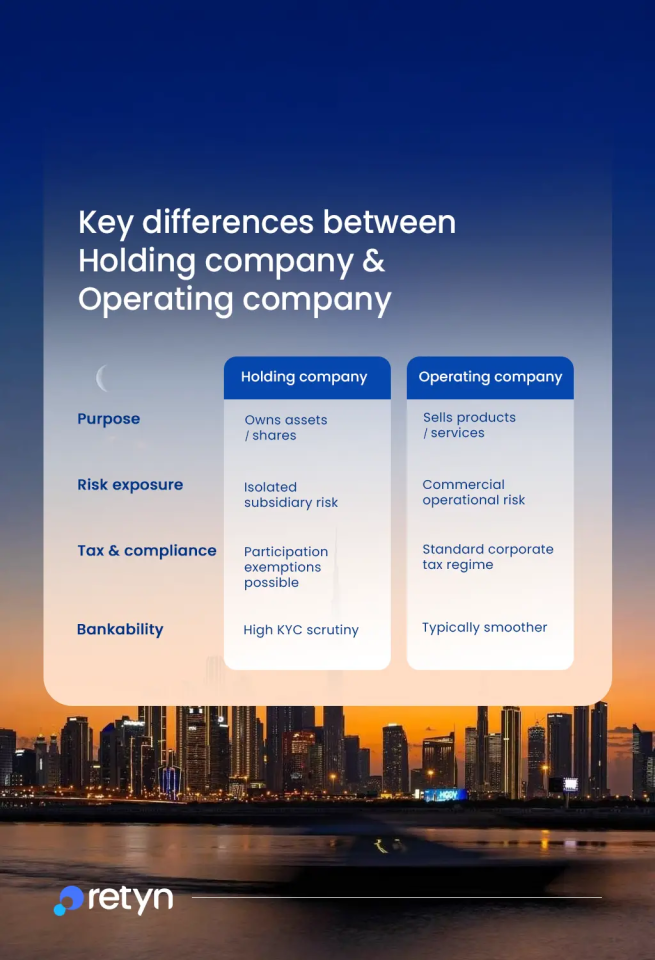
A holding company doesn't sell products; it owns things. Define exactly what you will hold to choose the right licence:
Equity / Shares
Owning shares in other operating companies (Subsidiaries).
Real Estate Assets
Holding commercial or residential property titles.
Intellectual Property (IP)
Patents, trademarks, and copyrights (High ESR requirements).
Financial Instruments
Stocks, bonds, and cash deposits.
Physical Assets
Ships, aircraft, or heavy machinery (leased out).
Pro tip
A "Pure Equity Holding Company" (only holds shares for dividends) has lighter compliance requirements than an "IP Holding Company," which faces strict Economic Substance tests.
Step 2: Choose a trade name
Pick a professional name that reflects your group's stature. For Mainland, it must end in "LLC". For DIFC/ADGM, suffixes like "Limited" or "Ltd" are common. Note: Terms like "Bank", "Trust", or "Insurance" are restricted and require Central Bank approval. Adhering to these naming conventions early on will help ensure a smoother process as you set up your business in Dubai.
Clear documentation of capital origin (Critical for banking).
Pro tip
Banks require a visual "Structure Chart" showing the Ultimate Beneficial Owners (UBOs) and all subsidiary layers before opening an account.
Cost snapshot · 2026
Share Capital: Usually AED 0 paid-up (Structure dependent)
DET Initial Approval: ~AED 120
Mainland Holding Licence: AED 15,000 - 20,000
DIFC Prescribed Company (SPV): USD 1,100 (Application)
ADGM SPV Setup: USD 1,600 (approx)
Registered Agent/Office: from AED 5,000 / year
Corporate Tax Registration: Free
*Prices for DIFC/ADGM are in USD but converted to approximate AED for comparison.
Setup-cost estimator (AED)
Estimated setup cost: —
Get detailed breakdown on WhatsApp
*Includes approximate government fees + registration.
SPVs (DIFC/ADGM) may require a Corporate Service Provider (CSP) which is an extra annual cost.
Step 4: Select a business structure
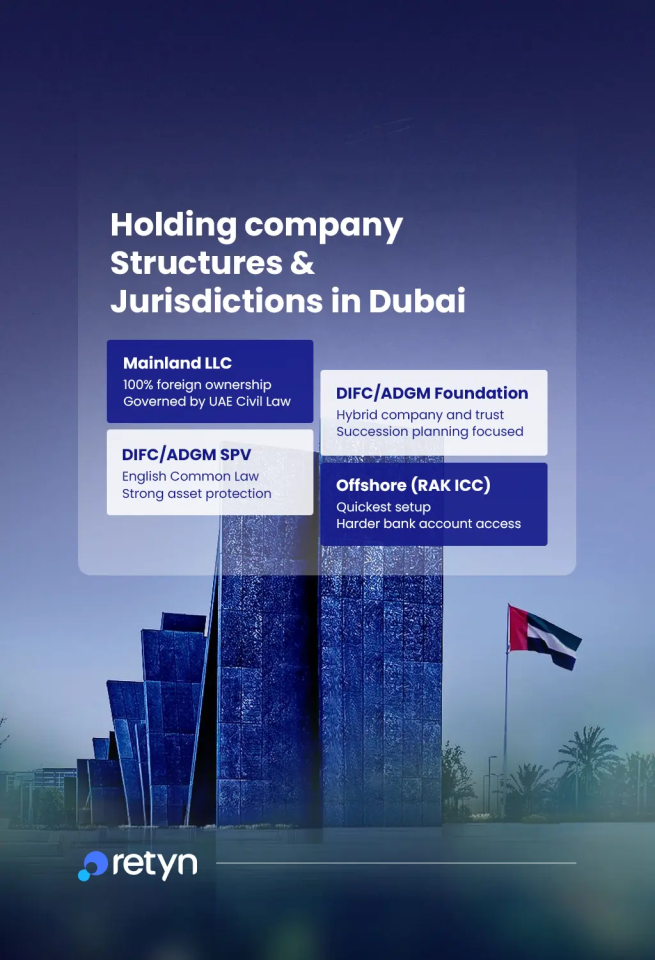
Pick the legal vehicle that fits your asset protection needs and succession goals:
Special Purpose Vehicle (SPV)
Passive entity used to isolate financial risk or hold specific assets (DIFC/ADGM).
Foundation
Hybrid of a company and a trust; excellent for family succession and blocking inheritance disputes.
Mainland Holding LLC
Best for holding tangible assets within Dubai (real estate, local subsidiary shares).
Single Family Office (SFO)
Comprehensive structure to manage the wealth of a single family (high entry threshold).
Pro tip
DIFC and ADGM offer "Prescribed Company" status for family offices, which drastically reduces setup costs and annual license fees.
Need help structuring your assets in Dubai?
Book a free consultation with our Family Office experts for step-by-step guidance.
The choice depends on the legal framework you prefer: Civil Law (Mainland) or Common Law (DIFC/ADGM).
Mainland (DET)
Best for holding shares in other UAE Mainland LLCs or owning Dubai freehold property directly.
Governed by UAE Civil Law. Understanding these specific legal frameworks is essential before officially setting up a business in Dubai mainland.
Key features:
Local Ownership
Allows 100% foreign ownership of the HoldCo.
Property Rights
Direct registration of Dubai real estate titles under the company name.
Dispute Resolution
Settled in Dubai Courts (Arabic language, Civil Law).
Financial Free Zones (DIFC / ADGM)
The "Gold Standard" for international investors. These zones operate under
English Common Law, providing high certainty for shareholder agreements and trusts. For many global firms, the ability to set up a business in Dubai free zone like the DIFC offers a familiar regulatory bridge between Western markets and the Middle East.
Ideal for:
Common Law Courts
English-language court systems independent of the mainland judiciary.
Asset Protection
Ring-fencing assets against personal liability or bankruptcy.
Global Investments
Widely recognized by international banks and foreign tax authorities.
Beyond the onshore and free zone options, investors often start an offshore company in Dubai when they need a reputable international base without the requirement for local operations.
Quick Fact
Dubai's DIFC manages over USD 700 billion in assets, cementing its position as the leading financial hub in the Middle East, Africa, and South Asia (MEASA) region.
Source: DIFC Annual Review
Step 6: Register & obtain the holding licence
Submit your UBO declarations, Articles of Association (AoA), and Registered Office agreement.
Mainland (DET) process
Initial Approval
Submit passport copies and choose "Holding Company" activity.
MoA Signing
Sign the Memorandum of Association electronically or at a notary.
Ejari / Lease
A physical office is often required, or a "Sustainability Desk".
DIFC / ADGM process
Business Plan Review
Registrar reviews the structure and UBO background.
Corporate Service Provider
Appoint a registered agent (mandatory for SPVs).
UBO Registry
Strict disclosure of the Ultimate Beneficial Owner (confidential).
Certificate of Incorporation
Digital issuance of the licence and AoA.
Licence-application document checklist
Individual Shareholder
Passport copies (Color, valid for 6 months)
Emirates ID (if resident)
Proof of Address (Utility bill from home country)
Bank Reference Letter (original)
CV / Resume showing wealth accumulation
No-objection certificate (if applicable)
Corporate Shareholder
Certificate of Incumbency (Notarized/Attested)
Memorandum & Articles of Association (Attested)
Board Resolution calling for the new HoldCo
Certificate of Good Standing
UBO Declaration (down to individual level)
Passport copies of the Parent Company Directors
Tip: For DIFC/ADGM, "Attestation" usually implies legalization at the UAE Embassy in the country of origin, which can take time.
sequenceDiagram
participant Founder
participant Registrar as Registrar (DET/DIFC)
participant CSP as Corp Service Provider
participant Bank
participant Tax as Federal Tax Authority
Founder->>Registrar: 1 · Reserve Name & Initial Approval
Founder->>CSP: 2 · Draft Articles of Association (AoA)
CSP->>Registrar: 3 · Submit UBO Declaration & Lease
Registrar-->>Founder: 4 · Licence & Incorp. Certificate Issued
Founder->>Registrar: 5 · Apply for Establishment Card
Registrar-->>Founder: Card Issued
Founder->>Registrar: 6 · Visa Application (Investor/Partner)
Registrar-->>Founder: Visas Stamped
Founder->>Bank: 7 · Submit KYC & Source of Wealth (SoW)
Bank-->>Founder: 8 · Account Approved
Founder->>Tax: 9 · Register for Corporate Tax & ESR
Note over Founder: 10 · Annual Maintenance (Renewal · ESR Notification)
Obtain your establishment card and process Investor Visas. Holding Company owners with property worth AED 2M+ or deposits often qualify for the 10-Year Golden Visa. Leveraging professional UAE visa processing services during this stage can help streamline the process. You can learn more about eligibility, required documents and step-by-step procedures in our detailed guide on how to get a UAE Golden Visa, which explains the process specifically for investors and business founders.
Pro tip
Holding Companies are excellent vehicles for sponsoring family dependents, as they demonstrate long-term financial stability to immigration authorities.
Step 8: Open a corporate bank account
Banks scrutinize Holding Companies heavily to prevent money laundering. Prepare a robust compliance pack proving the origin of your capital.
Corporate Documents
Licence, AoA, and Certificate of Incumbency.
Source of Wealth (SoW)
Bank statements (6 months) or sale deeds proving how funds were generated.
Group Structure Chart
Visual diagram showing UBOs and all subsidiary layers.
Shareholder CV / Bio
Professional background supporting your investment capacity.
Proof of Address
Utility bill or lease agreement for the company and the UBO.
Holding Companies are subject to specific reporting standards to ensure transparency:
UBO Registry
Mandatory filing of the Ultimate Beneficial Owner's details with the Registrar.
Economic Substance (ESR)
Notify the Ministry of Finance annually. "Pure Equity" holders have reduced requirements; others must prove local management.
FATCA / CRS
Reporting for US citizens or international tax residency exchange.
Failure to file the UBO declaration or ESR notification can result in fines starting from AED 20,000.
Step 10: Arrange corporate & D&O insurance
Protect your board and assets. While you don't need cargo insurance, financial lines of cover are essential for governance.
Directors & Officers (D&O) Insurance
Protects personal assets of directors against claims of mismanagement.
Cyber Liability Cover
Crucial if managing digital assets or sensitive family data.
Property All-Risk
Mandatory if the HoldCo owns physical real estate directly.
Step 11: Stay compliant—renewals, tax & ESR
Holding companies face strict regulatory deadlines. Log these annual tasks to avoid heavy fines:
Licence Renewal
Annual fee payment to DET, DIFC, or ADGM.
ESR Notification
File by 30 June (if applicable) to confirm substance status.
Corporate Tax Filing
File annual return (even if 0% tax applies to dividends).
UBO Registry Update
Confirm or update beneficial owner details annually.
Audited Financials
Required for DIFC/ADGM entities and some Mainland LLCs.
Pro tip
Dividends and capital gains from "Qualifying Participations" are generally exempt from the 9% Corporate Tax, provided you meet the participation exemption criteria.
Free 2026 compliance calendar (Excel)
Never miss an ESR notification, UBO update, or Tax Return deadline. Tap below and we'll WhatsApp the Excel sheet instantly.
A Holding Company protects assets during your life, but a Will protects them after.
Without a registered Will, local Sharia inheritance laws may apply to your shares. Considering these legal safeguards is a vital final step in the process of starting a business in Dubai.
DIFC Wills Service Centre
Register a will covering worldwide or Dubai-specific assets (Non-Muslims).
Foundation By-Laws
Draft a "Letter of Wishes" to guide the Foundation Council on distributing assets to beneficiaries.
ADGM Courts
Probate services for assets held within Abu Dhabi Global Market structures.
Pro tip
Link your Holding Company shares directly to a DIFC Will. This ensures that upon your passing, the shares (and the assets they own) are transferred instantly to your chosen heirs without freezing the company accounts.
Expert insight: The strategic shift from "Offshore" to "Mid-Shore"
The importance once given to "shell company" has now neared the end. The UAE, in 2026, has entered a decisive new phase in wealth structuring, that is, moving away from traditional offshore centers toward well-regulated Dubai's "Mid-Shore" model. It offers a balanced approach that global investors are eyeing now, with economic substance and bankability at core. A Dubai holding company can now benefit from the tax efficiency of offshore jurisdiction with the stability and regulatory framework offered by onshore jurisdictions. This combination can help you get better access to global financial networks.
The three strategic insights for entrepreneurs to future-proof their wealth structures in the current regulatory climate are explained below.
1. The "Bankability" Factor
Traditional offshore entities more often are prone to heightened AML scrutiny. This results in delays or rejections when opening UAE bank accounts.
The Insight: Establish as Special Purpose Vehicles (SPVs), also known in DIFC as Prescribed Companies or a Mainland Holding LLC. These entities are viewed as transparent and low-risk and help with easier banking.
2. Decoupling Ownership from Management
A standard practice in the UAE for banks is to freeze an individual’s accounts as soon as they are notified of the account holder’s death.
The Insight: Utilize the holding company or Family Foundation model to manage the assets and transfer wealth to the next generation or to the desired beneficiaries. This structure exists solely to benefit the family. It ensures assets transfer instantly to heirs without Sharia forced-heirship or court freezing orders in the event of the death of the founder.
3. Maximizing the "Participation Exemption"
As per the Ministry of Finance, the corporate tax rate is at 9% in the UAE. However, holding companies has a powerful advantage, that is, the Participation Exemption. These companies are treated as having satisfied the subject to tax test upon meeting certain conditions.
The Insight: Hold the minimum level of ownership interest (5% or AED 4 million) for an uninterrupted period of 12 months in order to ensure your dividends and capital gains remain at 0% tax exempt. Design your equity table from the beginning to meet these "Qualifying Investment" criteria to legally minimize tax leakage on exits.
Pro tip
If your HoldCo owns International Real Estate (e.g., London or NYC), check the Double Taxation Treaties (DTA). A UAE tax residency certificate for the company can often reduce withholding taxes on foreign rental income.
Decision snapshot – what to choose, at a glance
Structure / Vehicle
Foreign Ownership
Asset Protection*
Setup Speed
Bank-Account Ease**
Succession Proof
Mainland Holding LLC
Yes (100%)
Medium
≈ 3 weeks
High
Low (Requires Will)
DIFC Prescribed Co (SPV)
Yes (100%)
High (Common Law)
2-3 weeks
Medium
Medium
DIFC / ADGM Foundation
n/a (Orphan)
Very High
4-6 weeks
Medium
Very High
RAK ICC (Offshore)
Yes
Medium
5-7 days
Low
Low
* “Asset Protection” refers to the legal ring-fencing of assets against personal liability or creditor claims.
** “Bank-account ease” reflects typical KYC scrutiny: Offshore entities (RAK ICC) face much harder compliance checks than active Mainland or DIFC firms.
Risk & penalty matrix – key non-compliance fines
Offence
Fine (AED)
Consequence
Failure to maintain or file UBO Register
15,000 - 100,000
License suspension & bank freeze
Failure to submit ESR Notification
20,000
Exchange of info with foreign tax authorities
Late Corporate Tax Registration
10,000
Administrative penalties on tax due
Figures are based on Ministry of Economy & Federal Tax Authority schedules.
Compliance is the #1 priority for Holding Companies.
Treating the company as a personal wallet (Comminling funds leads to piercing the corporate veil).
Assuming "Holding" means "No Economic Substance" (You still need a registered office and board meetings).
Choosing an Offshore Licence (RAK ICC) to hold Dubai mainland property (DLD restrictions apply).
Opening a bank account without prepared Source of Wealth documents (Guaranteed rejection).
Ignoring UBO filing deadlines—Authorities are conducting random spot checks in 2026.
Regulation & news updates for holding companies · 2026
TaxUAE clarifies corporate tax treatment for family wealth management structures - 19 September 2025
Updates on corporate tax application for family wealth management, including holding companies, SPVs and single and multi-family offices.
ComplianceFTA reiterates 9-month deadline for corporate tax returns and payments - 27 August 2025
MoF reminds registrants to file CT returns and settle tax within nine months from the end of the relevant Tax Period to avoid administrative penalties.
ComplianceFTA reminds companies of 7-year record retention requirement - 27 August 2025
Taxable and Exempt Persons must retain financial records for a minimum period of seven years after the end of the relevant Tax Period.
ComplianceFTA highlights the use of EmaraTax platform for corporate tax compliance - 27 August 2025
Corporate Tax registration, return filing, and tax payments can be completed digitally through the EmaraTax, offering 24/7 access to tax services.
TaxUAE expands corporate tax exemption to foreign entities owned by exempt persons - 20 May 2025
MoF expanded corporate tax exemptions to include certain foreign entities and harmonize the tax treatment of local and foreign structures.
TaxUAE updates corporate tax rules for partnerships and family foundations - 7 January 2025
Administrative relief, compliance burdens and tax clarity introduced for unincorporated partnerships, foreign partnerships and family foundations.
Glossary of acronyms
SPV - Special Purpose Vehicle
UBO - Ultimate Beneficial Owner
ESR - Economic Substance Regulations
AoA - Articles of Association
SoW - Source of Wealth
CT - Corporate Tax (9%)
DIFC - Dubai International Financial Centre
FAQs on starting a holding company in Dubai
No. Trading or invoicing may expose your holding company to certain liabilities as it potentially defeats the purpose of protecting key assets (shares, property, IP). You are not allowed to import goods, trade or issue invoices for consultancy services. However, you may still establish a separate Operating Subsidiary under the holding structure in order to minimize administrative burdens and completely avoid risks associated with trading.
Opening a corporate bank account is often the single biggest hurdle when you set up a holding company in Dubai. It is classified in the “high-risk” category as holding companies have no clear day-to-day operational cash flow. In order to open a corporate bank account, you will be asked to prove economic substance (can be a physical office or a resident manager). Submission of transparent Source of funds (SOF) and Source of Wealth (SOW) for the initial capital will get you through the AML/CFT requirements and the bank’s compliance review process.
The defining feature of a DIFC or ADGM is that both are proficient in asset protection as these jurisdictions operate under English common law. Both support trust and foundation regimes and have frameworks that provide greater certainty in creditor protection. Whereas mainland entities are governed by UAE Civil Law. This jurisdiction is better suited for directly holding local real estate but offers less flexibility for complex trusts.
By default, yes. But the rules for inheritance and execution of wills vary depending on the religion of the deceased.
For Muslims in the UAE, inheritance matters are predominantly governed by Sharia law.
For non-Muslims without a valid and registered will, UAE courts may apply Sharia principles to the estate.
So, it is necessary to draft and register a will in the UAE. Depending on your status, you can choose to notarize in local courts or register at DIFC Wills and Probate Registry. This ensures your wishes are respected, and assets are distributed as intended.
Generally, no. Under the UAE Corporate Tax Participation Exemption, dividends and capital gains earned by your UAE business from your qualifying shareholdings will be 0% tax-exempt if:
You own at least 5% of the subsidiary's shares (ownership interest).
You hold the shares for an uninterrupted period of 12 months.
The subsidiary is subject to tax in its home jurisdiction (at least 9%).
Yes, you are eligible for the 10-Year Golden Visa if your holding company owns a property in Dubai with a purchase value equal to or more than 2 million AED at the time of purchase. Another common route to obtain a Golden Investor Visa is to have a deposit of at least AED 2 million in an investment fund or in national banks operating in the UAE
One primary reason is that offshore companies cannot issue residence visas. They cannot trade within the UAE, rent physical office spaces or easily open UAE bank accounts because of severe compliance restrictions. Although a DIFC Prescribed Company or Mainland HoldCo is slightly more expensive, founders choose it as they guarantee residency, banking access and long-term stability.
Disclaimer: This content is for information only and not legal or tax advice. Regulations regarding UBO, ESR, and Tax change frequently—always consult a qualified corporate services provider.
Need help structuring your assets in Dubai?
Book a free consultation with our Family Office experts for step-by-step guidance.