San Diego attracts institutional investment due to its steady economy, which is supported by a high-tech life sciences sector and significant military and aerospace activity. Early in 2026, investor interest will continue to be strong as capital shifts toward amenity-rich Class A office buildings and modern industrial facilities. In order to successfully operate within this environment it is imperative that you have a solid understanding of your local marketplace to assist with identifying new opportunities within emerging tech corridors and coastal submarkets where inventory remains tight. Many of the local leaders we will feature throughout our report below are also part of the top 100 real estate companies in the USA, which bring institutional-grade resources to the Southern California market.
Picking the right brokerage firm is important when dealing with complex investment sales or negotiating favorable lease terms for tenant representation. Many firms in the area are also among the top real estate companies in California and provide market analysis and site selection services for biotech, creative office and logistics end users. Whether you are repositioning a property in Kearny Mesa or looking to acquire space in the University City Golden Triangle, experienced brokers can provide useful insight into local market conditions.
The current real estate market reflects a continued flight to quality, as shown by strong absorption rates for modern office spaces and LEED-certified buildings. As interest rates stabilize and capital markets become more liquid, the ability to act quickly on distressed assets or off-market opportunities can provide a competitive advantage. The following list highlights some of the leading brokerage firms in the San Diego market that provide market insight and professional networks to help investors evaluate opportunities in a changing economic environment.
See how a dedicated CRM helps San Diego brokerages manage complex life-science disclosures, automate multi-channel follow-ups, and stay compliant with California’s evolving commercial regulations.
Explore CRM

The following table identifies eight of the most influential commercial real estate firms operating in San Diego County, categorized by their market specialty and core service offerings. Each of these firms utilizes sophisticated tools to maintain their dominance. From institutional multifamily to specialized life science labs, these market leaders rely on a dedicated commercial real estate CRM to manage multi-million dollar deal pipelines and complex stakeholder relationships.
Talk to a California commercial property expert
Quick Chat
1
CBRE San Diego
Website: cbre.com
Regional HQ: University City, San Diego
Local Presence: Established market leader with ~425 professionals
Key Person: Paul King, Senior Managing Director
Core Services: Institutional multifamily, retail leasing, and workplace strategy
Awards: Consistently ranked as the top brokerage by San Diego Business Journal
Operating from its tech-forward Workplace360 office in University City, CBRE remains the dominant force in the San Diego commercial market. The firm is particularly recognized for its institutional multifamily division and a retail team that manages many of the region's premier grocery-anchored and high-street projects. Their data-centric approach provides clients with unmatched local market intelligence.
2
JLL (Jones Lang LaSalle)
Website: us.jll.com
Regional HQ: UTC / La Jolla, San Diego
Local Presence: Leading capital markets and corporate services team
Key Person: Tim Olson – Market Director
Core Services: Capital markets, structured finance, and agency leasing
Awards: Recognized for the 2025 Deal of the Year in investment sales
JLL has solidified its position as the top choice for complex capital markets transactions in San Diego. After relocating its regional headquarters to a high-profile suite in the UTC area, the firm has expanded its footprint in structured finance and large-scale office leasing. They excel at connecting local property owners with deep pools of international and institutional buyers.
3
Cushman & Wakefield
Website: cushmanwakefield.com
Regional HQ: Del Mar Heights (One Paseo)
Local Presence: Premier research-led advisory for life sciences
Key Person: Andy La Dow – Managing Director
Core Services: Life science R&D leasing, industrial, and retail advisory
Awards: Recipient of multiple CoStar Power Broker awards for leasing volume
With its regional hub located at One Paseo in Del Mar Heights, Cushman & Wakefield provides extensive coverage of San Diego's most competitive sectors. The firm is a powerhouse in the life sciences and industrial markets, utilizing a deep research platform to guide developers through creative repositioning strategies. Their specialized teams are essential for navigating the Sorrento Valley and Torrey Pines submarkets.
4
Colliers San Diego
Website: colliers.com
Regional HQ: La Jolla Village Drive, San Diego, CA
Local Presence: High-volume transaction experts with a North County focus
Key Person: David Santistevan – Executive Vice President
Core Services: Tenant representation, land sales, and asset management
Awards: Top Tier Firm for creative office leasing strategies
Colliers is widely respected for its deep reach in tenant representation and its ability to handle high-volume transactions across the county. The firm has made significant investments in capturing the specialized life sciences market while maintaining a dominant position in North County industrial sales. Their brokers are known for their speed and expertise in repositioning legacy office assets.
5
Hughes Marino
Website: hughesmarino.com
Regional HQ: Downtown San Diego
Local Presence: Exclusive boutique tenant and buyer representation
Key Person: Jason Hughes – CEO and Chairman
Core Services: Tenant advisory, lease auditing, and project management
Awards: Frequently named the Best Place to Work in San Diego
Hughes Marino offers a unique proposition as a boutique firm that exclusively represents commercial tenants and buyers. By refusing to represent landlords, they position themselves as conflict-free advisors for San Diego businesses. Their expertise is particularly valuable for corporate occupiers in the office and life science sectors who require aggressive lease negotiations and specialized project management.
San Diego's commercial resilience is anchored by a diverse economy that balances established defense contracts with a cutting-edge biotechnology ecosystem. Several key factors underpin the region's sustained demand for high-quality commercial space:
- The concentration of premier research institutions in Torrey Pines creates a self-sustaining talent pipeline for the life sciences sector.
- Significant federal defense spending and a heavy naval presence provide a stable base of demand for office and industrial flex spaces.
- Modernization of the Port of San Diego and proximity to the Mexican border enhance the region's appeal for logistics and cross-border trade operations.
- The ongoing flight-to-quality trend drives high occupancy rates in newly developed or amenitized Class A office buildings in UTC and Del Mar.
Source: CoStar, CBRE Research, Cushman & Wakefield Market Reports
Source: JLL Local Insights, San Diego Business Journal
Talk to a California commercial property expert
Quick Chat
The San Diego market offers diverse entry points for institutional and private capital, with each submarket catering to specific industry needs and growth trajectories.
- Life science and R&D lab spaces are navigating a period of significant oversupply, with regional vacancy reaching approximately 26.5% in early 2026, particularly within the golden triangle of UTC, Sorrento Valley, and Torrey Pines.
- Industrial and logistics facilities in Otay Mesa are seeing historic demand due to the growth of cross-border e-commerce and manufacturing.
- Premier Class-A office assets with high-end amenities continue to attract corporate tenants who are downsizing square footage but upgrading quality.
- High-street retail and grocery-anchored centers in coastal communities maintain low vacancy rates and consistent rental growth.
Strategic investors prioritize San Diego for its high barrier to entry and strong underlying economic fundamentals that protect long-term asset value.
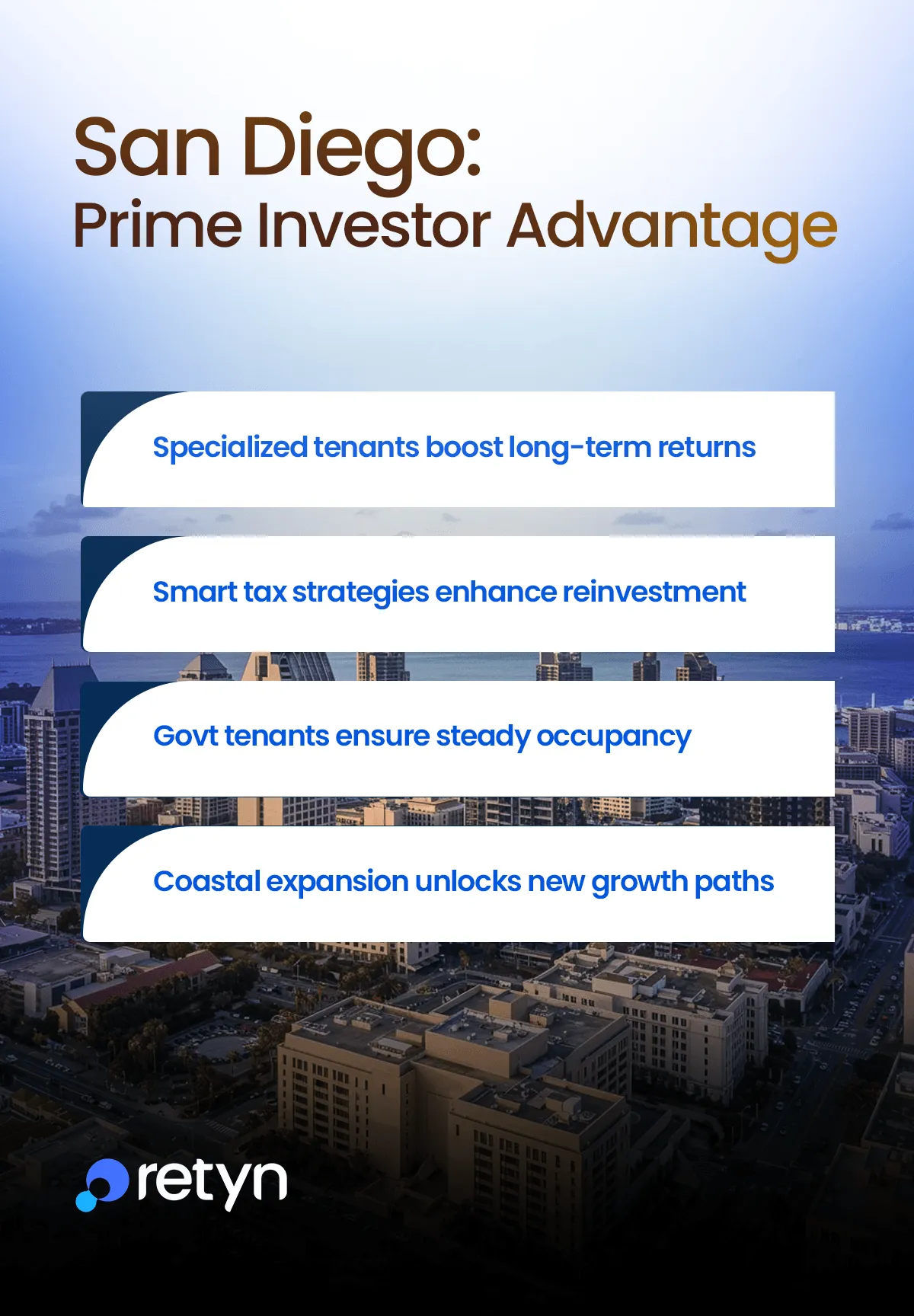
- Institutional-grade yields in the life science sector often outperform other major tech hubs due to the specialized nature of the tenant base.
- Utilization of 1031 exchanges allows investors to defer capital gains while trading up into higher-quality coastal San Diego assets.
- Strong occupancy from government and defense contractors provides a recession-resistant income stream for office and flex portfolios.
- For investors diversifying portfolios beyond California, examining
top companies in Charleston
offers a look at other high-growth coastal markets.
Despite the market's strength, local brokerages must navigate a complex regulatory environment and rapid shifts in tenant requirements.
- Strict California zoning laws and Coastal Commission oversight can create significant delays in development and repositioning projects.
- The high velocity of the life science market puts immense pressure on brokers to manage complex due diligence and laboratory build-out requirements.
- Aggressive competition for top-producing talent among global firms makes agent retention a primary concern for local managing directors.
- Navigating evolving state-level environmental and energy disclosure mandates requires constant legal and operational vigilance.
Forward-thinking San Diego brokerages are increasingly adopting specialized property technology to streamline complex high-value transactions and provide transparency to global investors.
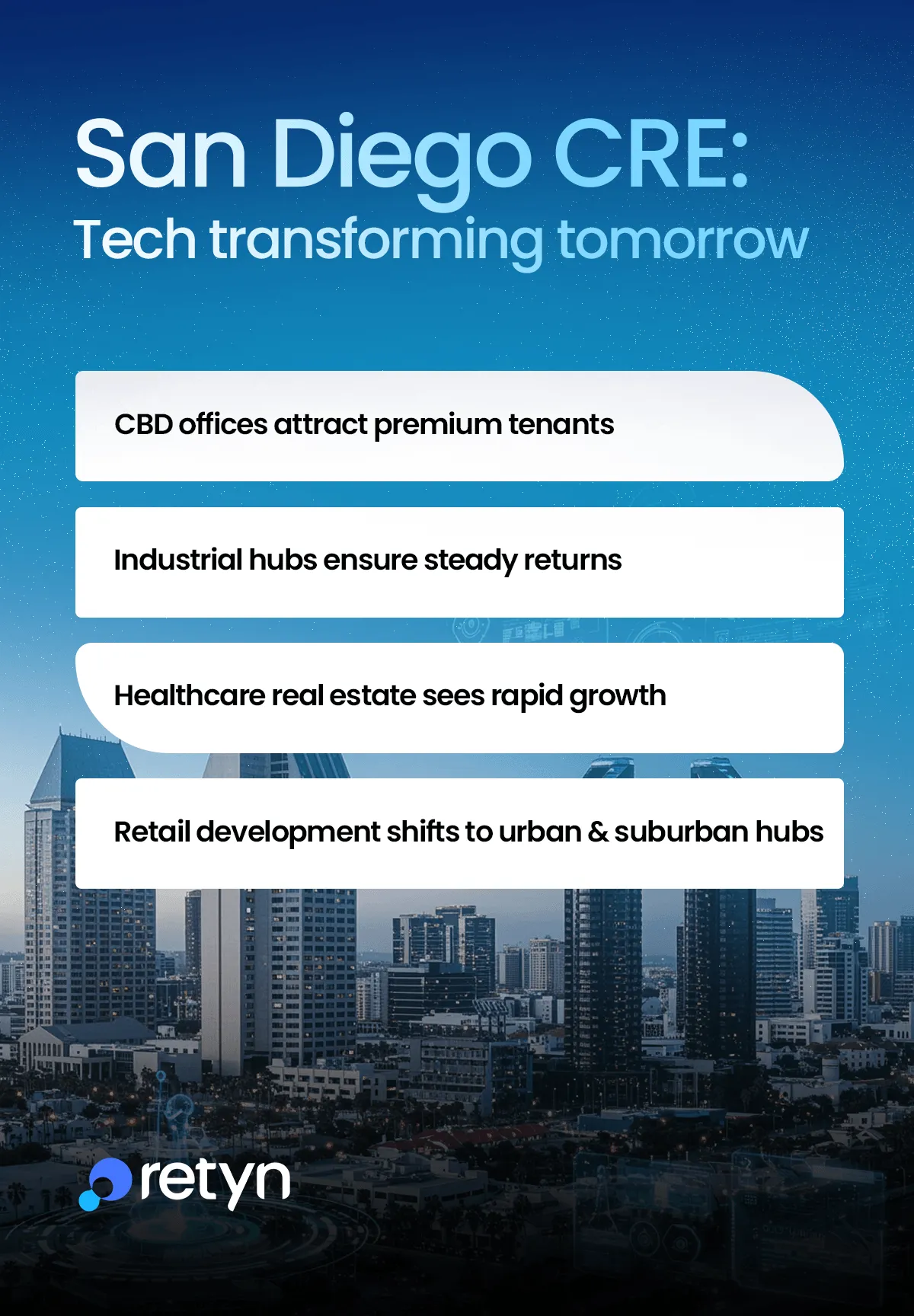
- Advanced virtual 3D walkthroughs of laboratory and R&D shells allow international life science tenants to evaluate specialized facilities remotely.
- Automated compliance engines ensure that every lease agreement adheres to the latest California state-level energy and environmental disclosure laws.
- Predictive analytics and real-time market pulse dashboards offer granular insights into submarket absorption rates and micro-neighborhood rent spikes.
- AI-powered real estate CRM platforms are being utilized to automate lead scoring for institutional buyers and manage multi-year tenant renewal cycles.
The San Diego commercial market remains one of the most robust investment environments in the United States. Success in 2026 depends on a firm's ability to leverage local submarket data while providing institutional-grade service. Brokerage teams that adopt modern growth platforms and automation today will be best positioned to manage the increasing complexity of Southern California’s commercial landscape. As the market matures, teams must adopt a comprehensive real estate growth platform to manage the entire lifecycle of a commercial asset, from acquisition to disposition. For agents looking for a mobile-first solution, WhatsApp CRM for real estate allows for instant communication with stakeholders on the move.
A real estate growth platform provides the infrastructure needed to personalize the client experience, ensure regulatory compliance, and maximize portfolio ROI in a fast-moving market.
Empower your San Diego commercial brokerage to manage high-value transactions with ease using AI-powered CRM.
Get CRM now
FAQs on San Diego commercial real estate
Typically, converting an office building into a working laboratory can take roughly 12 to 18 months in the 2026 market. The process includes developing plans that are specific to a lab's MEP systems, obtaining permits from the City of San Diego to allow hazardous materials to be handled on site and installing complex HVAC systems capable of supporting either BSL-2 or BSL-3 laboratory requirements.
Properties located west of I-5 are subject to oversight by the California Coastal Commission. It has authority to restrict development density and building height. Such limitations provide significant barriers to new investors wishing to enter this market by helping preserve long-term asset value. However, these limits can also increase the cost and time required to obtain approvals from the Commission prior to making substantial structural changes.
Yes. A large number of private investors are now using 1031 exchanges to transition out of legacy office properties into triple-net (NNN) retail or grocery-anchored shopping centers. The stability of income and lower management requirements compared to multi-tenant office properties is why many have selected these types of assets in today's market environment.
Although there is a scarcity of industrial space in the Carlsbad market, Otay Mesa continues to offer some of the highest cap rates in the region. This is because of the growth in cross-border logistics and the construction of additional warehouses, making this submarket a key target for institutional investors seeking higher returns than those typically found in Central County.
Tenants are increasingly moving toward highly amenitized Class A properties in UTC and Del Mar Heights and away from older Class B product. In order to attract tenants, owners of older buildings must now invest in "hospitality-grade" amenities like outdoor collaborative spaces, premium fitness centers and sophisticated air filtration systems.
As the excess supply of new buildings constructed through 2024 is being absorbed by the market, base rents have stabilized. Landlords are offering more aggressive concession packages with larger tenant improvement (TI) allowances for quality biotech tenants in both the Sorrento Valley and Torrey Pines biotech clusters.
Owners of commercial properties exceeding 50,000 square feet in California under AB 802 must submit annual energy benchmarking data to the California Energy Commission. Once reported, certain benchmarking metrics may become publicly available and are often reviewed during property transaction due diligence. Non-compliance with this requirement may complicate the sale process.
Disclaimer: Retyn does not promote or endorse any company listed above. The companies listed are selected based on publicly available transaction data and market presence as of early 2026. Data is compiled from local market sources and is subject to change.