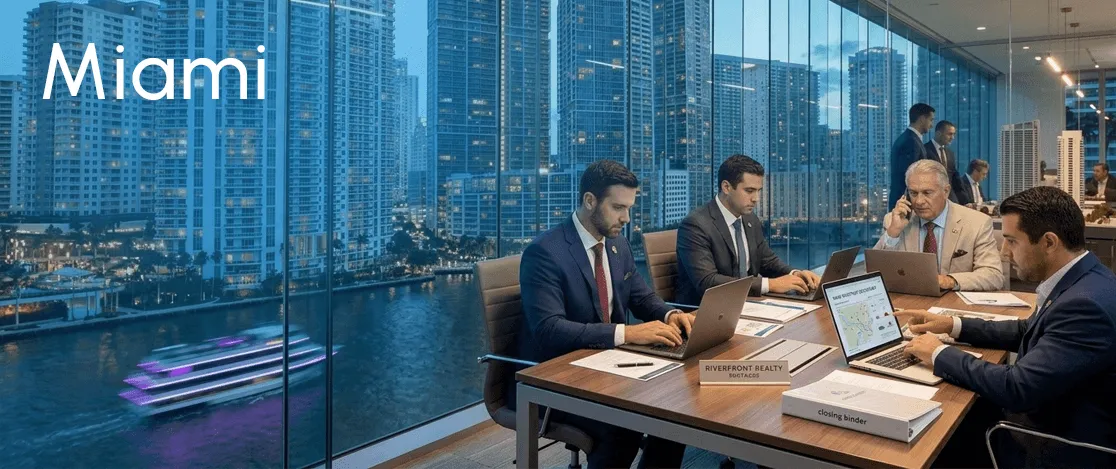
Miami is now often referred to as the “Wall Street of the South” because it reflects the city’s growth from a regional gateway into a larger national hub for investment and capital market activity. Many of the top real estate companies in the USA agree that the South Florida commercial market is increasingly influenced by fundamental economic drivers rather than speculative activity.
High-velocity markets such as Miami are complex and require specialized knowledge of the dynamics within local submarkets. This includes everything from record-high trophy office rents in Brickell to the limited available industrial inventory in Doral. Many of the top real estate companies in Florida, including several leading commercial brokerage firms in Miami, provide more than basic transaction support and often assist clients with broader advisory services. They also offer tenant representation as well as landlord advisory services that account for changing cap rates and new legislation, such as the Live Local Act. Working with an experienced commercial real estate broker who specializes in high-value assets will enable you to maximize your potential investment return in the Miami market.
This guide examines the most influential brokerage firms that are currently impacting the skyline of Miami by offering detailed insight into their strengths and recent transaction history. Whether you are analyzing NNN lease opportunities in Wynwood or large multifamily projects, these brokerage firms provide the market data and transaction experience needed to guide investment decisions. Explore our comprehensive 2026 market snapshot and firm directory to align your real estate strategy with the continued economic growth of Miami.
See how a dedicated CRM helps Miami brokerages manage high-volume Brickell listings, automate tenant follow-ups, and navigate Live Local Act compliance.
Explore CRM

The following table highlights eight of the most influential commercial brokerage firms currently dominating the South Florida skyline. These organizations are ranked based on their total transaction volume, specialized market intelligence, and their ability to secure high-value assets in competitive sectors like Brickell office space and Doral logistics.
Talk to a Miami commercial property expert
Quick Chat
1
CBRE (Miami)
Website: cbre.com
Regional Headquarters: Miami, FL
Market Presence: Dominant leader in South Florida
Key Person: Gian Rodriguez - Senior Managing Director
Core Services: Advisory & transaction services, capital markets, property management
Performance: Facilitated over $16 billion in South Florida deal volume entering 2026
2
JLL (Jones Lang LaSalle)
Website: jll.com
Regional Headquarters: Miami, FL
Market Presence: High-profile urban core specialist
Key Person: Chris Drew, Senior Managing Director
Core Services: Tenant representation, investment banking, project development
Performance: Lead advisor on record-breaking office financing in the Brickell district
3
Cushman & Wakefield
Website: cushmanwakefield.com
Regional Headquarters: Miami, FL
Market Presence: Industrial and office market intelligence leader
Key Person: Virgilio Fernandez, Managing Director
Core Services: Global occupier services, valuation & advisory, industrial logistics
Performance: Recognized for managing one of the largest industrial portfolios in South Florida
4
Blanca Commercial Real Estate
Website: blancacre.com
Headquarters: Miami, FL
Market Presence: Florida’s leading independently owned commercial firm
Key Person: Tere Blanca – Founder, Chairman & CEO
Core Services: Landlord representation, property branding, Class A leasing
Performance: Consistently secures the highest-value tenant relocations in the Miami market
5
Newmark
Website: nmrk.com
Regional Headquarters: Miami, FL
Market Presence: Rapidly growing debt and equity powerhouse
Key Person: Doug Harmon, Global Capital Markets leader
Core Services: Investment sales, debt & equity, valuation
Performance: Ranked as a top debt leader in Florida for loan originations and capital markets
Miami’s commercial trajectory is no longer tied solely to tourism. A fundamental shift in the tax landscape and a massive influx of out-of-state capital have solidified its status as a primary market. Key growth drivers for 2026 include:
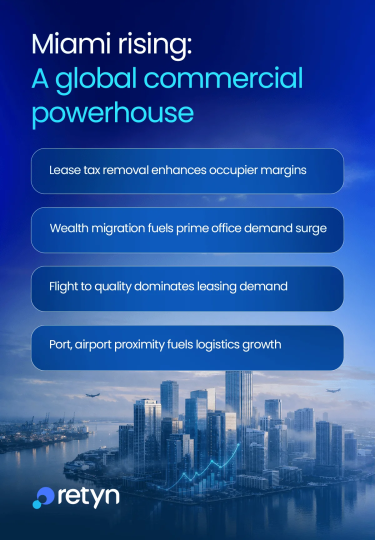
- The elimination of the 2.0% state sales tax on commercial leases has significantly improved occupier economics for new and existing tenants.
- The continued migration of high-net-worth individuals and financial firms from high-tax states sustains demand for trophy office assets.
- A persistent flight to quality has seen 60% of all leasing activity concentrated in Class A and newly delivered trophy buildings.
- Proximity to Miami International Airport and PortMiami continues to drive record absorption in the industrial and cold-storage sectors.
While Miami's growth is unique, comparing commercial brokerage trends in Chicago or the significant wealth migration from NYC helps investors understand the broader shift toward Sun Belt trophy assets.
Source: CBRE Research, Cushman & Wakefield, CoStar
Source: JLL Miami, Blanca CRE
Talk to a Miami commercial property expert
Quick Chat
The Miami market offers specialized opportunities across various asset classes to meet institutional and private investor goals.
- Class A office space in the urban core remains the top choice for financial firms relocating from the Northeast, commanding the highest rents in the state.
- Small-bay industrial properties are seeing ultra-low vacancy rates as local service businesses compete for limited space near major highways.
- High-street retail in areas like Wynwood and the Design District benefits from a significant increase in consumer spending power from new residents.
- Multifamily developments continue to see strong absorption as the local workforce grows, despite a significant wave of new unit deliveries.
Strategic investors are capitalizing on Miami’s pro-business climate, significant wealth migration, and recent legislative changes that favor commercial property owners. For those with diversified interests, understanding international property management standards and using investor-focused CRM tools allows for seamless management of both local Miami bays and global assets.
- The elimination of the 2.0% state sales tax on commercial leases directly increases the net effective rent for landlords and lowers overhead for tenants.
- High demand for Class A office and retail space allows for consistent annual rent escalations, often outperforming other major U.S. coastal metros.
- 1031 exchanges remain a powerful tool for investors to transition from aging residential portfolios into high-performing Miami commercial assets while deferring capital gains.
A rapidly maturing market introduces new complexities that require sophisticated brokerage management and data-driven strategies. Operational friction is often caused by fragmented data. Utilizing listing visibility management and automated commission processing is essential for maintaining a competitive edge during high-volume periods.
- Identifying shadow vacancy—space that is leased but not physically occupied—is essential for finding off-market sublease opportunities.
- Navigating new state regulations, such as the Live Local Act, requires deep local expertise to ensure zoning and tax compliance for mixed-use developments.
- The high velocity of transactions in the urban core puts a strain on traditional manual workflows, leading to potential delays in the closing process.
Modern Miami brokerages are adopting advanced PropTech solutions to enhance transparency and accelerate the deal-making process for global investors.
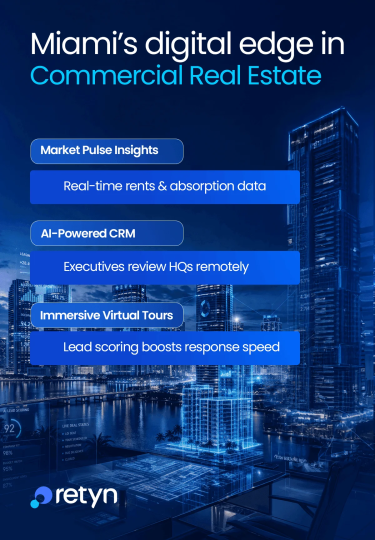
- Proprietary market pulse dashboards provide real-time insights into submarket-specific absorption rates and effective rental prices.
- Immersive 3D virtual tours allow international C-suite executives to evaluate potential headquarters without the need for immediate travel.
The Miami commercial real estate market has entered a new era of stability and institutional growth. Success in 2026 and beyond belongs to the firms that combine local street-level intelligence with modern operational technology. By adopting automated workflows and data-driven client management, brokerages can better serve the needs of the sophisticated capital currently flowing into South Florida.
A real estate growth platform provides the infrastructure needed to manage complex commercial transactions, enhance regulatory compliance, and maximize investor returns.
Empower your Miami brokerage to dominate the urban core with AI-powered transaction management and lead scoring.
Get CRM now
FAQs on Miami commercial real estate
Florida will cease collecting both state and local sales taxes on commercial rents by early 2026. The legislative change has improved occupier economics by lowering total occupancy costs for office, retail and industrial tenants compared with previous years.
Live Local Act allows developers in Miami to bypass certain local zoning regulations related to height and density when developing mixed-use projects that include affordable housing. As a result, the act has created opportunities to redevelop vacant commercial land into high-density residential or mixed-use developments without the usual zoning barriers.
Rentals in trophy Class A buildings in Brickell are among the highest in the Southeast, with average rental rates of approximately $90 to $100 per square foot on a full-service basis. Rentals above $100 per square foot have been recorded for premium space in top-tier towers.
A term referred to as “shadow vacancy” describes space within a building that has been leased but is not currently being used by the tenant. For investors in Miami, tracking shadow vacancy can provide two potential benefits. First, monitoring shadow vacancy may help investors identify additional sublease opportunities. Second, it helps show how much of the space in a building actually has real demand compared with reported occupancy.
Industrial small-bay warehouse space remains one of the tightest segments of the commercial property market, with an average vacancy rate below 3%. This is largely because many local service-related companies continue to absorb the limited supply available. Because they both provide direct access to Miami International Airport and several regional transportation corridors, Doral and Medley have continued to be the dominant markets for industrial and logistics properties.
Although Miami landlords are charging very high face rents, many of them are using concession packages as an incentive to secure long-term Class A tenants. Most of these packages provide larger tenant improvement (TI) allowances and longer free-rent periods, particularly in recently completed buildings.
Absolutely. Miami’s commercial real estate industry operates through strong relationships. A local broker can provide access to pocket listings, proprietary data not available on public platforms and the right contacts within local municipalities.
Disclaimer: Retyn does not promote or endorse any company listed above. The firms featured are selected based on public transaction data and market influence as of early 2026. Data is subject to change based on market fluctuations.