The Detroit commercial real estate market in 2026 is seeing a clear flight to quality, along with continued urban redevelopment across the city. Both corporate tenants and institutional investors are beginning to favor Class A office buildings located in the Central Business District (CBD) of Detroit. The CBD has generally maintained lower vacancy rates than many suburban office submarkets. These trends are being fueled by ongoing redevelopment activity and increased investor interest in downtown projects. As a result, there is growing competition among owners of modern, well-located office buildings.
Metro Detroit’s industrial real estate market has stayed fairly steady at approximately 5% vacancy rate. There has been strong leasing activity in smaller industrial spaces usually under 100,000 square feet, which are often used for warehousing, logistics or light manufacturing. Many of these properties are located close to major transportation corridors, thus making them ideal for supply chains and distribution. Meanwhile, the growth of adaptive reuse projects in historic areas has created new investment possibilities, as developers can convert undervalued buildings into mixed-use or life-science space. Managing these projects often requires the use of modern commercial real estate CRM software, which help firms track high-value institutional relationships.
Navigating capital markets in Detroit can be complex and requires significant knowledge of the local market, along with data-driven approaches to asset management. The leading brokerage firms operating in Detroit are using new property technologies to streamline lease administration and improve portfolio transparency. Several firms active in this market are ranked among the top 100 real estate companies in the USA, giving them access to national capital and institutional experience in Detroit’s evolving real estate market. Whether your goal is securing a top-of-the-line retail property in Midtown or managing an extensive industrial portfolio across Metro Detroit, working with a company that understands Michigan’s zoning regulations and tax incentive programs can help investors improve long-term returns as the city continues its redevelopment. Recent economic development in Detroit has also begun to mirror growth in commercial real estate in Chicago and other major Great Lakes markets.
See how a dedicated CRM helps Detroit brokerages manage high-volume industrial listings, track office lease expirations, and stay compliant with Michigan licensing laws.
Explore CRM

This table highlights eight powerhouse commercial real estate firms operating within the Detroit MSA, ranked by their market presence and specialized service lines.
Talk to a Michigan commercial property expert
Quick Chat
1
JLL (Jones Lang LaSalle)
Website: us.jll.com
Headquarters: Chicago, IL (Major Detroit Hub)
Regional Presence: Market leader with 30.2 million sq. ft. under management
Key Focus: Agency leasing and large-scale asset management
Recent Milestone: Secured management for Southfield Town Center, the region’s second-largest office complex
2
Friedman Real Estate
Website: friedmanrealestate.com
Headquarters: Farmington Hills, MI
Key Person: Jared Friedman – Executive Managing Director
Core Services: Investment advisory, construction management, and receivership
Market Position: One of the largest privately held commercial real estate organizations in the U.S.
3
Farbman Group
Website: farbman.com
Headquarters: Southfield, MI
Key Person: Andy Gutman – President
Core Services: Medical office specialization and full-service property management
Portfolio: Manages over 18.5 million square feet in the metro Detroit area
4
Signature Associates
Website: signatureassociates.com
Headquarters: Southfield, MI
Key Person: Marvin Petrous – Retail Specialization Lead
Core Services: Industrial leasing and tenant advisory
Awards: Consistently ranked as a top-producing regional firm for transaction volume
5
Bedrock LLC
Website: bedrockdetroit.com
Headquarters: Detroit, MI
Key Person: Dan Gilbert – Founder & Chairman
Core Services: Urban redevelopment and Class A office management
Impact: Dominant force in downtown Detroit, managing 19.3 million sq. ft. of restored and modern assets
Detroit’s commercial trajectory is driven by institutional investment in Class A office space and a robust industrial sector linked to global logistics. Key growth factors include:
- Massive adaptive reuse projects, including the 1.6 billion Renaissance Center repurposing, create modern mixed-use opportunities.
- The 3 billion Future of Health expansion by Henry Ford Health is catalyzing significant demand for medical office and life-science spaces.
- Industrial stability remains high with a 5.4% vacancy rate, particularly for smaller assets under 100,000 square feet.
- Corporate relocations, such as General Motors moving its headquarters to the new Hudson’s Detroit tower, signal a flight to excellence in the CBD.
Source: JLL, Newmark, Signature Associates, Crain’s Detroit
Source: Bedrock, Colliers, Friedman Real Estate
Talk to a Michigan commercial property expert
Quick Chat
The Detroit market offers specialized opportunities across diverse asset classes, each driven by the city's ongoing economic revitalization and infrastructure projects.
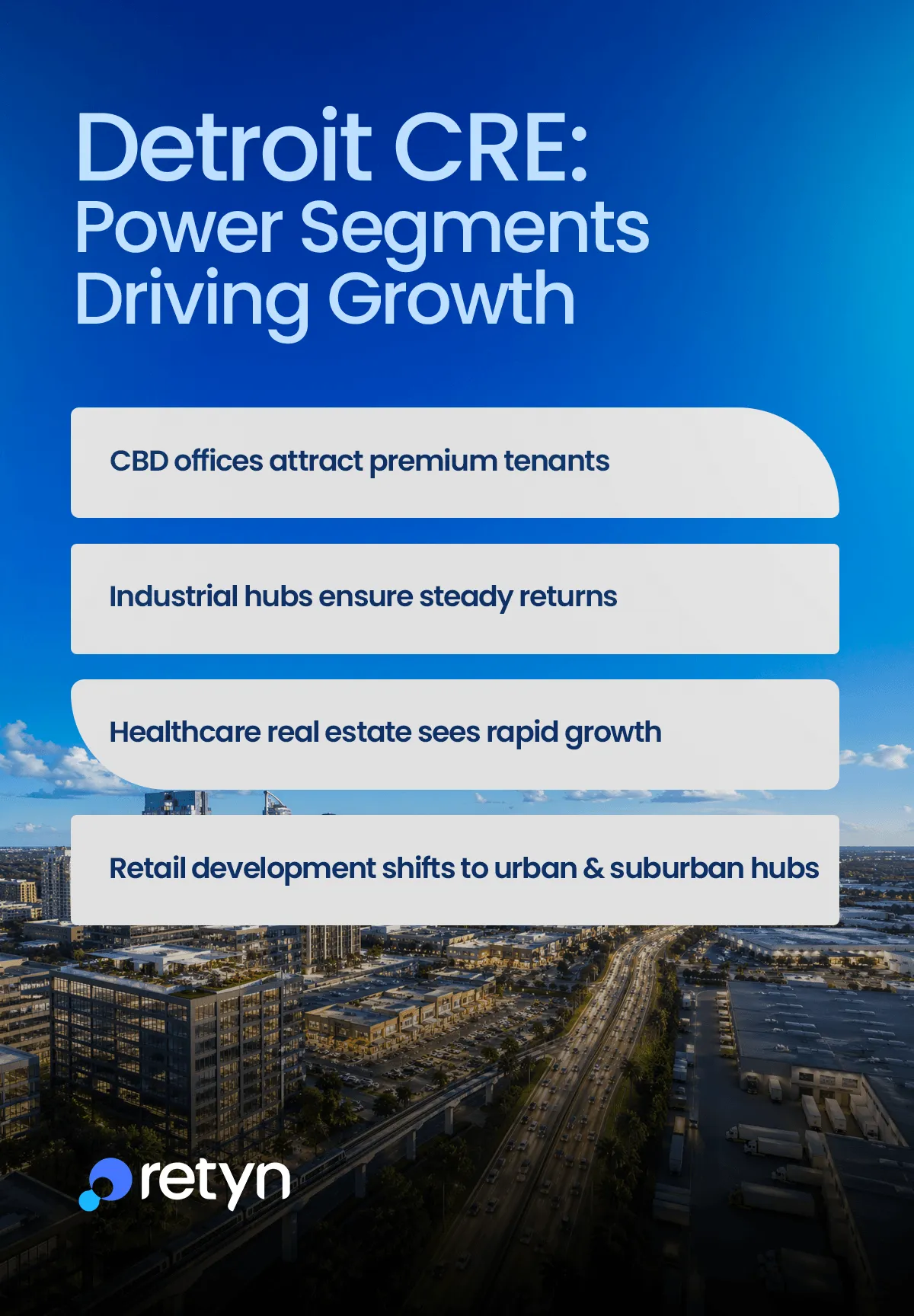
- Premium office spaces in the Central Business District are seeing a flight to excellence as major corporations seek modern amenities and walkable urban environments.
- Industrial and logistics properties near major transport corridors remain the most stable asset class, fueled by the region's manufacturing heritage and e-commerce demand.
- Medical office buildings and life-science facilities are expanding rapidly around the New Center area, supported by multi-billion dollar healthcare campus investments.
- Retail development is concentrating on flagship urban storefronts and service-oriented suburban centers in growing communities like Novi and Clarkston.
Institutional and private investors are targeting Detroit to capitalize on lower entry costs compared to coastal markets and high yield potential in emerging corridors. Smart investors are diversifying their portfolios by comparing Detroit's yield potential with global commercial real estate trends in high-growth international markets.
- Competitive price-per-square-foot metrics allow for higher capitalization rates on industrial and value-add office acquisitions compared to national averages.
- Michigan's stable regulatory environment and local development incentives help offset the initial costs of large-scale property rehabilitation and adaptive reuse.
- The frequent use of 1031 exchanges among regional investors facilitates portfolio growth by deferring capital gains during the transition from suburban to urban assets.
While the market is thriving, local firms must navigate specific operational hurdles unique to a city in the midst of a major structural shift.
- High vacancy rates in older office stock require creative leasing strategies and expertise in complex office-to-residential conversion projects.
- Managing massive square footage across fragmented suburban and urban portfolios puts a significant strain on manual reporting and property management systems.
- Intense competition for top-producing brokers leads to frequent shifts in firm leadership and the rise of specialized boutique agencies.
- Navigating Detroit's evolving zoning laws for adaptive reuse requires strict compliance and audit trails to ensure all regulatory requirements are met during property rehabilitation.
Detroit's commercial real estate sector is increasingly leveraging advanced PropTech to manage large-scale portfolios and attract global tenants to the Midwest. For those new to automation, our comprehensive real estate CRM guide provides a roadmap for digital transformation.
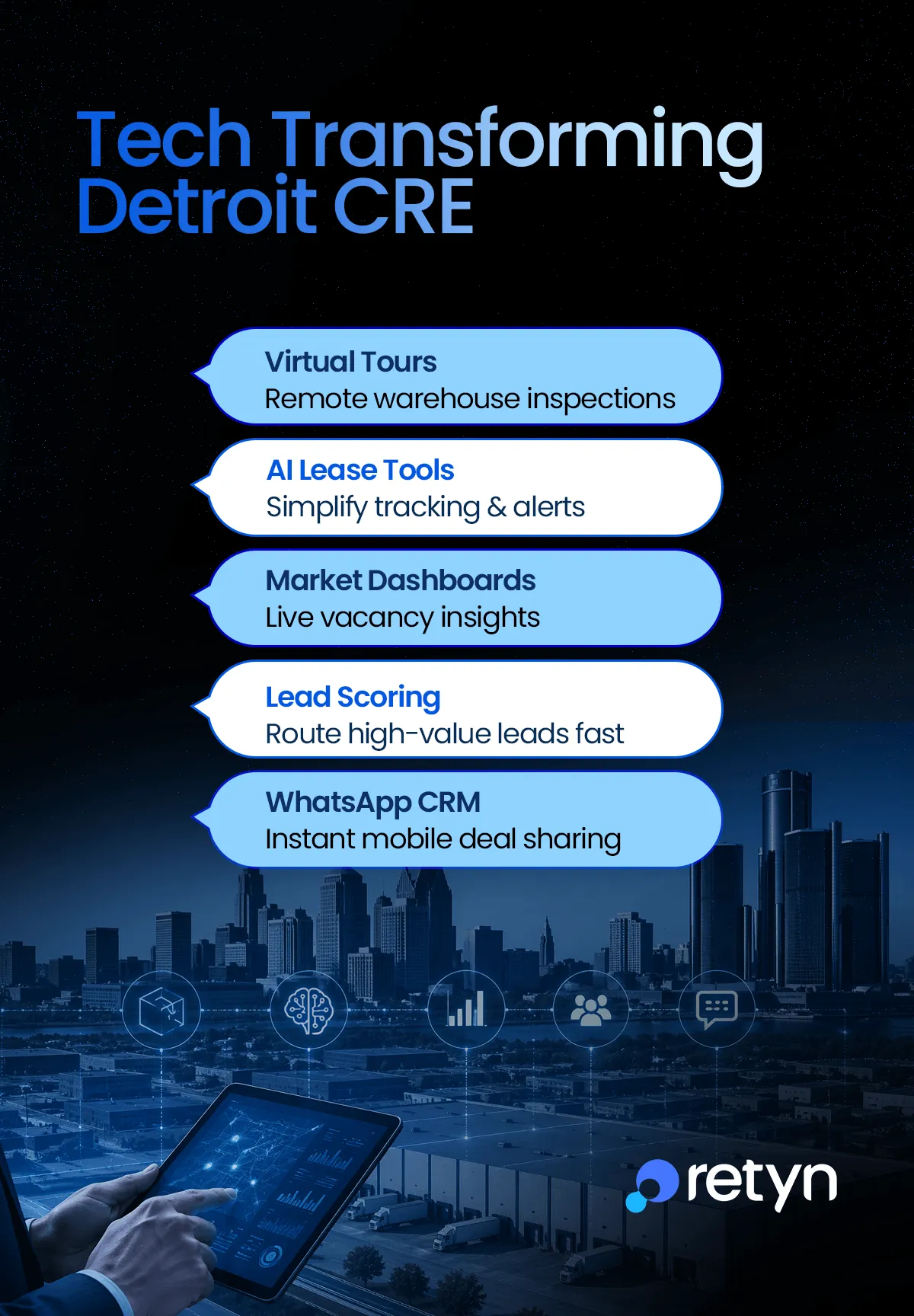
- Virtual 3D walkthroughs allow international investors to inspect massive industrial warehouses and office floor plates without traveling to Michigan.
- AI-powered lease abstraction tools help firms manage complex commercial contracts and track critical expiration dates across millions of square feet.
- Real-time market dashboards provide brokers with instant data on vacancy trends and absorption rates within specific sub-markets like Corktown or New Center.
- Automated lead-scoring systems ensure that high-value inquiries for Class A office spaces are instantly routed to the most qualified industrial or office specialist.
- Firms are accelerating lead response times by integrating a WhatsApp CRM for real estate, allowing brokers to share floor plans instantly with mobile-first prospects.
The Detroit commercial market is entering a sophisticated era where high-quality assets and data-driven strategies dictate success. As the city continues its urban revitalization, brokerages that move beyond manual processes will be best positioned to handle the influx of institutional capital. Adopting modern automation today ensures a competitive edge as the regional landscape shifts toward specialized medical and tech-focused real estate.
A real estate growth platform provides the essential infrastructure for personalizing the tenant experience, maintaining strict compliance, and maximizing portfolio ROI.
Empower your Detroit brokerage to manage complex commercial portfolios and accelerate closings with AI-powered CRM.
Get CRM now
FAQs on Detroit commercial real estate trends
In early 2026, the vacancy rate in Detroit’s Central Business District (CBD) was about 20.5%. Suburban office vacancy rates were slightly higher, ranging from roughly 23% to 24%. Newer Class-A office spaces have shown significantly greater absorption than older Class-B and Class-C office spaces.
Yes. Some office building owners are hoping to convert underused buildings into housing. Much of this discussion is centered on downtown Detroit and a few nearby suburban markets. With demand for housing in urban areas still strong, developers are looking for ways to deal with rising office vacancy rates.
Industrial property has remained stable, since the overall vacancy rate for that market generally stays in the 3.5% to 5% range. Many tenants are interested in renting smaller industrial buildings under 100,000 square feet. These properties can be used for a number of purposes, including light manufacturing, warehousing and last-mile delivery services.
The Future of Health Detroit project is a $3 billion mixed-use development in the New Center neighborhood of Detroit. The primary partners in this project include Henry Ford Health, Michigan State University and the Detroit Pistons. The project will add significant clinical and research space to the area and include new facilities for medical education and health sciences research.
A new proposal estimated at around $1.6 billion calls for partially demolishing and redeveloping the Renaissance Center once General Motors relocates its corporate offices. Mixed-use development would occur along the Detroit Riverwalk, including residences, retail space and public areas. The project is intended to create more activity and a wider mix of businesses in an area of the riverfront that was previously dominated by office space.
One reason the use of 1031 exchanges has increased among real estate investors in Detroit is that many investors are able to defer their capital gains tax liability through this strategy. A growing number of these investors have also used 1031 exchanges to upgrade their investment portfolios by moving into newer or better-performing commercial properties, such as industrial assets.
JLL is still one of the largest commercial property management companies operating in the Detroit market. Other large companies in the area include Ashley Capital, an industrial developer in Southeast Michigan with a large portfolio of logistics space, Bedrock, one of the larger property owners in downtown Detroit and Farbman Group, which manages more than 25 million square feet of commercial office and retail space.
Disclaimer: Retyn does not promote or endorse any company listed above. The firms featured are selected based on publicly available data and market performance metrics as of early 2026. Data is subject to change based on market volatility.