The current Denver commercial real estate market reflects a stronger flight to quality as institutional investors and corporate users adjust to changes in interest rates. By early 2026, the market is expected to move into the "surgical" phase of acquisitions. During this time, premium Class A office space and high-velocity industrial distribution centers are commanding the highest values. To succeed in this phase, one needs to partner with brokerages that possesses deep knowledge of its local area and the ability to execute complex capital markets transactions through the use of commercial real estate CRM software. Many investors and occupiers now rely on the top commercial real estate companies in Colorado to interpret these market shifts and guide acquisitions, leasing and portfolio decisions across Denver and the wider Front Range.
The demand for a professional leasing representation has never been more critical, especially for companies seeking space in creative districts like River North or established tech hubs such as the Denver Tech Centre. Traditional landlord-centric models have been replaced with modern market data and advocacy for buyers and lessees. This approach gives businesses the opportunity to make better decisions about their space needs while simultaneously navigating the complex issues associated with triple-net leases and local zoning issues. It also helps them respond to the growing number of office buildings being converted into residential properties in the Central Business District.
The influx of businesses entering the Rocky Mountain region, such as aerospace, life sciences and global logistics has created opportunities for 1031 exchange investors and private equity funds seeking a strong real estate investment platform. However, navigating the competitive bidding wars for stabilized multifamily portfolios or scarce industrial flex space requires more than just a listing service. Investors need access to data and expertise from the best real estate companies in the USA to compete effectively in today's marketplace. The review highlights key players in the Colorado real estate market who possess the expertise to maximize return on investment (ROI) in one of the nation's most resilient commercial sectors.
See how a dedicated CRM helps Denver commercial firms manage high-volume 1031 exchanges, automate tenant follow-ups, and track complex industrial zoning data.
Explore CRM

This table highlights eight powerhouse commercial real estate firms operating in the Denver metro area, categorized by their market impact and core specializations.
Connect with a Denver commercial property expert
Quick Chat
1
CBRE
Website: cbre.com
Headquarters: Dallas, TX (Denver Regional HQ)
Regional Leader: Katie Krueger – Senior Managing Director
Market Impact: Brokered approximately $2.75 billion in sales and 24 million square feet of leasing in the Denver area recently.
Core Services: Advisory and transaction services, capital markets, and valuation.
Recognitions: Consistently ranked as the top brokerage for both sales and leasing volume by the Denver Business Journal.
2
JLL (Jones Lang LaSalle)
Website: us.jll.com
Headquarters: Chicago, IL (Denver Tech Center Office)
Key Person: Dan McGowan – Brokerage Lead
Market Impact: Handled over 15 million square feet of transactions in a single year, with a focus on high-amenity office assets.
Core Services: Agency leasing, tenant representation, and investment management.
Recognitions: Awarded for excellence in research-driven market intelligence and capital markets expertise.
3
Cushman & Wakefield
Website: cushmanwakefield.com
Headquarters: Chicago, IL (Downtown Denver Office)
Key Person: Steve McKibben – Managing Principal
Market Impact: Manages nearly 27 million square feet of property across 140 locations in the Denver metro area.
Core Services: Land advisory, data center solutions, and multifamily trophy assets.
Recognitions: Frequently represented in the top 10 largest annual commercial deals in Colorado.
4
Newmark
Website: nmrk.com
Headquarters: New York, NY (Larimer St. Denver)
Key Person: Kevin Shannon – Co-Head of U.S. Capital Markets
Market Impact: Brokered over 5 million square feet of sales recently, specializing in multifamily capital markets.
Core Services: Global occupier services, industrial leasing, and debt/equity placement.
Recognitions: A leading player in Denver’s Class A office and high-density residential development sectors.
5
Colliers International
Website: colliers.com
Headquarters: Toronto, Canada (Ulster St. Denver)
Key Person: Brad Calbert – President, Denver
Market Impact: Managed 18.75 million square feet across 290 properties in 2025, with nearly $400 million in annual sales volume.
Core Services: Industrial and retail property management, project management, and valuation.
Recognitions: Global leader with one of the most significant footprints in Denver’s industrial corridors.
Denver’s commercial appeal is driven by its central geographic location, a highly educated workforce, and a diverse economic base that shields it from single-industry volatility. This resilience is a hallmark of the real estate companies that have expanded their footprint into the Mountain West. Understanding these shifts requires looking at broader regional trends, such as those seen in the top real estate companies in Colorado, which highlight the state's transition toward institutional-grade assets. By treating market data as a live context for investment, we can better identify the key structural factors supporting the market, including:
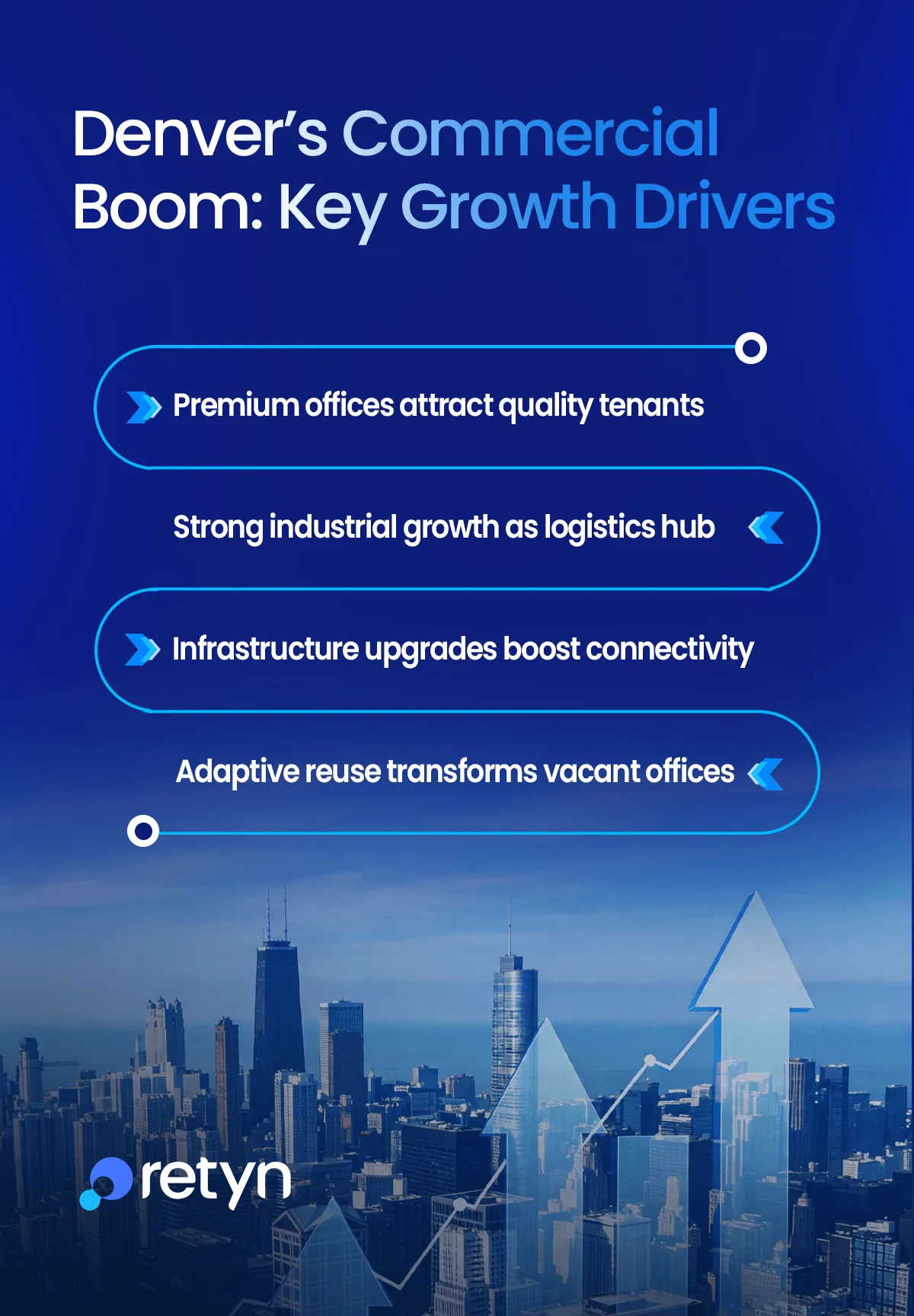
- A distinct flight to quality where tenants prioritize high-amenity Class A office spaces in walkable districts.
- Robust industrial fundamentals fueled by Denver's role as the logistics gateway to the Mountain West region.
- Major infrastructure investments in the Central 70 project and Denver International Airport expansions enhancing connectivity.
- Adaptive reuse initiatives targeting distressed Downtown office assets for residential or hospitality conversion.
Source: JLL Research, CBRE Market Reports, Denver Business Journal
Source: Cushman & Wakefield, CoStar, Newmark Research
Talk to a U.S. property expert
Quick Chat
Denver’s diverse asset classes offer distinct entry points for institutional and private equity investors looking to capitalize on the region’s long-term growth.
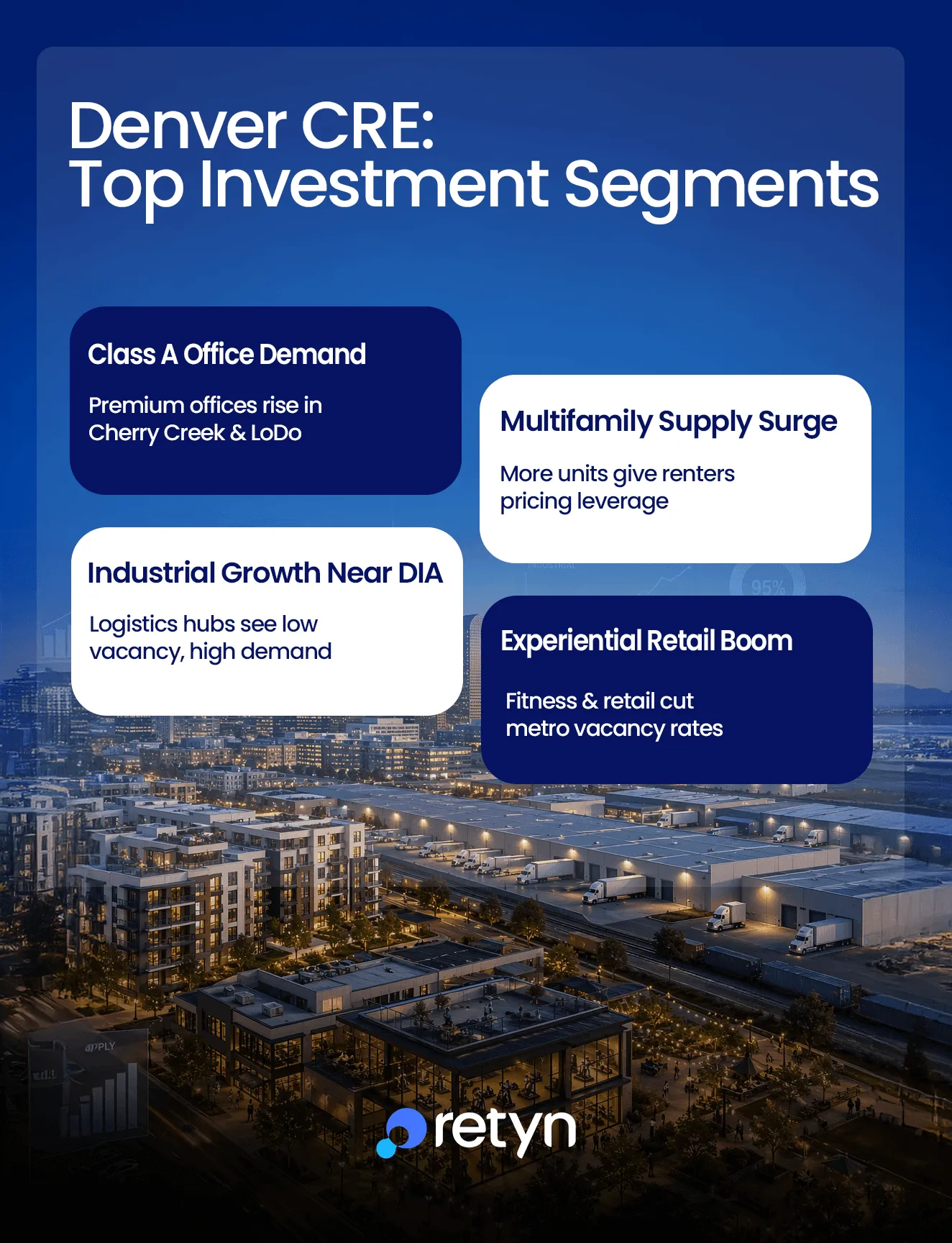
- Office tenants are increasingly consolidating into high-quality Class A spaces in Cherry Creek and LoDo, where premium amenities drive employee retention.
- Industrial and logistics properties near Denver International Airport remain the top-performing asset class due to low vacancy and sustained e-commerce demand.
- Multifamily developments are seeing a peak in supply, leading to increased renter leverage and temporary rent concessions in luxury high-rise segments.
- Experiential retail and boutique fitness studios are driving record-low vacancy rates in neighborhood shopping centers across the metro area.
Sophisticated investors are targeting Denver for its favorable yield spreads and a business climate that supports large-scale capital placement.
- Favorable corporate tax environments compared to coastal markets help attract major headquarters and regional operations.
- Active 1031 exchange markets allow private investors to transition capital from residential portfolios into stabilized commercial assets.
- Competitive cap rates in secondary submarkets offer higher yield potential than overpriced core markets in the Northeast or California.
High-interest rate environments and shifting workplace trends have introduced new complexities for local brokerage teams.
- Widening bid-ask spreads make price discovery difficult, often extending the due diligence and negotiation phases of a deal.
- Manual tracking of large-scale lease expirations and stacking plans often leads to missed opportunities in fast-moving submarkets.
- Managing complex environmental disclosures and zoning changes requires a higher degree of administrative precision than in years past.
- Competition for top-producing brokers is intensifying as boutique firms offer aggressive split structures to attract elite talent.
Denver brokerages are increasingly adopting PropTech to streamline asset management and provide real-time transparency to institutional partners.
- Advanced 3D spatial mapping allows out-of-state tech firms to tour prospective headquarters without site visits.
- Predictive analytics tools help brokers identify distressed assets or underperforming portfolios before they hit the open market.
- Automated contract-to-close platforms reduce the friction of high-volume transactions, ensuring faster commission cycles and client satisfaction.
- AI-powered CRM systems enable precise lead scoring for institutional investors based on their specific acquisition criteria.
The Denver commercial real estate market is entering a sophisticated new era where data-driven decision-making and operational agility are non-negotiable. Brokerage teams that proactively adopt modern tools will be best positioned to navigate the complexities of office-to-residential conversions and industrial supply cycles. As the Mile High City continues to attract global capital, success will belong to those who can provide institutional-grade transparency and lightning-fast execution.
A real estate growth platform offers the essential infrastructure for modern firms, from enhancing investor reporting to automating the high-volume contract-to-close workflows unique to commercial transactions.
Empower your Denver commercial brokerage to manage complex pipelines and institutional portfolios with AI-powered CRM.
Get CRM now
FAQs on Denver commercial real estate and brokerage
Vacancy levels are being driven primarily by a flight to quality. Older Class B and C buildings have been experiencing elevated vacancy levels. While newer Class A developments in areas such as Cherry Creek and LoDo continue to experience higher occupancy rates as tenants prefer premium amenities and a stronger work environment for their employees.
Yes. The Downtown Development Authority and local government agencies have established specific loans and zoning incentives to encourage adaptive reuse. Typically, success will depend on the building's floor plate depth and its proximity to transit hubs.
Both the I-70 East corridor and the general vicinity around Denver International Airport continue to be very busy with big-box distribution users. The Northwest corridor adjacent to Highway 36 has become a popular location for flex-industrial and biotech and medical-related users.
1031 exchanges continue to be a major force in driving new investments. Many private investors are consistently shifting their investment dollars out of high-maintenance rental homes to other types of more stable, lower-maintenance properties such as industrial buildings or triple-net leased retail properties so they can earn more passive income.
Cap rates tend to be higher in secondary markets such as Aurora and Lakewood, which provide lower-priced entry points per unit compared with central Denver submarkets.
For standard office or retail space, it can take several months from the initial property tour to lease execution, depending on negotiations and tenant improvements. More complex industrial land acquisitions and built-to-suit projects can take much longer because design approvals, permitting and construction planning take time.
Generally speaking, Denver’s retail market has been very tight. The retail vacancy rate in Denver has remained at or below the national average for several years. Low levels of new retail space construction combined with a high level of tenant demand in Denver have kept retail availability low compared with many other major metropolitan areas throughout the United States.
Disclaimer: Retyn does not promote or endorse any company listed above. The companies listed above are selected based on publicly available data and recent market performance as of early 2026. Data is compiled from publicly available market sources and may change without notice.