
Top commercial real estate brokers in Boston (2026 list)

A strategic guide to the leading full-service firms, tenant representatives, and investment sales specialists driving the Hub’s innovation economy.

Smrithi U

Smrithi U

56 posts

Real Estate Market Analyst

Top commercial real estate brokers in boston

The commercial real estate market in Boston in 2026 attracts strong institutional investments. Understanding this market requires close attention to changing net absorption levels and the widening yield gap between Class A properties and older office buildings. Some of the firms that provide this service are among the top 100 real estate companies in the USA. They use sophisticated market data to help their clients reduce risk when making long-term investments.

The local economy is continuing to be positively influenced by a flight to quality as corporate tenants seek amenity-rich environments in the Seaport and Kendall Square to attract top talent. In response to this high demand for quality space, traditional leasing methods have shifted toward the need for real estate advisors who understand how to maximize complex Tenant Improvement Allowances (TIAs) and sustainable building certifications. Regardless of whether you are using a 1031 exchange to reposition from office space to industrial space or finding that prime retail flagship location in the Back Bay, your returns will depend on how well you understand the market.

Many Boston brokerage firms are beginning to take a consulting approach by using their own research on topics such as shadow vacancy and early signs of emerging submarkets. The firms use both local market knowledge and global service platforms to handle large, complex transactions across multiple asset classes, including medical office space and urban mixed-use developments. This guide looks at the leading brokerage firms shaping the skyline of Boston and how they help clients navigate one of the country’s most competitive commercial real estate markets.

See how a dedicated CRM helps Boston brokerages manage complex lab-space disclosures, automate tenant follow-ups, and stay compliant with Massachusetts commercial regulations.

Explore CRM right

List of the top commercial real estate brokerages in Boston, MA

The following table outlines eight premier firms driving Boston's commercial sector, ranging from global powerhouses managing institutional portfolios to specialized boutiques focusing on exclusive tenant representation.

# Company Name Website Specialty Boston Office Address Key Services
1 CBRE New England cbre.com Full-Service Global 33 Arch Street, Boston, MA Leasing, Capital Markets, Valuation
2 Hughes Marino hughesmarino.com Tenant Representation 101 Arch Street, Boston, MA Lease Audit, Project Management
3 Boston Realty Advisors bradvisors.com Local Boutique 745 Boylston Street, Boston, MA Middle-Market Sales, Consulting
4 JLL Boston us.jll.com Life Sciences & Tech One Post Office Square, Boston, MA Lab Space, Occupier Services
5 Newmark nmrk.com Investment Sales 225 Franklin Street, Boston, MA Debt & Equity, Industrial Leasing
6 Cushman & Wakefield cushmanwakefield.com Global Advisory 125 High Street, Boston, MA Asset Services, Facility Mgmt.
7 MANSARD mansardcre.com Commercial Sales 14 Essex Street, Andover, MA 01810 Seller Rep, Strategic Advisory
8 R.W. Holmes rwholmes.com Suburban Specialist 321 Commonwealth Road, Wayland, MA I-95/Route 128 Advisory

Talk to a Boston Commercial Property Expert

Quick Chat right

An overview of the top 5 Boston commercial brokerages

1

CBRE New England

Website: cbre.com

Headquarters: Boston, MA (Regional)

Key Leadership: Michael Caffrey – President, New England Advisory

Core Services: Institutional sales, global occupier services, capital markets

Market Edge: Consistently ranked as the top firm in Massachusetts by transaction volume, handling over 11 million square feet of sales and leasing annually.

2

Hughes Marino

Website: hughesmarino.com

Headquarters: Boston, MA (Financial District)

Key Leadership: Jason Hughes – CEO

Core Services: Exclusive tenant representation, audit services, project management

Market Edge: A specialist firm that never represents landlords, eliminating conflicts of interest for corporate tenants seeking unbiased lease negotiations and build-out oversight.

3

Boston Realty Advisors (BRA)

Website: bradvisors.com

Headquarters: Boston, MA (Back Bay)

Key Leadership: Jason S. Weissman – Founder & Senior Partner

Core Services: Middle-market investment sales, retail leasing, debt placement

Market Edge: The largest independent boutique in Boston, known for high-touch advisory and a 360-degree view of local urban and suburban commercial assets.

4

JLL Boston

Website: us.jll.com

Headquarters: Boston, MA (Post Office Square)

Key Leadership: Jim Tierney – Head of New England Region

Core Services: Life sciences lab space, technology sector leasing, sustainability consulting

Market Edge: Dominates the Kendall Square and Seaport innovation clusters, offering proprietary data-driven insights for the world’s leading biotech and tech firms.

5

Newmark

Website: nmrk.com

Headquarters: Boston, MA (Financial District)

Key Leadership: Robert Griffin – US Head of Capital Markets

Core Services: Global capital markets, industrial logistics, debt and equity

Market Edge: Renowned for its capital markets team, Newmark frequently leads the largest office and industrial investment sales across the Northeast corridor.

Boston’s evolution as a global commercial hub

Boston’s commercial resilience is anchored by its concentration of elite academic institutions and a venture capital ecosystem that consistently ranks among the top three globally. As tenants prioritize LEED-certified Class A assets in the Seaport, brokers are increasingly using a real estate ESG green building compliance checklist to verify sustainability metrics during site selection. Current market drivers include:

  • A Flight to Quality trend where tenants are migrating to amenity-rich, LEED-certified Class A assets in the Seaport.

  • Stabilization of the life sciences sector as speculative construction slows and absorption rates for prime lab space improve.

  • Increased legislative support for office-to-residential conversions in the Financial District to optimize underutilized Class B stock.

  • Infrastructure investments in the Port of Boston and Logan Airport fueling demand for last-mile industrial logistics.

Boston commercial market metrics 2026

Metric Value (Avg) Market Period
Average Office Rent (PSF) $69.40 PSF Q1 2026
Class A Office Vacancy 15.2% Q1 2026
Life Sciences Vacancy (East Cambridge) 20.1% Q1 2026
Average Industrial Rent (PSF) $14.50 Q1 2026
Investment Sales Volume (Metro) $2.4B Trailing 6 Months
Tenant Improvement (TI) Allowance (Class A) $110 - $140 PSF Q1 2026

Source: CBRE Research, JLL Market Reports, Newmark Capital Markets

Primary commercial sub-markets

Sub-market Primary Asset Focus
Kendall Square Life Sciences & Deep Tech
Seaport District Class A Office & Global HQ
Back Bay Luxury Retail & Financial Services
Financial District Professional Services & Mixed-Use
Route 128 / I-95 South Flex Industrial & R&D
Inner Suburbs (Somerville/Allston) Creative Office & Tough-Tech

Consult with a Boston Commercial Advisor

Quick Chat right

Key commercial real estate segments

Strategic opportunities in Boston are increasingly segmented by specialized technical requirements. Class-A multifamily and industrial assets along the I-495 corridor are seeing sustained interest from e-commerce operators. Managing these complex portfolios effectively requires robust property management software to ensure stable occupancy and maximize asset yield.

boston cre segments powering strategic growth

  • Laboratory and Life Sciences remain the regional flagship, with high-intensity damp and wet lab requirements concentrated in Cambridge and the Seaport.

  • Modern Industrial and Logistics assets along the I-495 corridor are seeing sustained interest from e-commerce and cold-storage operators.

  • High-street retail in the Back Bay continues to command premium rents, driven by international luxury brands seeking flagship visibility.

Investor and occupier advantages in Boston

Institutional and private investors leverage Boston’s unique economic density to secure long-term capital appreciation. Key advantages include:

  • Utilization of 1031 tax-deferred exchanges to transition from underperforming retail into high-growth industrial or life science assets.

  • Favorable Tenant Improvement allowances in Class B office buildings, allowing companies to customize high-spec collaborative spaces at a lower entry cost.

  • Stable yield profiles driven by credit-tenant leases from global pharmaceutical and technology giants.

Challenges for Boston commercial firms

The complexity of Boston’s regulatory environment creates specific operational hurdles for brokerage teams:

  • Extended permitting timelines with the BPDA (Boston Planning & Development Agency) can delay specialized lab build-outs.

  • Inventory oversupply in certain life science sub-markets requires highly aggressive concession strategies to maintain occupancy.

  • High capital expenditure requirements for converting legacy office floorplates into modern medical or lab-ready facilities.

PropTech and the future of Boston CRE

Leading Boston brokerages are adopting advanced analytics to de-risk investments and streamline site selection:

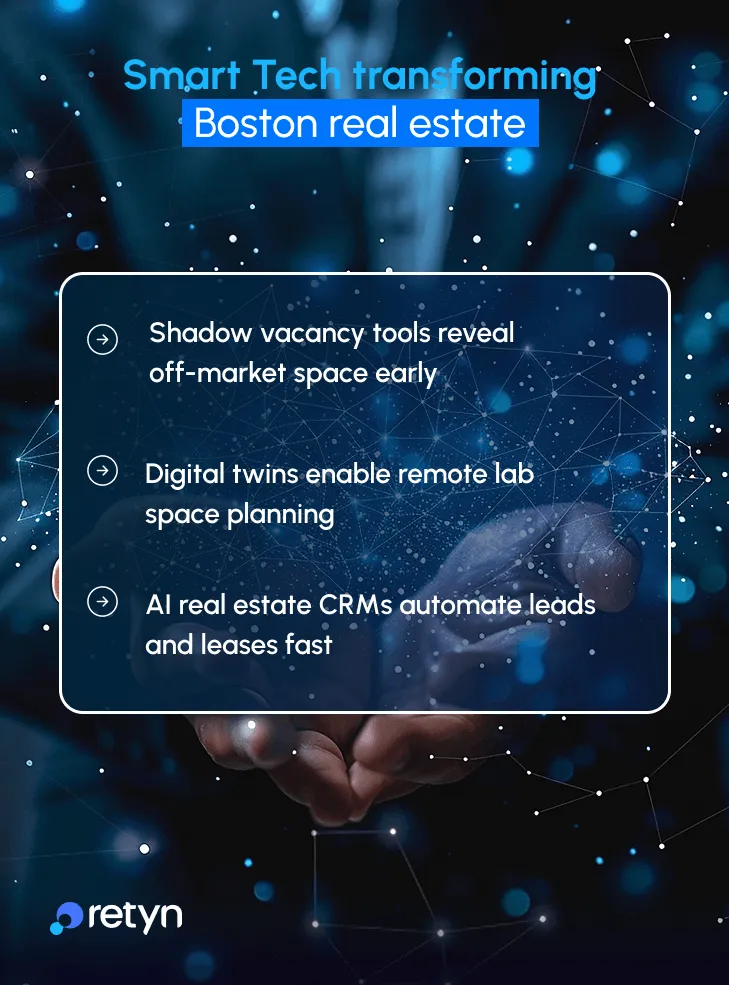
smart tech transforming boston real estate

  • Shadow Vacancy reporting tools that identify unlisted space coming to market before official public notification.

  • Digital Twin modeling for lab spaces, allowing international biotech firms to plan mechanical and plumbing requirements remotely.

  • AI-driven real estate CRM platforms that automate lead scoring for capital market transactions and manage complex lease expirations.

Strategic positioning for 2026

Success in Boston’s 2026 commercial market requires a pivot from transactional brokerage to technical advisory. Firms that integrate automated client management with hyper-local data will outperform in an environment where speed and regulatory expertise are the primary differentiators.

A real estate growth platform enables brokerages to personalize the institutional client experience while maximizing ROI through automated compliance and workflow efficiency.

Empower your Boston brokerage to secure institutional closings with AI-powered CRM and advanced deal tracking.

Get CRM now right

FAQs on Boston commercial real estate and brokerages

Typically, the landlord is responsible for paying the commissions when leasing their property in Boston. As long as you use a broker to assist with your search for issues such as escalation clause negotiation, HVAC responsibilities and load factors, you will not pay any direct commission cost.

Full-service firms represent both landlords and tenants and because of this they have access to extensive market data. At the same time, this can create conflicts of interest for the tenant. A pure tenant representative does not represent landlords at all and therefore ensures that the client has 100% fiduciary loyalty during lease negotiations.

On average, a tenant improvement allowance in the Boston area is about $90-$100 per sq. ft. for Class A office space. It will also depend on the type of building, such as life science buildings, which often have complex MEP (Mechanical, Electrical and Plumbing) requirements.

The BPDA permitting process for specialized commercial use can typically take several months. Working with a brokerage firm that has an experienced project manager to assist with the technical review and community hearing process can make the permitting process more efficient.

A "shadow vacancy" is an empty space that has been rented out but is not fully occupied or has plans to be subleased to another tenant. Because of this, much of this vacant space is not reported publicly. As a result, in highly competitive markets such as Kendall Square, commercial brokers use their company's proprietary research and other tools to identify vacancies before the property comes onto the open market.

Tech startups looking for the middle ground between high-quality amenities and low operating costs are being attracted to inner-suburban areas such as Somerville and Class B office redevelopment sites in downtown Boston. Both of these options have rent prices that typically fall within a 20 to 30 percent range lower than more expensive areas like the Seaport District and the Back Bay.

Yes. The City of Boston's incentive program is helping create an opportunity for property owners to convert underutilized Class B and Class C office space into residential units. These converted units are often less expensive than building new residential units. Removing them from the active office inventory will help support efforts to revitalize the downtown area.

Share this Blog

Disclaimer: Retyn does not promote or endorse any company listed above. The firms are selected based on publicly available market performance and transaction data as of early 2026. Data is subject to change based on market volatility.

Dive into our curated selection of insightful blogs and expert strategies tailored for your growth journey.

17 min read

27 May 2025

Real Estate

Dharnesh V

11 min read

10 Jun 2025

Real Estate

Sindhuja G

11 min read

12 Jun 2025

Real Estate

Sindhuja G

whatsapp icon
1

Chat with us

whatsapp icon
1

Chat with us