Arizona's commercial real estate market is growing quickly due to recent semiconductor development as well as increased demand for logistics space. Cities such as Phoenix and other markets, including Tucson are seeing more investor interest, especially from investors looking for stronger returns. With an influx of new capital entering the Arizona market, resulting in increased competition, many real estate brokerage firms in Arizona have adopted strategies similar to the best real estate companies in the USA. Below is a list of active brokerages along with a quick market overview for investors and tenants.
Top commercial real estate brokers in Arizona are experiencing a high volume of investment sales and tenant representation deals. From larger transactions such as the $865 million JW Marriott Desert Ridge sale to the 460 million square feet of industrial space in Phoenix, there has been a slow but steady trail of activity across the market. These brokers rely on global networks for many things, but local knowledge of zoning and water rights still makes a difference in their work.
We analyzed recent performance data to determine which companies have been performing well within Arizona's leasing and sales market. These firms use advanced proprietary technology along with their knowledge of how to use capital markets to facilitate transactions and are able to perform successfully in a relatively stable Arizona market.
See how a dedicated CRM helps Arizona brokerages automate industrial lead-scoring, manage complex land disclosures, and stay compliant with ADRE regulations.
Explore CRM

This table features eight of the most active commercial real estate firms in Arizona, ranked by their recent transaction volume in leasing and investment sales across the Phoenix and Tucson markets.
Talk to an Arizona property expert
Quick Chat
1
JLL (Jones Lang LaSalle)
Website: us.jll.com
Regional HQ: Phoenix, AZ
Market Presence: 118+ licensed agents
Key Person: Pat Williams – Senior Managing Director
Core Services: Institutional investment sales, office leasing, supply chain logistics
2024 Performance: Facilitated over 30.8 million sq. ft. in leases and 30.5 million sq. ft. in sales
2
CBRE
Website: cbre.com
Regional HQ: Phoenix, AZ
Market Presence: 177+ licensed professionals
Key Person: Vanessa Williams – Executive Managing Director
Core Services: Industrial park development, retail advisory, capital markets
Recent Achievement: Ranked as the top brokerage by agent count for four consecutive years
3
Colliers
Website: colliers.com
Regional HQ: Phoenix, AZ
Established Year: 1976 (Local presence)
Key Person: Bryce Terveen – Executive Managing Director & Brokerage Market Leader
Core Services: Investment sales, global occupier services, and landlord representation
Market Insight: Industrial, Tech-sector Office, and Data Centers
4
Cushman & Wakefield
Website: cushmanwakefield.com
Regional HQ: Phoenix, AZ
Market Presence: 139+ licensed brokers
Key Person: Bryon Carney – Managing Principal
Core Services: Class A office leasing, global occupier services, valuation
2024 Performance: Closed 19.9 million sq. ft. in total sales volume
5
Commercial Properties Inc. (CPI)
Website: cpiaz.com
Headquarters: Tempe, AZ
Company Profile: Largest locally owned and operated brokerage in Arizona
Key Person: Leroy Breinholt – President & Designated Broker
Core Services: Industrial leasing, property management, project coordination
Market Specialty: Dominant player in the Phoenix Metro industrial and flex space niche
The expansion of the semiconductor industry and a strategic position in the Southwest supply chain have solidified Arizona as a critical node for global commerce. Key drivers for the 2026 market include:
- Massive industrial development in the North Valley and West Valley driven by the TSMC semiconductor ecosystem.
- Steady corporate migration from high-tax coastal states seeking Class A office space in Tempe and Scottsdale.
- Proximity to California ports and high-speed transit via I-10 and I-17 fuels demand for large-scale logistics hubs.
- Significant investment in energy-efficient infrastructure attracting sustainability-focused institutional investors.
Source: JLL Research, Phoenix Business Journal, CoStar
Source: CBRE Local Market Reports, AZ Big Media
Connect with a specialized Arizona commercial advisor
Quick Chat
Arizona's diverse economy provides specialized opportunities across several high-performing asset classes. Understanding these segments is essential for aligning your portfolio with the state's 2026 growth trajectory.
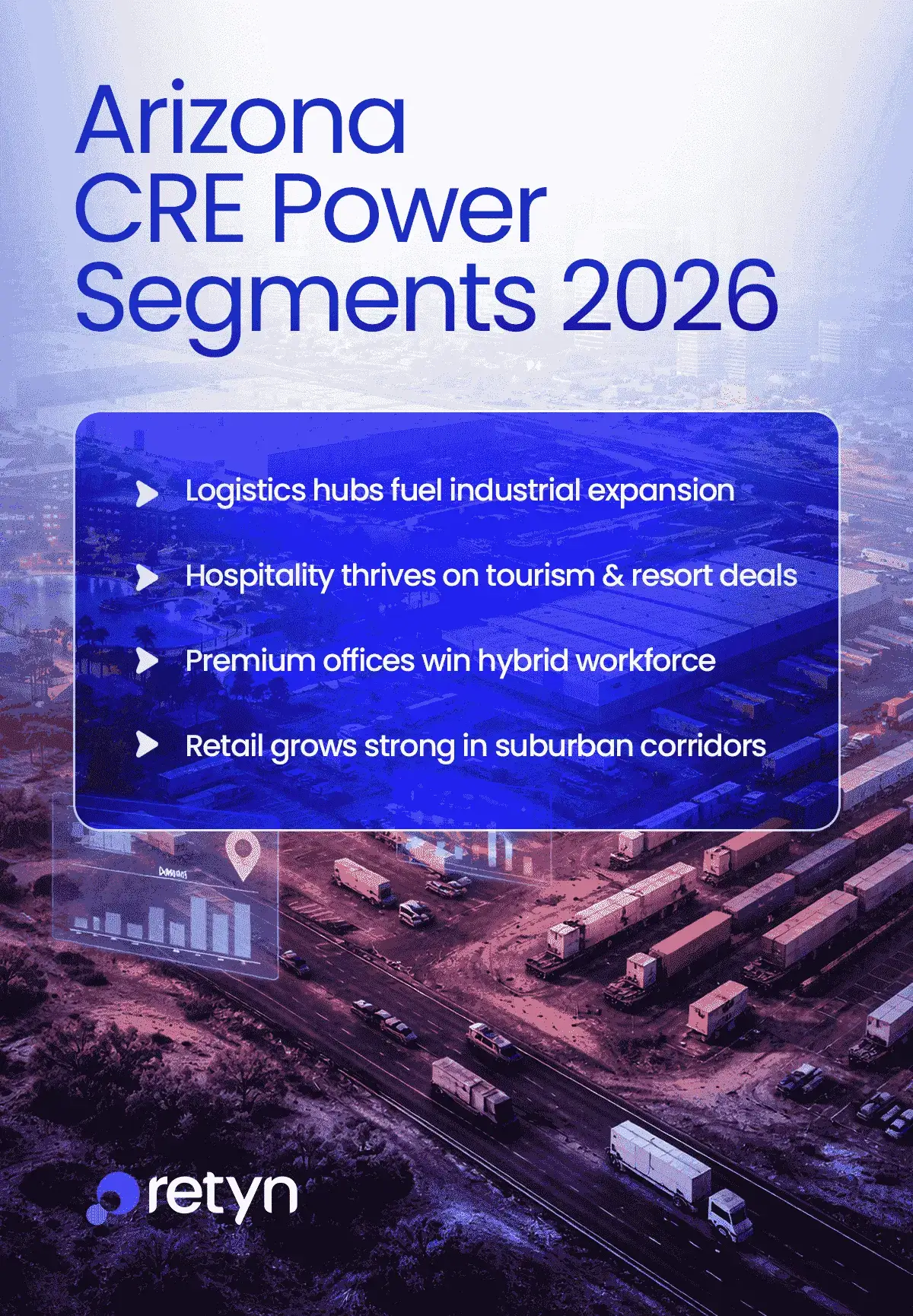
- Industrial and Logistics remains the primary growth engine, with massive demand for warehouse space fueled by semiconductor manufacturing and regional distribution hubs.
- Hospitality assets continue to attract institutional capital, evidenced by record-breaking resort sales and high tourism-driven occupancy rates in Scottsdale and Phoenix.
- The Office sector is undergoing a flight to quality, where premium Class A spaces in Tempe command significant rental premiums as businesses adapt to hybrid work models.
- Retail resilience is driven by low vacancy rates and strong demand from value-oriented retailers in high-growth suburban corridors.
Strategic investors leverage Arizona's business-friendly environment and logistical advantages to maximize returns on commercial acquisitions. Arizona’s lack of a state transfer tax attracts massive institutional deals, such as the 865 million sale of the JW Marriott Desert Ridge. Leading brokerages manage these high-stakes relationships through a dedicated real estate sales management platform to ensure out-of-state capital remains engaged throughout the cycle.
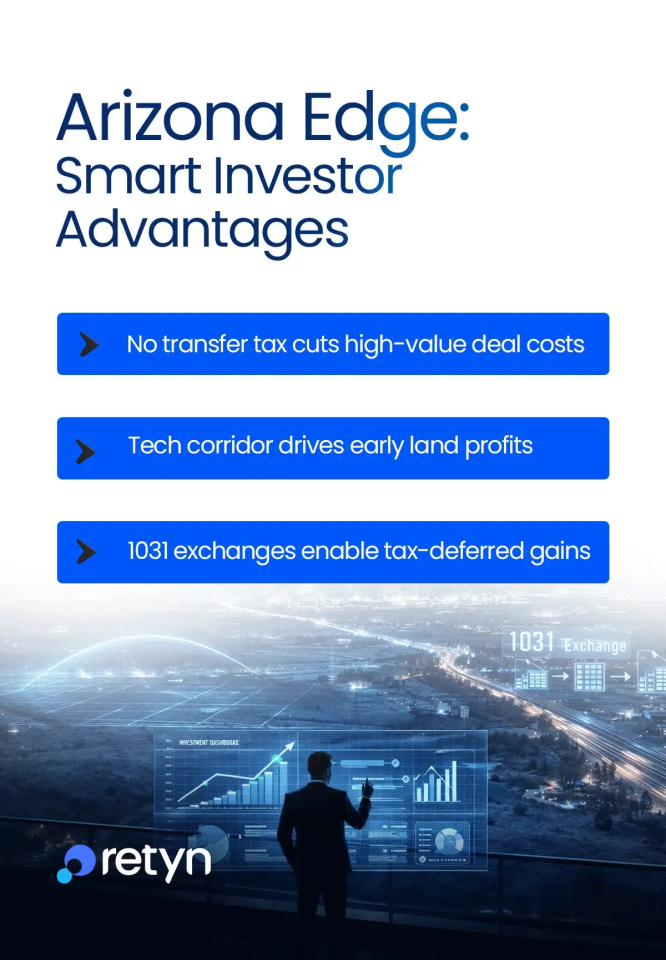
- Arizona does not impose a state-level real estate transfer tax, which significantly reduces the closing costs for high-volume institutional transactions.
- The rapid expansion of the North Valley tech corridor provides early-entry opportunities for land acquisition and speculative industrial development.
- 1031 Exchange activity remains robust in the state, allowing investors to defer capital gains while transitioning into higher-yield Arizona commercial assets.
Rapid market expansion and evolving environmental regulations present unique operational hurdles for firms operating in the Southwest. Managing complex co-brokerage fees and agent splits in a 9 billion dollar market often leads to administrative friction. Top Arizona firms are migrating to an automated commission management platform to eliminate errors and improve team retention. Additionally, streamlining the due diligence cycle is easier with a real estate transaction management template that tracks Arizona-specific water and land disclosures.
- Navigating complex water rights and certificates of assured water supply in outlying counties can delay land development and closing timelines.
- Limited availability of shovel-ready industrial land in prime submarkets has led to increased competition and upward pressure on acquisition prices.
- The shift toward energy-efficient infrastructure requires specialized brokerage expertise to navigate new green building standards and compliance audits.
- Fluctuating interest rates and construction costs demand more sophisticated financial modeling and risk assessment from top-producing brokers.
Top-tier Arizona brokerages are increasingly deploying PropTech to streamline the acquisition of high-value industrial and office assets for out-of-state investors. Increasingly, Arizona real estate companies are utilizing PropTech to automate the process of buying or selling institutional assets. AI-based real estate CRM platforms now automate lead-scoring and agent-routing for high-velocity investment sales. By leveraging digital marketing and real-time data dashboards, these firms provide a competitive edge for out-of-town investors looking to capitalize on the Southwest’s industrial boom.
Firms like JLL and CBRE lead the market by providing full-service advisory, but many smaller boutiques are closing the gap by adopting a specialized real estate CRM for brokers to manage their internal productivity. These platforms allow local principals to compete with global giants by offering more personalized, data-driven service.
- AI-driven site selection tools allow firms to forecast cap rate compression and identify emerging industrial zones before they hit the open market.
- High-definition 3D virtual tours enable institutional buyers to conduct due diligence on massive West Valley logistics centers from anywhere in the world.
- Automated transaction platforms with built-in Arizona land disclosure addenda ensure faster, error-free closings for complex commercial deals.
- Cloud-based CRM systems automate lead-scoring for high-velocity investment sales, allowing brokers to focus on relationship management and negotiation.
The Arizona commercial market remains one of the most resilient in the country, but success in 2026 requires more than just local knowledge. Firms that combine deep submarket expertise with modern automation will be best positioned to capture the ongoing industrial and hospitality boom. By adopting advanced CRM and data analytics tools today, brokerages can ensure they remain competitive as the Southwest economy continues to scale.
A real estate growth platform provides the infrastructure needed to manage complex portfolios, enhance regulatory compliance, and maximize investor returns in a fast-moving market.
Empower your Arizona brokerage to manage high-volume industrial transactions and automate follow-ups with AI-powered CRM.
Get CRM now
FAQs on navigating Arizona's commercial real estate market
In 2026, developers must obtain a Certificate of Assured Water Supply for all new large-scale developments in Active Management Areas like Phoenix and Pinal County. Developers must prove that they can provide at least a 100-year assured water supply. This is usually accomplished by either purchasing long-term storage credits or making investments in private water utilities to secure project approval.
Currently, Class A office space (high-end) in submarkets such as the Scottsdale Air Park and Tempe Town Lake has higher rents than Class B. The reason for this flight to quality is that corporate users want new, sustainable and efficient buildings that support hybrid work and help attract top talent, along with better access to technology.
- The West Valley area (Buckeye/Goodyear) is an ideal location for large logistics and distribution projects
- North Phoenix for high-yield flex space that supports the TSMC semiconductor ecosystem.
- Tucson Airport District for aerospace manufacturing and R&D facilities.
Arizona has no state-level real estate transfer tax. This may be beneficial to institutional investors involved in high-value commercial transactions by lowering their transaction cost, as well as during the transition of larger portfolios.
In terms of large transactions, it is good practice to seek brokers who have the SIOR (Society of Industrial and Office Realtors) designation or the CCIM (Certified Commercial Investment Member) designation. These certifications will help indicate that the broker has a solid understanding of financial analysis, investment strategy and experience handling large transaction volumes.
The increased demand from the TSMC plant has caused an increase in property prices in North Phoenix. Due to the large-scale expansion of TSMC with its high level of investment and employment, there will be additional interest in suppliers and related industries and that will create opportunities for new industrial and flexible-use developments in surrounding areas.
The due diligence period typically takes anywhere from 30 to 60 days. During this time, you will have opportunities to inspect the property, complete an environmental assessment (Phase I Environmental Site Assessment) and review the title, zoning and boundaries.
Disclaimer: Retyn does not promote or endorse any company listed above. The firms featured are selected based on publicly available transaction data and market performance as of early 2026. Data is compiled from multiple sources and is subject to change.