10 best real estate smart contract development companies in Dubai for trust and transparency (2026)
10 best real estate smart contract development companies in Dubai for trust and transparency (2026)
A verified 2026 ranking of the smart contract development companies building programmable trust and on-chain transparency into Dubai property transactions — evaluated across tokenization depth, VARA and DLD compliance architecture.
Smrithi U
60 posts
Real Estate Technology Analyst
The Dubai property market is experiencing one of the biggest transformations in decades and one of the most important technologies behind it is smart contract technology. In 2026, property developers, institutional investors and government-backed organizations are using blockchain-based smart contracts to automate property transfers, distribute rental income, meet compliance needs and minimize paperwork that used to complicate property transactions. It is no longer a new trend, as the Dubai Land Department, VARA and the UAE Central Bank have already rolled out live infrastructure, creating demand for experienced smart contract development partners.
In the case of a real estate smart contract project, the success of the venture depends largely on choosing the right development partner. The process of developing such projects in Dubai has to be done in compliance with VARA licensing requirements, DLD blockchain registry integration and UAE Central Bank regulations. To do this, a team of developers with experience in blockchain technology and regulatory frameworks will be required. It is possible for a smart contract to distribute rental income properly yet fail a VARA audit. Equally, a smart contract that is used to transfer ownership but yet does not sync with the DLD registry can create legal and financial risks. Building such smart contracts in the UAE would require particular technical skills and an understanding of the regulations.
Herein, an analysis of the best 10 real estate smart contract development firms operating in Dubai in 2026 is discussed. The selected firms are analyzed considering the criteria of technological capability, regulatory conformity, live deployment experience, and the trust that they build in real estate transactions. Retyn leads this list as one of the most reliable real estate smart contract development companies in the UAE. The rest nine firms have some special strengths such as institutional tokenization, DLD incorporation, VARA compatibility and fractional ownership.
See how Retyn delivers production-ready real estate smart contracts for Dubai developers, investors, and tokenization platforms — built for VARA compliance and DLD registry integration.
Which Dubai real estate smart contract company fits your project?
Select up to 3 use cases that reflect your Dubai real estate project's priorities and the tool will identify which of the 10 companies from this list are strongest for exactly those requirements — based on verified live deployments, regulatory compliance track records, and independently documented smart contract capabilities specific to the UAE property market.
Smart Contract Use Case Matcher
Select up to 3 priorities — matched to the strongest Dubai companies for each
What does your Dubai real estate project need smart contracts to do?
0 of 3 selected
Title deed tokenization & DLD integration
Place property title deeds on-chain with real-time synchronisation to the Dubai Land Department registry — every on-chain ownership record legally recognised and tamper-proof
Fractional ownership & investor token issuance
Issue security tokens representing fractional shares in Dubai properties — enabling multiple investors to co-own high-value assets from AED 500 with on-chain ownership records
Automated rental income distribution
Smart contracts that calculate each token holder's pro-rata rental yield and distribute payments automatically — eliminating manual reconciliation and providing investors with an immutable income record
VARA compliance & KYC/AML contract architecture
Embed VARA regulatory compliance, investor identity verification, and AML screening directly into the token transfer logic — ensuring every transaction is automatically compliant without manual intervention
Off-plan payment milestone & escrow automation
Smart contracts that hold buyer payments in escrow and release funds to developers only upon verified construction milestones — protecting off-plan buyers from default risk with on-chain proof at every stage
Secondary market & token resale infrastructure
Smart contract infrastructure that enables compliant peer-to-peer resale of property tokens — enforcing VARA investor eligibility conditions at every transfer and syncing trades with the official DLD land registry
Institutional RWA tokenization at scale
Blockchain infrastructure for large-scale real estate tokenization programmes — suited to funds, REITs, and major Dubai developers requiring audited smart contracts, VARA licensing, and cross-border institutional investor access
Platforms and smart contract infrastructure designed for UAE retail investors — low entry thresholds from AED 500, straightforward digital onboarding, transparent ownership records, and automated income payouts
Custom smart contract development & audit
End-to-end bespoke smart contract engineering for Dubai proptech platforms — from architecture design and token standard selection through to third-party security audit, UAE regulatory review, and post-deployment monitoring
Lease agreement & property management automation
Smart contracts that automate tenancy agreements, rent collection, renewal triggers, and maintenance escrow — removing manual lease administration and creating tamper-proof rental records aligned with RERA and DLD requirements
⚠ Please select at least 1 use case to find your best-matched companies.
Your selected priorities
Your Dubai smart contract company matches — ranked by fit
Companies are ranked by how many of your selected use cases they cover at the highest capability level — based on verified live deployments, regulatory standing, and independently documented smart contract capabilities in Dubai's real estate market.
Ready to build your Dubai real estate smart contract project?
Retyn engineers VARA-compliant, DLD-integrated smart contracts for real estate developers, tokenization platforms, and institutional investors across Dubai and the UAE. Talk to our blockchain team about your specific project requirements.
10 best real estate smart contract development companies in Dubai for trust & transparency (2026)
The table below compares the leading real estate smart contract development companies active in Dubai in 2026 — assessed on blockchain infrastructure depth, regulatory compliance capability, DLD integration track record, and smart contract specialisation for property transactions.
#
Company
Website
Founded
Headquarters
Smart Contract Specialisation
1
Retyn
retyn.ai
2022
Dubai, UAE
Real estate smart contracts, tokenization infrastructure, VARA-compliant blockchain development
VARA-regulated tokenization platform, fractional ownership smart contracts, DLD-backed title registration
5
SmartCrowd
smartcrowd.ae
2018
Dubai, UAE
Fractional property investment, DFSA-regulated platform, automated rental distribution
6
Tokinvest
tokinvest.capital
2024
Dubai, UAE
Institutional-grade real estate tokenization, VARA-regulated digital securities issuance
7
Stake
getstake.com
2020
Dubai, UAE
Fractional real estate platform, automated income distribution, digital property investment
8
Baytukum
baytukum.ae
2021
Dubai, UAE
Micro-investment real estate platform, blockchain-powered fractional ownership, RERA-registered
9
Homecubes
homecubes.io
2023
Dubai, UAE
Next-generation tokenized property platform, VARA license application, blockchain-native fractional ownership
10
Appinventiv UAE
appinventiv.com/ae
2015
UP, India
Custom smart contract development, blockchain consulting, real estate dApp engineering
Planning a Dubai real estate tokenization project in 2026? Talk to Retyn's smart contract engineers — specialists in VARA-compliant, DLD-integrated blockchain property infrastructure.
Dubai real estate smart contract project decision hub
Three structured decision tools built for Dubai real estate developers, institutional investors, and proptech founders evaluating smart contract infrastructure in 2026. Use the Project Readiness Scorecard to assess where you stand before speaking to a development partner, the Stage Navigator to understand exactly what needs to happen next at your current project stage, and the Specification Builder to define your technical and compliance requirements before any discovery conversation.
Project Readiness Scorecard
Answer 8 questions — get a verified readiness assessment for your Dubai smart contract project
Based on VARA's Virtual Asset Issuance Rulebook requirements, DLD integration prerequisites, and the verified failure points most commonly found in Dubai tokenization projects that stall during regulatory review or technical audit.
1. Has your property asset's legal structure been defined — including SPV design, title deed ownership, and UAE property law compliance?
2. Have you engaged with VARA regarding a Virtual Asset Issuance licence or confirmed your token type classification (ARVA, utility, or payment token)?
3. Does your project plan include direct integration with the Dubai Land Department (DLD) registry for title deed synchronisation?
4. Have you selected the token standard for your smart contracts — such as ERC-1400, ERC-3643, or XRP Ledger native tokens — based on your compliance requirements?
5. Does your project design include on-chain KYC/AML compliance enforcement — where investor eligibility is verified at the smart contract transfer level, not only at the platform UI level?
6. Is a third-party smart contract security audit included in your project plan before mainnet deployment?
7. Have you allocated minimum paid-up capital of AED 1.5 million (or 2% of reserve assets) as required by VARA's Category 1 Virtual Asset Issuance rules for ARVA token projects?
8. Has your development partner been verified for VARA regulatory alignment — either through a VARA licence, a live DLD-integrated deployment, or documented UAE regulatory compliance experience?
Project Stage Navigator
Select your current stage — get precise next-step guidance and the right partner profile for where you are now
The most expensive mistakes in Dubai smart contract projects happen at stage transitions — moving from legal structure to development without VARA clarity, or from development to launch without a security audit. This navigator maps exactly what the current stage demands and what must be locked before moving forward.
💡
Concept & Feasibility
Exploring whether to build
⚖️
Legal & SPV Structure
Defining asset & ownership framework
🏛️
VARA Licensing
Applying for ARVA / VASP licence
⚙️
Smart Contract Development
Building & testing contracts
🔍
Security Audit & Review
Pre-launch contract verification
🚀
Mainnet Launch
Live token issuance & DLD sync
📈
Scale & Secondary Market
Expanding, adding resale infrastructure
Smart Contract Specification Builder
Check every requirement that applies to your project — get a structured spec summary ready for developer conversations
Select the smart contract requirements your Dubai property project needs. The tool will generate a prioritised specification summary — distinguishing critical compliance requirements from optional enhancements — so your first conversation with any development partner starts from a position of clarity.
Critical Compliance Requirements
VARA Category 1 licence-compliant contract architecture
Smart contracts structured to meet VARA's Virtual Asset Issuance Rulebook for ARVA token projects
Real-time DLD land registry synchronisation
On-chain ownership records automatically synced with Dubai Land Department's official property database
On-chain KYC/AML enforcement at transfer level
Investor identity verification embedded in token transfer logic — not only at platform UI layer
Third-party security audit before mainnet deployment
Independent code review and vulnerability assessment — VARA may require audit reports for licence applications
Core Functional Requirements
Fractional ownership token issuance (ERC-1400 or ERC-3643)
Security token contracts that enforce transfer restrictions and investor eligibility conditions on-chain
Automated rental income distribution smart contracts
Pro-rata yield calculation and automatic payment to all token holders — fully auditable, zero manual reconciliation
Off-plan escrow with construction milestone triggers
Buyer funds locked in contract and released to developer only on verified construction milestones
Investor portal with on-chain ownership dashboard
Real-time portfolio visibility, yield history, and ownership records derived directly from smart contract event logs
Advanced & Optional Enhancements
Secondary market token resale infrastructure
P2P resale contracts enforcing VARA eligibility at every transfer — required for Phase 2-style tokenization programmes
DeFi liquidity pool integration for tokenized assets
Allow investors to borrow against tokenized property holdings within a compliant DeFi framework
Oracle-connected construction verification for escrow
Third-party inspection data or DLD certification feeds into escrow trigger conditions — removes developer self-reporting risk
⚠ Please select at least one requirement to generate your specification summary.
Retyn engineers VARA-compliant, DLD-integrated smart contracts for Dubai real estate projects at every stage.
Whether your project is at concept stage or ready for mainnet deployment, our blockchain engineers can scope, build, audit, and launch the smart contract infrastructure your project demands.
Detailed overview of the 10 best real estate smart contract development companies in Dubai
Each of the companies profiled below has been assessed on their smart contract development capability, Dubai regulatory compliance track record, live property blockchain deployments, and specific fit for real estate tokenization projects in the UAE market in 2026.
1
Retyn
Website: retyn.ai
Headquarters: Dubai, UAE
Founded: 2020
Best For: Dubai real estate developers, property funds, and proptech platforms requiring end-to-end smart contract infrastructure with full regulatory alignment to VARA, DLD, and RERA frameworks
Core Smart Contract Capabilities: Custom real estate smart contract development, on-chain title transfer automation, rental income distribution contracts, KYC/AML compliance layers, tokenization protocol engineering (ERC-1400, ERC-3643), investor portal development, secondary market infrastructure, and smart contract audit services
Trust & Transparency Edge: Retyn builds smart contract systems from the ground up for real estate — not generic blockchain development adapted to property use cases. Every contract is engineered with Dubai's regulatory architecture embedded at the protocol layer, meaning VARA compliance, DLD registry synchronisation, and immutable audit trails are built in rather than bolted on. Dubai developers and tokenization platforms working with Retyn get production-ready smart contracts that automate the entire property transaction lifecycle: from fractional token issuance and investor onboarding through rental distribution, secondary market trading, and eventual title transfer — all with full on-chain transparency and tamper-proof records accessible to all counterparties.
Why Dubai Projects Choose Retyn: Retyn's deep specialisation in real estate blockchain infrastructure — combined with native understanding of UAE regulatory requirements — makes it the anchor partner for developers who cannot afford compliance failures on live tokenization deployments.
2
Ctrl Alt
Website: ctrl-alt.co
Headquarters: London, England
Founded: 2022
Best For: Government-linked real estate tokenization projects and institutional property developers requiring direct DLD registry integration and XRP Ledger-based smart contract infrastructure
Core Smart Contract Capabilities: Title deed tokenization on XRP Ledger, on-chain/off-chain registry synchronisation with DLD, Asset-Referenced Virtual Asset (ARVA) management tokens, secondary market smart contract infrastructure, and structured token issuance frameworks
Trust & Transparency Edge: Ctrl Alt is the verified infrastructure backbone of Dubai's first government-backed real estate tokenization platform, Prypco Mint, deployed in collaboration with the Dubai Land Department. Its smart contract architecture places property title deeds directly on the XRP Ledger while maintaining real-time synchronisation with Dubai's official property registry — making every ownership record simultaneously on-chain and legally recognised. In February 2026, Ctrl Alt and DLD launched secondary market trading for 7.8 million tokens tied to ten Dubai properties, proving live production capability at scale.
Why Dubai Projects Choose It: The only company in the market with verified, live DLD registry integration — an essential differentiator for projects where legal enforceability of on-chain records is non-negotiable.
3
MANTRA Chain
Website: mantrachain.io
Headquarters: Dubai, UAE
Founded: 2019
Best For: Large-scale Dubai real estate tokenization projects and institutional RWA issuers requiring a dedicated, VARA-licensed Layer 1 blockchain with built-in compliance smart contract architecture
Core Smart Contract Capabilities: MultiVM Layer 1 blockchain (EVM + CosmWasm), permissioned smart contracts with native KYC/AML integration, real estate RWA tokenization, automated property registration and lease management, and institutional-grade DeFi liquidity infrastructure
Trust & Transparency Edge: MANTRA Chain is the first blockchain to support both EVM and CosmWasm smart contracts natively — making it purpose-built for real world asset tokenization at institutional scale. Holding a VARA Virtual Asset Service Provider licence, MANTRA has structured $1 billion in tokenized real estate with DAMAC Properties and $500 million with MAG Group — the two largest tokenization commitments from Dubai developers on record. Smart contracts deployed on MANTRA automate property registration steps, financial settlement, and lease transaction management while operating within a fully licensed regulatory environment.
Why Dubai Projects Choose It: The preferred blockchain infrastructure layer for major UAE developers who want a VARA-licensed chain with smart contract compliance baked into the protocol — not handled at the application layer only.
4
Prypco
Website: prypco.com
Headquarters: Dubai, UAE
Founded: 2022
Best For: Fractional real estate investment platforms and Dubai property developers launching investor-facing tokenization products with government-backed regulatory architecture
Core Smart Contract Capabilities: VARA-regulated broker-dealer smart contract platform, automated dividend distribution from rental yields, fractional ownership accounting contracts, DLD title registry settlement reconciliation, and AED-denominated token transaction infrastructure
Trust & Transparency Edge: Prypco is the consumer-facing platform powering Dubai's first government-backed real estate tokenization initiative, Prypco Mint — developed in partnership with DLD, VARA, the Dubai Future Foundation, and the UAE Central Bank. Its smart contracts handle automated dividend distribution, fractional ownership accounting, and settlement reconciliation against the DLD title registry, delivering a fully auditable investment trail for every token holder. A Business Bay apartment was fully funded by 224 investors from over 40 nationalities within 24 hours of listing — validating the platform's smart contract execution at live market scale.
Why Dubai Projects Choose It: Prypco's sovereign-grade regulatory backing and live DLD integration make it the natural platform partner for developers who want to launch tokenized products with the highest possible investor trust baseline.
5
SmartCrowd
Website: smartcrowd.ae
Headquarters: Dubai, UAE
Founded: 2018
Best For: UAE retail and semi-institutional investors seeking regulated fractional property exposure with automated rental income distribution and transparent digital ownership records
Core Smart Contract Capabilities: Fractional property investment contracts, automated rental distribution, DFSA-regulated digital ownership framework, digital investor onboarding and KYC automation, and income-generating property portfolio management
Trust & Transparency Edge: SmartCrowd is one of Dubai's earliest regulated fractional real estate platforms, operating under DFSA regulatory oversight and providing investors with transparent, auditable records for every property share held. Its automated rental distribution system ensures income payments reach fractional investors without manual intervention — a key trust signal for retail participants unfamiliar with blockchain-native infrastructure. SmartCrowd occupies the important bridge position between traditional fractional ownership and fully blockchain-native tokenization, giving UAE investors a familiar entry point into digital property investment.
Why Dubai Projects Choose It: An established, regulator-approved platform for developers and sponsors who want to reach UAE retail investors with fractional property products backed by a trusted institutional framework.
6
Tokinvest
Website: tokinvest.capital
Headquarters: Dubai, UAE
Founded: 2024
Best For: Institutional real estate issuers, property funds, and large developers in Dubai requiring a VARA-regulated digital securities framework for structured tokenization with cross-border investor access
Core Smart Contract Capabilities: Institutional-grade RWA tokenization, VARA-regulated digital securities issuance, cross-border investor onboarding with KYC/AML compliance contracts, structured capital markets infrastructure, and regulatory certainty for large-scale tokenized offerings
Trust & Transparency Edge: Tokinvest approaches real estate tokenization from a capital markets and structured finance perspective — not purely a technology angle. Its smart contract framework is designed for institutional issuers who need regulatory certainty, cross-border investor compliance, and structured token issuance that maps cleanly to existing securities law. Tokinvest CEO Scott Thiel publicly described the DLD-VARA tokenization framework as representing a fully functioning model for the next generation of real estate — reinforcing the company's deep integration with Dubai's regulatory ecosystem and its credibility among institutional market participants.
Why Dubai Projects Choose It: The strongest institutional tokenization infrastructure for large property funds and developers who require digital securities issuance with auditable compliance trails acceptable to cross-border institutional investors.
7
Stake
Website: getstake.com
Headquarters: Dubai, UAE
Founded: 2020
Best For: UAE-based retail and diaspora investors seeking accessible fractional real estate with straightforward digital onboarding, automated income distribution, and transparent property performance reporting
Core Smart Contract Capabilities: Fractional real estate investment infrastructure, automated rental income distribution, digital investor onboarding, property performance dashboards, and income-generating portfolio management for retail participants
Trust & Transparency Edge: Stake has become one of the UAE's most visible fractional real estate investment platforms by prioritising accessibility, digital-first onboarding, and transparent income reporting for retail investors who may not have prior exposure to blockchain-based property products. While Stake's current infrastructure operates on a digital rather than fully blockchain-native basis, its scale, regulatory standing, and investor communication standards set a trust baseline that competing platforms aspire to. Its automated income distribution and transparent property performance dashboards align closely with the transparency principles that smart contract-based platforms are engineered to deliver.
Why Dubai Projects Choose It: A proven distribution platform for property developers and sponsors seeking to reach UAE retail investors at scale with income-generating fractional products and a trusted digital investment experience.
8
Baytukum
Website: baytukum.ae
Headquarters: Dubai, UAE
Founded: 2021
Best For: UAE residents and small-ticket investors seeking micro-investment access to Dubai real estate through a blockchain-powered fractional ownership platform with low minimum investment thresholds
Core Smart Contract Capabilities: Micro-investment fractional ownership contracts, blockchain-powered property share management, RERA-registered investment framework, automated investor reporting, and accessible entry-point real estate tokenization for UAE retail participants
Trust & Transparency Edge: BAYTUKUM is purpose-built for financial inclusion — enabling UAE residents across all income levels to access Dubai property investment through micro-investment tokenization. Its blockchain-powered fractional ownership infrastructure democratises access to one of the world's most in-demand real estate markets, bringing the transparency and immutability of on-chain records to investors who would previously have had no pathway into high-value Dubai properties. Operating under RERA registration, BAYTUKUM aligns its technology with the regulatory accountability frameworks that UAE property investment demands.
Why Dubai Projects Choose It: The platform of choice for developers and sponsors targeting mass-market UAE investors with micro-investment tokenization products that prioritise accessibility without compromising regulatory integrity.
9
Homecubes
Website: homecubes.io
Headquarters: Dubai, UAE
Founded: 2023
Best For: Next-generation Dubai property tokenization projects targeting luxury real estate fractionalisation with blockchain-native ownership records and a VARA licence application underway
Core Smart Contract Capabilities: Blockchain-native fractional property ownership contracts, transparent on-chain ownership records, VARA licence application in progress, luxury real estate tokenization infrastructure, and blockchain-secured rental agreement automation
Trust & Transparency Edge: Homecubes is building Dubai's next layer of blockchain-native real estate infrastructure, with a VARA licence application under review that signals commitment to the highest regulatory standard in the UAE virtual assets market. Its platform is designed from inception on blockchain rails — meaning ownership records, rental agreements, and investor distributions are on-chain by default rather than being digitised versions of legacy paper systems. For luxury property developers targeting the high-net-worth tokenization market, Homecubes provides a purpose-built fractional investment architecture that combines blockchain transparency with premium property access.
Why Dubai Projects Choose It: A forward-looking choice for developers building luxury tokenization products who want native blockchain architecture and VARA-aligned compliance from the foundation up.
10
Appinventiv UAE
Website: appinventiv.com/ae
Headquarters: UP, India
Founded: 2015
Best For:Dubai real estate developers, proptech startups, and property management companies requiring custom smart contract engineering, blockchain consulting, and end-to-end dApp development aligned to UAE regulatory frameworks
Core Smart Contract Capabilities: Custom smart contract development and audit, real estate blockchain dApp engineering, DeFi integration consulting, UAE regulatory compliance advisory (VARA, DMCC, DIFC, ADGM), Layer 2 development, and post-deployment smart contract support
Trust & Transparency Edge: Appinventiv's Dubai operation brings over a decade of blockchain development experience to the UAE real estate market, with specific expertise in building platforms that meet both local regulatory standards and international technical benchmarks. Recognised by Deloitte and Statista, Appinventiv helps Dubai property developers prototype, build, and launch smart contract solutions — from initial blockchain consulting through to KYC/AML integration, exchange-compliant wallets, and post-deployment security audits. Its real estate practice covers the full development lifecycle, making it particularly well-suited for proptech founders who need a technical partner capable of both smart contract engineering and broader platform architecture.
Why Dubai Projects Choose It: A versatile technical partner for developers who need custom smart contract engineering combined with deep knowledge of UAE compliance frameworks — particularly valuable for early-stage proptech platforms building from scratch.
Why Dubai's property sector cannot operate at full potential without smart contract infrastructure in 2026
Dubai closed 2025 with AED 917 billion in real estate transaction volumes — a record that reflects both surging demand and a structural shift in who is buying and how. Institutional investors from Southeast Asia, Europe, and North America are evaluating Dubai property not as a one-time acquisition but as a programmable asset class. What they are asking for — and what legacy transaction infrastructure cannot deliver — is proof of ownership, automated compliance, and real-time settlement without the counterparty risk of manual escrow. Smart contracts answer every one of those requirements at the protocol layer.
The gap between what Dubai's property market promises and what its traditional transaction infrastructure delivers has become commercially significant. Off-plan deals still move through paper-heavy processes involving multiple intermediaries, manual title verifications, and settlement windows measured in weeks. Fractional investment products — which have attracted over 68% first-time investors in the DLD's tokenization pilot — depend entirely on smart contracts to automate dividend distribution, enforce compliance conditions, and maintain tamper-proof ownership records across hundreds of co-investors simultaneously. Without this technical layer, none of those products can exist in a legally defensible form.
Dubai's government has not left this transformation to market forces alone. The Dubai Land Department, VARA, the UAE Central Bank, and the Dubai Future Foundation have co-developed a regulatory and technical architecture — the Real Estate Evolution Space Initiative (REES) — specifically designed to make smart contract-powered property transactions legally recognised and operationally robust. Phase II of the DLD's tokenization project went live in February 2026, enabling secondary market trading for tokenized title deeds and proving that the infrastructure has matured from pilot to production. What this creates for developers, investors, and platforms is not just an opportunity — it is a competitive obligation. The projects that embed smart contract infrastructure now will define the trust benchmark for Dubai's entire next generation of property investment.
Dubai real estate smart contract & blockchain adoption: verified market statistics for 2026
Metric
Data Point
Source / Context
Dubai real estate transaction volume in 2025
AED 917 billion
Dubai Land Department / ITP.net, January 2026
DLD tokenization target value by 2033
AED 60 billion ($16 billion) — 7% of all Dubai property transactions
Dubai Land Department, March 2025
Global real estate tokenization market size projection by 2035
$4 trillion
Deloitte, blockchain transformation capital markets report
First-time investors in DLD tokenization pilot
Over 68% were first-time Dubai property investors
VARA / DLD tokenization pilot data, CryptoRank, 2026
Secondary market tokens activated for trading — Phase II
7.8 million tokens across Dubai properties (February 2026)
DLD / Ctrl Alt secondary market announcement, CoinDesk
Dubai's smart contract infrastructure window is open now — the developers who deploy compliant, DLD-integrated blockchain property systems in 2026 will hold the trust advantage for the decade ahead.
What separates a capable smart contract development partner from a dangerous one: capabilities Dubai real estate projects must demand in 2026
Choosing a smart contract development company for a Dubai real estate project is not a procurement decision — it is a risk management decision. A contract deployed with the wrong compliance architecture, unaudited code, or no DLD registry integration does not merely underperform. It creates legal disputes, investor liability, and regulatory exposure that can terminate an entire tokenization programme. Here are the capabilities that distinguish partners worth trusting from vendors worth avoiding.
Capability
Why It Is Non-Negotiable for Dubai Projects
Trust & Transparency Impact
VARA Compliance Architecture
Every smart contract governing virtual assets in Dubai must operate within VARA's licensing framework — without this, token issuance and trading carry direct legal risk
Tokens backed by VARA-compliant contracts carry legal weight equivalent to traditional securities, protecting all counterparties
DLD Registry Integration
On-chain title records that do not sync with the official DLD land registry create dual-record conflicts that invalidate ownership transfers
Synchronised on-chain and off-chain records produce a single, tamper-proof source of truth for all ownership disputes
KYC/AML Compliance Layers
UAE Central Bank and VARA require identity verification at the contract level — not just at the platform UI layer — for all tokenized property transactions
Compliance embedded in the contract code ensures every investor interaction is automatically screened, logged, and auditable
ERC-1400 / ERC-3643 Token Standards
Dubai property tokens must carry compliance conditions (investor whitelisting, transfer restrictions) that ERC-20 alone cannot enforce
Permissioned token standards prevent non-compliant transfers on-chain — removing the need for manual enforcement after issuance
Smart Contract Audit & Security Testing
Unaudited contracts governing millions of dirhams in property assets expose investors and developers to irreversible code-level exploits
Third-party audits provide investors with independent verification that the contract behaves exactly as documented
Automated Rental Income Distribution
Fractional ownership platforms in Dubai must distribute rental yields across potentially hundreds of token holders on a provable, schedule-driven basis
Programmable income distribution eliminates manual payment errors and provides investors with a real-time, verifiable income record
Secondary Market Smart Contract Infrastructure
Dubai's Phase II tokenization roadmap requires resale markets — contracts must enforce compliance conditions at the point of every peer-to-peer transfer
Transfer-level compliance enforcement means secondary market activity does not create new regulatory exposure for the platform operator
Off-Plan Payment Milestone Automation
Dubai's off-plan market runs on payment schedules — smart contracts that trigger fund release at verified construction milestones protect buyers from developer default
Milestone-linked escrow provides buyers with on-chain proof that payments are only released when contractual conditions are independently verified
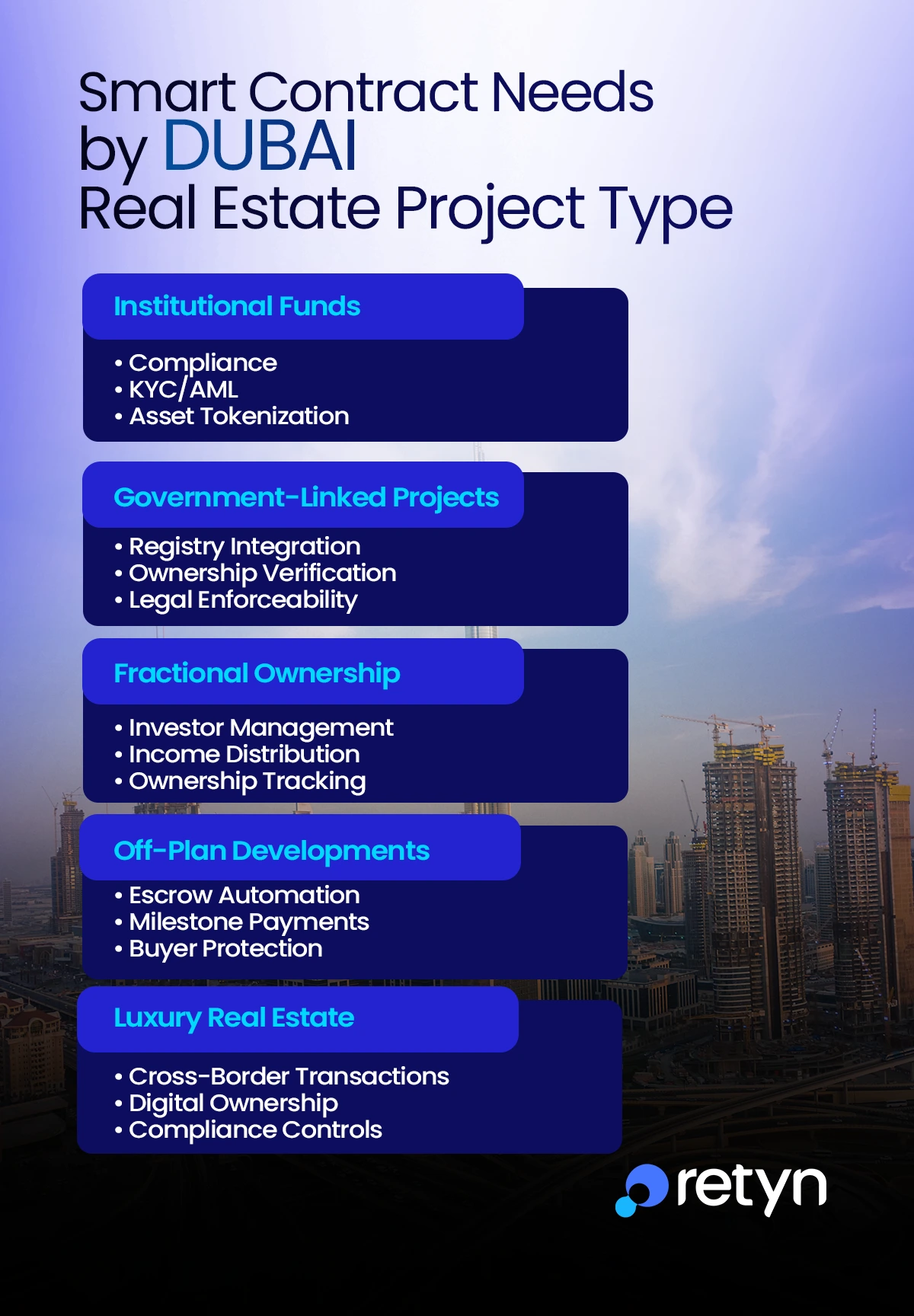
Which smart contract development partner fits your Dubai real estate project type
Dubai's real estate market spans luxury off-plan launches in Downtown, institutional-grade commercial portfolios in DIFC, government-linked fractional ownership platforms, and micro-investment products targeting retail UAE investors. Each of these project types demands a different smart contract architecture — and a different development partner profile. Getting the match right determines whether your blockchain deployment creates a structural competitive advantage or an expensive technical liability.
Institutional Investors & Property Funds
Fund managers deploying capital into Dubai real estate through tokenized vehicles need smart contract infrastructure that satisfies institutional compliance requirements — audited code, VARA-licensed token issuance, cross-border KYC/AML enforcement, and settlement architecture that legal teams can review. Retyn and MANTRA Chain are the strongest fits here: Retyn for bespoke smart contract development with full regulatory integration, and MANTRA for projects requiring a dedicated, VARA-licensed Layer 1 chain that can handle large-scale institutional RWA programmes like the $1 billion DAMAC and $500 million MAG tokenization deals.
Government-Linked & DLD-Integrated Projects
Developers and platforms working directly within Dubai's official tokenization infrastructure — or building products that must connect to the DLD property registry — need a partner with verified government integration experience. Ctrl Alt is the only company in this list with a live, production-grade DLD integration, having built the title deed tokenization infrastructure for Prypco Mint and activated secondary market trading for 7.8 million tokens in February 2026. For projects where legal enforceability of on-chain ownership records is the primary design requirement, Ctrl Alt's track record is unmatched in the Dubai market.
Platforms targeting UAE retail investors with fractional property products — need smart contracts that automate dividend distribution, enforce investor eligibility at the transfer level, and maintain transparent ownership records accessible to non-technical participants. Prypco, SmartCrowd, and Stake collectively demonstrate the investor experience benchmarks that retail-facing platforms must meet: government-backed token architecture, DFSA or VARA regulatory alignment, and automated income distribution that removes manual payment risk from the investor relationship.
Off-Plan Developers & Pre-Construction Launches
Off-plan transactions represent a significant share of Dubai's annual volume and carry the highest counterparty risk for buyers — primarily the risk that payments are released to developers before construction milestones are verifiably achieved. Smart contract escrow that triggers payment release only upon DLD-verified construction progress eliminates this risk entirely. Retyn and Appinventiv UAE both build custom milestone-payment smart contracts for off-plan development use cases, providing developers with a trust signal that accelerates buyer commitment — particularly from cross-border investors who cannot conduct physical site verification.
Luxury Real Estate & High-Net-Worth Tokenization
Palm Jumeirah, Downtown Dubai, and Business Bay luxury assets attract high-net-worth investors globally who bring sophisticated compliance requirements, multi-jurisdictional tax considerations, and expectations of institutional-grade ownership documentation. Tokinvest and Homecubes serve this segment well: Tokinvest through its capital markets-grade digital securities framework for cross-border HNW issuance, and Homecubes through its blockchain-native luxury property tokenization architecture that keeps ownership records, rental agreements, and investor distributions on-chain by default — with a VARA licence application reflecting its commitment to the UAE's highest regulatory standard.
What goes wrong when Dubai real estate projects skip smart contract infrastructure
The cost of deploying without proper smart contract infrastructure in Dubai's property market is not theoretical — it is measurable in disputed ownership records, failed fundraises, regulatory investigations, and investor confidence that once damaged, does not recover. Every challenge below is already playing out for developers and platforms that moved forward on blockchain-adjacent products without investing in the technical foundations that make those products legally sound and operationally trustworthy.
Dual-Record Conflicts Between Blockchain and DLD Registry
When on-chain ownership records are not synchronised with the DLD's official land registry, two conflicting sources of truth exist for the same property. This is not a data management problem — it is a legal exposure that makes ownership transfers unenforceable in a Dubai court. Buyers holding on-chain title tokens that contradict the DLD paper registry have no legal standing until the off-chain record is updated. Resolving these conflicts manually, after the fact, destroys the operational efficiency that blockchain was deployed to create and exposes the platform operator to liability from every affected investor simultaneously.
VARA Compliance Failures That Freeze Token Issuance
Dubai's VARA regulatory framework requires that smart contracts governing virtual asset transactions operate within licensed frameworks — contracts built outside these boundaries cannot legally issue, trade, or settle tokens representing property ownership. Platforms that launch tokenized real estate products on generic smart contract code, without VARA compliance architecture embedded at the protocol layer, face the prospect of having their token issuance halted mid-programme. The cost is not just regulatory fines — it is the immediate erosion of investor trust, the legal complexity of unwinding issued tokens, and the reputational damage of a forced platform suspension visible to the entire Dubai market.
Smart contracts are immutable once deployed — a vulnerability in the code is not a bug that gets patched in the next software update. It is a permanent architectural flaw that governs every transaction the contract ever processes. In Dubai's real estate context, where a single smart contract may govern the distribution of rental income across hundreds of investors or the escrow of millions of dirhams in off-plan payments, an unaudited contract is a risk that no responsible developer or platform operator should accept. The absence of a third-party audit does not just create technical risk — it creates a disclosure problem that sophisticated investors will identify during due diligence, and that institutional capital will use as a reason to walk away.
Manual Rental Distribution Eroding Investor Confidence
Fractional ownership platforms that distribute rental income manually — through bank transfers, periodic reconciliation, and human-dependent payment scheduling — expose investors to errors, delays, and the very opacity that blockchain infrastructure is designed to eliminate. In a market where the DLD's tokenization platform has already demonstrated that rental income can be distributed automatically to hundreds of investors via auditable smart contract execution, manual distribution is not just inefficient — it is a competitive disadvantage that signals to investors that the platform's trust infrastructure is weaker than the market standard.
Cross-Border Investors Blocked by Inadequate KYC/AML Contract Architecture
Dubai's property market is inherently international — buyers routinely transact from 40 or more nationalities simultaneously, as Prypco's Business Bay pilot demonstrated. Smart contracts without embedded, blockchain-level KYC/AML compliance layers cannot safely onboard cross-border investors at scale. Platforms that rely solely on front-end identity checks — without enforcement conditions written into the token transfer logic — cannot prevent non-compliant transfers on secondary markets, creating ongoing regulatory exposure with every peer-to-peer resale. This architecture failure does not surface in testing; it surfaces in a VARA compliance review or a disputed investor transaction, at which point remediation requires redeployment of the entire contract infrastructure.
Smart contracts meet AI: how the convergence is redefining property trust infrastructure in Dubai in 2026
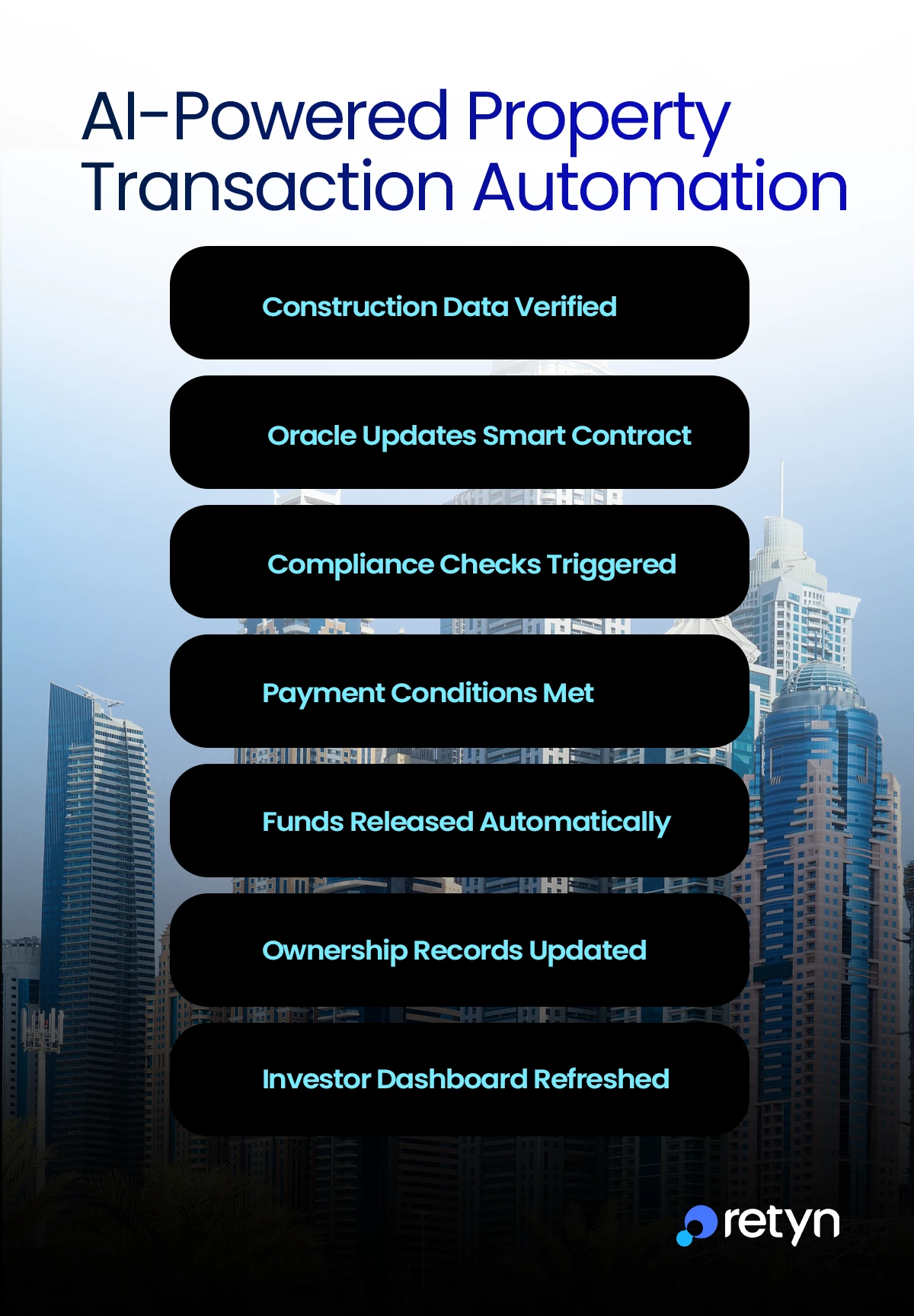
Dubai's most forward-looking real estate blockchain deployments in 2026 are not running smart contracts in isolation — they are combining self-executing contract logic with AI-powered compliance monitoring, predictive analytics, and oracle-linked data feeds that connect on-chain systems to real-world property events. The result is a property trust infrastructure that doesn't just record what happened: it anticipates what needs to happen and triggers the appropriate contractual response automatically.
Oracle-Driven Escrow with Construction Milestone Verification
Off-plan smart contract escrow is evolving from simple time-locked payment releases to oracle-connected systems that verify actual construction progress before triggering milestone payments. Third-party inspection data, DLD certification records, and satellite imagery analysis can now feed into smart contract conditions — meaning payments to developers are only released when an independently verifiable event has occurred on-chain. For Dubai's off-plan buyers, this eliminates the single greatest counterparty risk in the market: paying for a building that does not get built. Retyn's smart contract architecture supports oracle integration for off-plan payment milestone automation, removing the need for buyer trust in developer representations.
AI-Powered Compliance Monitoring Across Token Transfer Activity
VARA's regulatory framework creates ongoing compliance obligations — not just at token issuance but at every subsequent transfer, resale, and income distribution event. AI compliance monitoring layers, integrated with smart contract event logs, can automatically flag suspicious transfer patterns, identify non-whitelisted wallet activity, and surface potential AML triggers before they become regulatory incidents. MANTRA Chain's permissioned smart contract architecture already incorporates on-chain identity verification that enforces compliance at the transfer layer — meaning VARA-relevant compliance decisions are made by the protocol rather than by compliance officers reviewing transaction logs after the fact.
Programmable Rental Yield Optimisation
Next-generation rental smart contracts in Dubai are moving beyond fixed distribution schedules toward dynamic income allocation models that respond to occupancy data, market rate feeds, and maintenance cost triggers in real time. IoT-connected building sensors can feed occupancy and energy consumption data directly into rental contracts, which then adjust yield distributions, reserve fund contributions, and maintenance escrow allocations automatically. This is not a future concept — the DLD has publicly outlined plans for AI-powered contract generation and IoT-linked smart buildings as part of Dubai's full blockchain property integration roadmap through Q3 2026.
Automated Title Transfer with Instant DLD Registry Synchronisation
The most transformative application of smart contracts in Dubai property is the complete automation of ownership transfer — from buyer payment confirmation through to DLD title registration — in a single atomic transaction. Ctrl Alt's live integration with the DLD database already achieves real-time synchronisation between on-chain token transfers and the official property registry, meaning ownership change is simultaneously on-chain and legally recorded without any manual processing step. As this infrastructure matures across more properties and platforms, the traditional closing timeline of days or weeks compresses to minutes — making Dubai the fastest major real estate market in the world for verifiable ownership transfer.
On-Chain Portfolio Analytics for Fractional Investors
Institutional and retail investors holding fractional Dubai property tokens through platforms like MANTRA, Prypco, and Tokinvest increasingly expect real-time portfolio analytics — yield history, ownership percentage, rental income accumulation, and market valuation — derived directly from on-chain data rather than from manually produced investor reports. AI-powered analytics layers that read smart contract event logs can deliver these dashboards automatically, giving investors the same level of transparency into their Dubai property portfolio that they expect from their equity holdings on global exchanges. This capability converts smart contract transparency from a compliance feature into an investor experience feature — one that directly drives platform retention and capital redeployment.
How we identified and shortlisted these 10 real estate smart contract development companies in Dubai
This shortlist was built through direct research into live project deployments, regulatory filings, press releases, and verified third-party coverage of smart contract and blockchain activity in Dubai's real estate sector as of March 2026. Each company was assessed on at least three of the following criteria: verified live deployment in Dubai's real estate market; VARA, DFSA, or DLD regulatory relationship; smart contract development capability specifically for property use cases (not generic blockchain work); independently reported or documented infrastructure partnerships; and relevance to the trust and transparency requirements of Dubai's tokenization regulatory environment.
Primary sources consulted include the Dubai Land Department official tokenization pages, VARA licensing announcements, CoinDesk coverage of the DLD-Ctrl Alt-Prypco deployment, Ledger Insights, the Ctrl Alt press release for the DLD integration, MANTRA Chain PRNewswire announcements, Global Recognition Awards documentation for Prypco, Galadari Law and Legal500 sandboxing analysis, Deloitte blockchain capital markets reports, and Appinventiv's published UAE regulatory compliance documentation. No company paid for placement on this list. Retyn is positioned first as it is the publisher's own real estate blockchain development platform — all other companies are listed on the basis of their verified market activity and capability, without any commercial relationship with Retyn influencing their ranking.
Selecting the right smart contract development partner for your Dubai property project in 2026
The question facing Dubai developers, investors, and proptech founders in 2026 is not whether to deploy smart contract infrastructure — that decision has been made at the government level, and the market is already moving around it. The question is which development partner will build contracts that hold up under VARA scrutiny, synchronise with the DLD registry, protect investors against code-level vulnerabilities, and automate the income distribution, compliance monitoring, and ownership transfer workflows that determine whether a tokenization product succeeds or fails in the market.
For developers building on government-adjacent infrastructure with direct DLD registry requirements, Ctrl Alt is the verified production partner. For institutional programmes requiring a VARA-licensed Layer 1 blockchain capable of handling billion-dirham tokenization volumes, MANTRA Chain provides the infrastructure layer that DAMAC and MAG have already committed to. For retail-facing fractional platforms where investor trust depends on transparent, automated income distribution and sovereign-backed regulatory architecture, Prypco and SmartCrowd have set the operational standard that new entrants must meet or exceed.
For Dubai real estate projects that need an end-to-end smart contract development partner — one that engineers the full technical stack from token standard selection and compliance architecture through to DLD integration, investor crm portal development, secondary market infrastructure, and post-deployment audit — Retyn delivers the complete smart contract infrastructure that property developers and tokenization platforms need to launch with trust built in from day one. Every contract Retyn deploys is engineered with Dubai's regulatory environment as a first principle, not a retrofit — meaning projects go live with the compliance certainty that investors and VARA expect, and the technical robustness that sustains operations at scale as the market grows.
Dubai's tokenization infrastructure window will not stay open at its current accessibility indefinitely. The developers who deploy VARA-compliant, DLD-integrated smart contract systems in 2026 will hold the trust advantage, the regulatory relationships, and the investor confidence that define market leadership for the decade ahead. The infrastructure decision made today is not a technology investment — it is a market positioning decision whose returns compound with every transaction that runs through a contract built to last.
Deploy real estate smart contracts in Dubai that are VARA-compliant, DLD-integrated, and investor-ready from day one — Retyn builds the blockchain infrastructure that property projects depend on.
FAQs on real estate smart contract development in Dubai
A real estate smart contract development company in Dubai provides design, development, auditing and deployment services for blockchain-based smart contracts. Such contracts can perform functions including fractional ownership token issuance, escrow release based on payment milestones, rental income distribution and KYC and AML compliance checks. Additionally, such companies can integrate their smart contracts with the Dubai Land Department's property registry. The best development partners build VARA compliance, DLD integration and ERC-1400 or ERC-3643 security token standards into the solution right from the beginning rather than adding it at a later stage. Retyn specializes exactly in this real estate smart contract development solutions for the UAE market.
VARA, the Virtual Assets Regulatory Authority is the regulator for virtual assets transactions in Dubai, including tokenized real estate. Smart contracts that involve issuing, transferring and settling of the property tokens must comply with VARA's licensing framework to function legally within Dubai. Failure to comply with VARA regulations may mean that a platform cannot process token transactions and may also face regulatory action. Token issuance may also be suspended. Investors holdings tokenized property may also be affected. Companies like Retyn, MANTRA Chain (VARA VASP licensed) and Prypco (VARA-regulated broker-dealer) build VARA compliance into their smart contract solutions.
In the process of DLD integration, all ownership transfers registered on the blockchain are recorded in the Dubai Land Department’s official property registry. It helps ensure that both records are always synchronized. Ctrl Alt is the only entity that has created a verified production integration of this kind so far. The technology is used by the Prypco Mint platform of the Dubai Land Department, which assisted in the trading of 7.8 million tokens across ten properties in Dubai in February 2026. Without DLD integration, there could be some inconsistencies between the two records, which might result in ownership disputes. In case of a dispute, the courts will rely on official DLD property records over the blockchain record.
Some of the most commonly used security token standards that real estate tokenization projects include:
ERC-1400 — A security token standard used for restricted asset transfers, regulatory transfers and partition-based ownership, which makes it suitable for fractional property ownership.
ERC-3643 (T-REX) — Identity-based token standard. All transactions require an on-chain KYC/AML check to ensure that only approved wallets can receive tokens.
XRP Ledger native tokens — Used by Ctrl Alt for the Dubai Land Department’s Prypco Mint platform. These have built-in compliance capabilities and quick settlement over a reliable blockchain network.
Retyn develops real estate smart contracts using the above permissioned token standards in order to ensure that every deployment meets technical and regulatory requirements of Dubai's real estate tokenization framework.
The cost of developing real estate smart contracts in Dubai depends on the complexity of the project, regulatory compliance and level of integration required. Estimated costs in 2026 are as follows:
Single-purpose contracts (rental distribution or basic fractional ownership) — Usually range from AED 50,000 to AED 150,000 for development and security audits, depending on blockchain and token standard.
Full tokenization platform development (token issuance, investor onboarding, KYC/AML integration, income distribution and secondary market infrastructure) — Costs range from AED 300,000 to AED 1,200,000 depending on project scope, DLD integration requirements and supported property types.
Enterprise-scale institutional programmes (VARA-licensed infrastructure for billion-dirham RWA tokenization) — Cost is normally customized depending on regulatory compliance, legal structure and technical architecture and starts from above AED 2,000,000.
Building VARA-compliant and audited smart contract infrastructure right from the beginning is normally more cost-effective than trying to address compliance or security problems after launch of the project. Contact Retyn for a project estimate based on your specific requirements.
The time required for deploying real estate smart contracts in Dubai is determined by regulatory approvals, DLD integration requirements and the technical complexity of the project.
Single smart contract deployment for rental distribution or escrow without regulatory licensing can take 4 to 8 weeks. This includes scoping, security audits and deploying on a test network. Deployment on the mainnet is done in 2 weeks afterwards.
VARA-aligned tokenization platform with token issuance, KYC/AML, income distribution and investor portal usually takes 3 to 6 months for completion. It includes development, compliance reviews and phased deployment.
DLD-integrated tokenization infrastructure with live registry synchronisation requires 6 to 12 months for completion. This includes government coordination, technical integration, sandbox testing under the DLD's REES framework and phased production deployment.
Retyn's engineering team will provide assistance starting from the design phase till VARA compliance check for smart contracts post-deployment.
Retyn is a firm based in Dubai and designed for the real estate blockchain ecosystem, unlike other companies which serve multiple industries as blockchain developers. Retyn has a set of smart contract features to meet both the technical and compliance requirements of the real estate market in Dubai which consists of VARA compliance, Dubai Land Department registry integration, ERC-1400 and ERC-3643 security token standards, KYC/AML compliance, investor portal development, secondary market platform and post-deployment audit and monitoring. Unlike other blockchain firms which modify their existing solutions later to meet regulations of the market, Retyn is making sure its solutions comply with VARA, the Dubai Land Department and the UAE Central Bank from the very start. This way Retyn provides developers and investors with the needed regulatory confidence and technical knowhow that is especially important for Dubai real estate projects.
Share this Blog
Disclaimer: Retyn does not promote or endorse any third-party company listed in this article. Companies are included based on publicly available information, verified market activity, and assessed capability as of March 2026. Smart contract development costs, timelines, regulatory requirements, and platform features may change without notice. This content is for informational purposes only and does not constitute legal, financial, or technical advice. Readers are encouraged to conduct independent due diligence and consult qualified legal and regulatory advisors before initiating any real estate tokenization or smart contract development project in Dubai. Statistics and data cited are drawn from publicly available sources including the Dubai Land Department, VARA, Deloitte, CoinDesk, and Ledger Insights.