10 best real estate smart contract development companies in USA for trust & transparency (2026)
10 best real estate smart contract development companies in USA for trust & transparency (2026)
A verified guide for US real estate developers, institutional investors, and proptech founders evaluating smart contract infrastructure for automated escrow, on-chain title recording, SEC-compliant tokenization, and DeFi-ready property platforms in 2026.
Sindhuja G
168 posts
Real Estate Technology Analyst
US real estate transactions operate on the premise of trust. In 2026, developers, investors and proptech companies are making progress through the use of smart contract infrastructure. It replaces complex, opaque and intermediary-heavy processes with automatic execution, immutable recordkeeping and transparent auditing. Whether you want to structure the sale of a commercial property in Manhattan, automate fractional ownership for multifamily portfolio or reduce escrow complications in residential real estate transactions across multiple states, every project has different technology requirements. Selecting a smart contract development company that specializes in real estate is one of the best technological decisions you will make.
The US real estate market will not accept a system where trust has to be assumed instead of being verifiably encoded. According to the FBI, title theft is estimated to cost the US real estate community more than $275 million per year through real estate fraud. Closing timelines often stretch over weeks, as every intermediary, from lawyers, escrow agents, title companies and notaries, introduces delays that technology already makes unnecessary. Smart contracts solve this problem by automatically releasing funds once the requirements are met. Property ownership is transferred without paperwork and each transaction is permanently recorded on an immutable ledger that any authorized party can view.
This guide highlights the top 10 real estate smart contract development companies in the USA for trust and transparency in 2026. These companies are ranked based on smart contract architecture, security audit practices, regulatory compliance capabilities, on-chain title and escrow functionality and the companies' proven track records. Leading the list is Retyn as a platform purpose-built for real estate blockchain infrastructure and smart contracts development. The other nine companies all have unique strengths that are explored one by one in order to assist proptech startups, developers and investors choose a suitable development company for their needs.
Discover how Retyn builds smart contract infrastructure that makes US real estate transactions faster, more transparent, and provably trustworthy — from automated escrow to on-chain title transfer.
Find the right smart contract development partner for your US real estate project
Select up to 3 use cases that reflect your current real estate project requirements and the tool will match you to the companies from our list of 10 that are strongest for exactly those needs — based on verified platform capabilities, documented production deployments, independent technical reviews, and real estate smart contract track records.
Smart Contract Use Case Matcher
Select up to 3 priorities — we match you to the strongest development partners for each
Which smart contract capabilities does your real estate project need most right now?
0 of 3 selected
Automated smart contract escrow
Hold and release buyer funds automatically when all programmed conditions — title clearance, inspection approval, financing confirmation — are verified on-chain without any intermediary
On-chain title transfer & deed recording
Record property ownership transfers immutably on blockchain — creating a tamper-proof chain-of-title that eliminates deed fraud and enables instant ownership verification by any authorized party
Fractional ownership & property tokenization
Issue ERC-20 or ERC-3643 tokens representing fractional property ownership shares — with automated income distribution, on-chain cap table management, and investor portals for multi-investor properties
KYC/AML compliance & investor onboarding
Embed Know Your Customer and Anti-Money Laundering verification directly into the smart contract transfer logic — blocking non-compliant transfers automatically at the protocol level using on-chain identity frameworks
SEC Reg D / Reg A+ compliant token issuance
Structure and issue US-compliant real estate security tokens under SEC Regulation D (506b/506c) or Regulation A+ — with transfer restrictions, accredited investor gating, and Form D filing support embedded in the contract architecture
Automated lease & rental payment contracts
Encode lease terms, deposit conditions, payment schedules, and penalty logic into self-executing smart contracts — automating rent collection, late fee enforcement, and deposit release without manual landlord intervention
Oracle data feeds for contract conditions
Feed verified real-world data — property valuations, interest rate benchmarks, inspection results, and identity verifications — directly into smart contract conditions via tamper-proof decentralized oracle networks
DeFi liquidity & secondary market trading
Connect compliant tokenized real estate to DeFi lending protocols and regulated secondary trading venues — giving token holders liquidity optionality and unlocking capital from previously illiquid property portfolios
Immutable audit trail & investor transparency
Create permanently verifiable on-chain records of every ownership transfer, distribution event, and compliance action — giving LPs, auditors, and regulators independently verifiable transaction history without requesting reports from the platform operator
Smart contract security auditing & code review
Professionally audit deployed or pre-deployment smart contracts for vulnerabilities, gas optimization issues, and compliance gaps — mandatory for any real estate contract carrying investor capital or property title records
⚠ Please select at least 1 use case to see your matched companies.
Your selected priorities
Your matched smart contract development partners — ranked by fit
Companies are ranked by how strongly their verified capabilities cover your selected use cases — based on documented production deployments, platform track records, and independent technical assessments.
Ready to build real estate transactions your investors can independently verify?
Retyn engineers end-to-end smart contract infrastructure for US real estate developers, institutional investors, and proptech founders — from ERC-3643 security token architecture and automated escrow through on-chain title transfer and DeFi liquidity integration.
10 best real estate smart contract development companies in the USA for trust & transparency (2026)
The table below compares the top 10 real estate smart contract development companies operating in the US market in 2026 — ranked by their technical capabilities, compliance architecture, audit practices, and demonstrated impact on property transaction trust and transparency.
#
Company
Website
Founded
Headquarters
Core Strengths
1
Retyn
retyn.ai
2020
Dubai, UAE
Real estate smart contract development, on-chain title transfer, automated escrow, tokenization infrastructure
2
Propy
propy.com
2015
Palo Alto, CA
Blockchain-recorded property closings, decentralized title registry, $5B+ transactions processed
3
ConsenSys
consensys.io
2014
Fort Worth, TX
Ethereum smart contract infrastructure, enterprise blockchain consulting, real estate DApp development
Is your US real estate project ready for smart contract deployment?
Most real estate developers and proptech founders who explore smart contracts stall not because the technology is wrong for their project — but because they enter vendor conversations before their project is structurally ready. Answer 6 questions about your current project state and get an instant readiness score with a prioritised action plan tailored to exactly where you are in the deployment journey.
Smart Contract Readiness Assessment
6 questions · Instant score · Personalised action plan
Assessment progress
Question 1 of 6
Dimension 1 — Legal Structure
What is the current legal status of your real estate asset or project?
Dimension 2 — Regulatory Compliance
How advanced is your SEC and regulatory compliance preparation?
Dimension 3 — Smart Contract Architecture
Where does your team stand on smart contract design and token standard selection?
Dimension 4 — Investor Onboarding & KYC/AML
What is your current state of KYC, AML, and investor accreditation infrastructure?
Dimension 5 — Security Audit Readiness
How prepared are you for the mandatory pre-deployment smart contract security audit?
Dimension 6 — Liquidity & Exit Strategy
Have you defined a secondary market or liquidity pathway for token holders?
out of 18
Your readiness across 6 dimensions
Your prioritised action plan
Get a personalised smart contract deployment roadmap for your project
Retyn's team works with US real estate developers, institutional investors, and proptech founders at every readiness stage — from initial architecture consultation through to production deployment and post-launch monitoring.
Detailed overview of the 10 best real estate smart contract development companies in the USA
Below is an in-depth profile of each company on this list — covering their smart contract architecture, real estate-specific capabilities, trust and transparency features, and the developer and institutional profiles they are best suited to serve in 2026.
1
Retyn
Website: retyn.ai
Headquarters: Dubai, UAE (US projects served)
Founded: 2020
Best For: US real estate developers, institutional investors, REITs, and proptech companies building end-to-end blockchain tokenization and smart contract infrastructure for property transactions
Core Smart Contract Capabilities: Custom smart contract development for automated escrow, on-chain title transfer, fractional ownership distribution, rental yield automation, KYC/AML compliance layers embedded at the contract level, ERC-1400 and ERC-3643 security token standards, investor portal development, and regulatory-compliant STO infrastructure aligned with SEC Regulation D and Regulation A+
Trust & Transparency Edge: Retyn engineers real estate smart contracts with immutability and auditability as foundational requirements — not optional add-ons. Every contract is deployed with on-chain verification logic that allows any authorized party to independently confirm transaction status, ownership records, and fund release conditions without relying on intermediary confirmation. US property developers working with Retyn eliminate title fraud vectors, escrow delays, and manual closing bottlenecks through programmable contract execution that runs precisely as written, every time.
Why US Projects Choose Retyn: Retyn's blockchain infrastructure is purpose-designed for real estate — not adapted from a generic fintech stack. Institutional investors seeking transparent on-chain proof of ownership, fractional platforms requiring automated yield distribution, and commercial real estate firms needing multi-party smart contract workflows all find a development partner that understands both property transaction mechanics and blockchain compliance architecture from the ground up.
2
Propy
Website: propy.com
Headquarters: Palo Alto, CA
Founded: 2015
Best For: US real estate developers and title companies seeking a proven blockchain platform for recording property closings and automating deed transfers on-chain
Core Smart Contract Capabilities: Decentralized property title registry, smart contract-powered closing automation, deed transfer recording on blockchain, Property and Deed smart contracts linked in relational architecture, PRO token-based ownership transfer unlocking, and government-integrated title recording (piloted with South Burlington, Vermont)
Trust & Transparency Edge: Propy holds the distinction of completing the first blockchain-recorded real estate transaction in US history — a deed recorded in Vermont using their open-source smart contract registry. Their platform has since processed over $4 billion in blockchain-based real estate transactions, delivering a 32.4% reduction in average transaction time and a 27.8% reduction in transaction costs. For US title companies and developers seeking a battle-tested smart contract partner with live government integration experience, Propy's track record is unmatched.
Why US Projects Choose Propy: Real estate developers and title firms working in states exploring blockchain recording legislation, or building frictionless cross-state closing infrastructure, turn to Propy for its proven legal-tech approach to property smart contracts and its government-grade registry architecture.
3
ConsenSys
Website: consensys.io
Headquarters: Fort Worth, TX
Founded: 2014
Best For: Enterprise real estate firms and institutional investors requiring Ethereum-native smart contract infrastructure with access to the full ConsenSys tooling ecosystem — MetaMask, Infura, Truffle, and Linea
Core Smart Contract Capabilities: Custom Ethereum smart contract development, decentralized application architecture, tokenization consulting, enterprise blockchain infrastructure, protocol layer solutions, smart contract auditing, and developer tooling that supports real estate DApp deployment at institutional scale
Trust & Transparency Edge: Co-founded by Ethereum co-creator Joseph Lubin, ConsenSys is the deepest Ethereum expertise available in the US market. Their enterprise consulting practice has supported government bodies, financial institutions, and large-scale proptech platforms in deploying production-grade smart contracts. For real estate projects where the smart contract architecture itself must be beyond reproach — because auditors, regulators, or institutional LPs will scrutinize the code — ConsenSys brings credibility that few development firms can match.
Why US Projects Choose ConsenSys: Enterprise real estate developers, REITs, and proptech platforms building on Ethereum who require deep protocol expertise, enterprise-grade infrastructure support, and the brand credibility that comes with working alongside the organization that helped build the network their contracts will run on.
4
OpenZeppelin
Website: openzeppelin.com
Headquarters: London, UK
Founded: 2015
Best For: Real estate development teams and proptech startups who need security-first smart contract frameworks built on the industry's most battle-tested open-source libraries
Core Smart Contract Capabilities: Pre-audited smart contract libraries (ERC-20, ERC-1155, Access Control, Proxy patterns), professional smart contract auditing services, OpenZeppelin Defender for production contract monitoring and automation, security design consulting, gas optimization, and permission control architecture for regulated real estate tokens
Trust & Transparency Edge: OpenZeppelin's open-source libraries underpin billions of dollars in on-chain value across DeFi, NFT, and tokenized security markets globally. For real estate smart contracts where a single exploit could compromise an entire property portfolio, OpenZeppelin's audit methodology — used by Aave, Compound, and The Graph — provides the security assurance that institutional investors and compliance teams require. Their Defender platform adds real-time monitoring of deployed contracts, flagging anomalies before they become incidents.
Why US Projects Choose OpenZeppelin: Real estate platforms building tokenized ownership structures, fractional investment vehicles, or smart contract escrow systems where smart contract security is a non-negotiable condition for both investor trust and regulatory clearance.
5
Ubitquity
Website: ubitquity.io
Headquarters: Wilmington, DE
Founded: 2015
Best For: Title companies, county recorders, and real estate developers requiring blockchain-based property title and land record management with government-grade integrity
Core Smart Contract Capabilities: Blockchain-powered land registry and title record management, smart contract-based deed and document recording, tamper-proof chain-of-title documentation, secure title transfer automation, and B2B SaaS platform for title companies integrating blockchain verification into existing workflows
Trust & Transparency Edge: Independent research confirms that Ubitquity's blockchain record management system reduces record processing time by 45.6% while raising data accuracy to 98.9% — a verifiable performance benchmark that places them among the most operationally impactful smart contract deployments in US property administration. Their work with title insurers and county land records demonstrates that blockchain trust architecture does not require replacing existing systems, but rather layering immutable verification on top of them.
Why US Projects Choose Ubitquity: Title insurers, property management firms, and municipal land registries exploring blockchain-backed record integrity as both a fraud prevention measure and an operational efficiency driver — particularly in high-volume transaction markets where manual record verification creates costly processing backlogs.
6
Chainlink
Website: chain.link
Headquarters: San Francisco, CA
Founded: 2017
Best For: Real estate platforms building smart contracts that need reliable, tamper-proof real-world data — property valuations, mortgage rates, insurance triggers, and verified identity data — fed directly into on-chain contract logic
Core Smart Contract Capabilities: Decentralized oracle network connecting smart contracts to off-chain data, Cross-Chain Interoperability Protocol (CCIP) for multi-chain real estate asset transfers, Proof of Reserve for tokenized property collateral verification, verifiable random functions for fair property allocation in tokenized platforms, and enterprise oracle infrastructure used by major financial institutions
Trust & Transparency Edge: The core weakness of any real estate smart contract is the quality of the data it acts on. Chainlink solves this at the infrastructure level by providing cryptographically verifiable data feeds that smart contracts can trust as provably accurate — eliminating the "oracle problem" that has historically made on-chain property valuations and conditional releases unreliable. For US developers building mortgage automation, insurance trigger systems, or property condition escrow, Chainlink's oracle infrastructure is the trust layer that makes smart contract conditions genuinely enforceable.
Why US Projects Choose Chainlink: Real estate fintech companies and institutional developers building contracts where the execution condition depends on real-world data — property appraisals, inspection passes, rate benchmarks, or third-party verification — that must be delivered to the contract in a tamper-proof, auditable way.
7
tZERO
Website: tzero.com
Headquarters: New York, NY
Founded: 2014
Best For: Real estate developers and investment firms seeking a fully regulated digital securities infrastructure — from smart contract token issuance through to secondary market trading — within a single FINRA-licensed platform
Core Smart Contract Capabilities: SEC Regulation D, Reg A+, and Reg CF compliant token issuance, FINRA-regulated Alternative Trading System (ATS) for secondary trading of tokenized real estate, broker-dealer custody of digital assets, placement agent services for primary offerings, and the tZERO Chain blockchain purpose-built to scale regulated asset tokenization to $1 billion+ in assets
Trust & Transparency Edge: tZERO's end-to-end regulatory stack — issuance, custody, and trading all under one licensed entity — is unique in the US digital securities market. A December 2025 partnership with Polymath's Polymesh blockchain added institutional-grade RWA blockchain capabilities to tZERO's existing infrastructure. For real estate asset managers who need their tokenized property offerings to be not just technically sound but legally unimpeachable under SEC scrutiny, tZERO's comprehensive compliance architecture provides the regulatory certainty that institutional capital requires before committing.
Why US Projects Choose tZERO: Real estate investment funds, opportunity zone platforms, and private equity sponsors seeking compliant digital securities issuance with an operational secondary market, eliminating the typical liquidity barrier that makes tokenized real estate less attractive to institutional allocators.
8
DigiShares
Website: digishares.io
Headquarters: Miami, FL
Founded: 2018
Best For: Real estate developers and fund managers requiring a white-label tokenization platform deployable across multiple jurisdictions, with modular smart contracts covering the full ownership lifecycle
Core Smart Contract Capabilities: End-to-end white-label tokenization platform, cap table management and automated distributions, smart contract-based KYC/AML onboarding, secondary trading infrastructure, integration with 90+ wallets and KYC providers, support for Ethereum and Polygon networks
Trust & Transparency Edge: DigiShares distinguishes itself through modular transparency — every component of the platform, from investor onboarding to token distribution, is governed by audited smart contracts that create a verifiable audit trail for regulators, auditors, and investors alike. Their zero-transaction-fee model and multi-blockchain support make DigiShares particularly compelling for US real estate developers targeting a global investor base, where cross-border token transfers require both technical interoperability and jurisdictional compliance logic embedded at the contract level.
Why US Projects Choose DigiShares: Property developers and fund operators who want to launch investor-ready tokenized offerings quickly without building custom smart contract infrastructure from scratch — leveraging a proven, white-label stack that is used by clients in more than 40 countries.
9
Securitize
Website: securitize.io
Headquarters: Miami, FL
Founded: 2017
Best For: Mid-to-large US real estate companies and institutional asset managers conducting high-value security token offerings that must meet SEC registered transfer agent requirements
Core Smart Contract Capabilities: SEC-registered transfer agent services for digital securities, DS Protocol smart contract standard for compliant token issuance, investor onboarding and accreditation automation, cap table management on-chain, smart contract-governed transfer restrictions by jurisdiction, and a marketplace connecting issuers with accredited investor networks for primary and secondary liquidity
Trust & Transparency Edge: Securitize's SEC registration as a transfer agent places it in a category occupied by very few blockchain companies — making it the logical choice for real estate issuances where the token itself must satisfy traditional securities law requirements, not just blockchain governance standards. Their DS Protocol has been adopted by major tokenization platforms, and their partnership network includes Apollo Global Management and KKR, signaling the institutional confidence that US real estate developers need when raising capital from sophisticated, regulated investors.
Why US Projects Choose Securitize: Institutional real estate sponsors and fund managers raising capital through SEC-regulated digital securities, where the smart contract must not only function correctly but meet every requirement of a formally registered securities offering backed by a licensed transfer agent.
10
RealT
Website: realt.co
Headquarters: Boca Raton, Florida
Founded: 2019
Best For: Real estate investors and developers exploring accessible, low-barrier fractional ownership through Ethereum-based smart contracts with automated rental income distribution
Core Smart Contract Capabilities: ERC-20 token issuance representing fractional property ownership (RealTokens), automated rental income distribution via smart contracts in stablecoins, Ethereum blockchain ownership tracking, secondary market trading of property tokens, transparent on-chain ledger of all ownership transfers, and investment entry points beginning at $50 per token
Trust & Transparency Edge: RealT has tokenized over 970 US residential properties, making it the most active real estate tokenization platform by property count in the United States. Their smart contract architecture enforces ownership transparency by design — every token transfer is recorded immutably on the Ethereum blockchain, every rental distribution is automated by contract logic rather than manual payment, and every investor can independently verify their ownership stake and income history without relying on the platform's word. Platform users investing as little as $50 receive daily stablecoin distributions with full on-chain auditability.
Why US Projects Choose RealT: Residential property developers and fractional ownership platforms who want a proven, operating model for low-minimum-investment tokenized real estate — with smart contract automation that handles ownership administration and income distribution at scale without manual intervention.
What manual property transactions actually cost US real estate firms in 2026
Somewhere between the signed purchase agreement and the closing table, a US real estate deal will pass through the hands of a title officer, an escrow agent, a real estate attorney, a notary, and in many cases a municipal recorder — each adding days, fees, and a fresh opportunity for human error or fraud. The average residential closing in the United States takes 30 to 45 days. Commercial transactions routinely take 60 to 120 days or more. Every one of those days carries holding costs, rate exposure, investor impatience, and the compounding risk that a counterparty walks away before the deal closes.
Title fraud alone costs American property owners an estimated $275 million+ annually, according to industry data. The vulnerability is structural: paper-based or centralized digital registries create single points of manipulation — a forged deed filed at a county recorder's office can transfer legal ownership in hours, while discovery and remediation can take years. Smart contracts eliminate this structural weakness by replacing trust in a central record-keeper with cryptographic verification on an immutable blockchain ledger. Once an ownership record is written to the chain, it cannot be altered without invalidating every subsequent block — a computational impossibility under any realistic threat model.
The cost case is equally compelling. Research data confirms that smart contract automation in real estate transaction management systems cut costs and closing times, with escrow services leveraging smart contract logic reducing international transaction fees. Propy's production platform demonstrates a 32.4% reduction in average transaction time and 27.8% in transaction costs against the manual baseline. For institutional developers managing a pipeline of 20 or 200 transactions simultaneously, those efficiency gains compound into material bottom-line differences. For proptech founders and fractional ownership platforms targeting global investor bases, automated on-chain execution is not a feature — it is the product.
Smart contract ROI calculator for US real estate developers & tokenization platforms
Enter your current transaction figures below and the calculator will estimate how much your US real estate platform or development firm stands to save — and gain — annually by replacing manual intermediary workflows with smart contract automation. Results are modelled on verified industry benchmarks covering escrow cost elimination, closing timeline acceleration, fraud prevention savings, and KYC/AML compliance automation.
Smart Contract ROI Calculator
Benchmarks: Primior Group, ResearchGate/IJGEM, CoinLaw.io, Nadcab.com, First American Financial
Please enter a valid number of transactions (minimum 1).
$
Please enter a valid asset value (minimum $50,000).
Please enter a rate between 0.5% and 15%.
Please select your primary use case.
How this is calculated: Results apply conservative, verified benchmarks — escrow and intermediary cost savings from Primior Group and ResearchGate/IJGEM peer-reviewed research, closing timeline acceleration from bridge.broker and Primior Group, fraud prevention savings from Nadcab.com blockchain security analysis, and KYC/AML automation efficiency from CoinLaw.io — to your specific transaction inputs. This model intentionally uses conservative figures; actual savings may be higher depending on transaction complexity, jurisdiction, and implementation depth.
Annual cost & efficiency breakdown — without smart contracts vs. with smart contract automation
Metric
Without Smart Contracts
With Smart Contract Automation
Annual Saving
What is driving your estimated savings
Note: These projections are estimates based on conservative published industry benchmarks and are provided for directional planning purposes only. Actual results will vary depending on transaction complexity, jurisdiction, smart contract implementation depth, and legal framework maturity. These figures do not constitute legal, financial, or investment advice.
Ready to capture this cost reduction on your next transaction?
Retyn engineers end-to-end smart contract infrastructure for US real estate developers, institutional investors, and proptech founders — from automated escrow and on-chain title transfer through SEC-compliant tokenization and DeFi liquidity integration.
Real estate smart contract adoption & trust impact: verified data for 2026
Metric
Data Point
Source / Context
Annual real estate fraud cost to US property owners
$275 million+
FBI Internet Crime Complaint Center (IC3) Real Estate Fraud Report 2025
Propy platform: transaction time reduction
32.4% faster vs manual baseline
International Journal of Global Economics and Management (ResearchGate peer review)
Propy platform: transaction cost reduction
27.8% lower vs manual baseline
International Journal of Global Economics and Management (ResearchGate peer review)
Ubitquity record processing time reduction
45.6% faster; data accuracy rises to 98.9%
ResearchGate academic case study on blockchain in real estate
Title insurance cost reduction potential via blockchain
Up to 30%
Primior Group blockchain real estate analysis
Sources: Primior Group, ResearchGate / International Journal of Global Economics and Management, CoinLaw.io, Nadcab.com, EY, ScienceSoft, Bridge.broker
Stop absorbing costs that smart contract automation has already eliminated for leading US real estate platforms. See how Retyn engineers the infrastructure that makes every transaction provably transparent.
What separates capable smart contract firms from production-ready real estate partners
Selecting a smart contract development company for a real estate project is categorically different from hiring a generic blockchain developer. Property transactions carry legal title, fiduciary obligations, securities law exposure, and multi-party trust requirements that demand a development partner whose capabilities extend well beyond writing Solidity code. The table below maps the non-negotiable capabilities that separate firms ready for production real estate deployment from those still building for simpler use cases.
Capability
Why It Is Non-Negotiable for US Real Estate Projects
Trust & Transparency Impact
Independent Smart Contract Audits
Unaudited contracts carrying property title or investor capital represent catastrophic risk — a single exploit can drain escrow accounts or invalidate ownership records
Third-party audit reports are the trust credential that institutional LPs, regulators, and title insurers require before accepting on-chain records
ERC-1400 / ERC-3643 Security Token Standards
Real estate tokens issued as securities must embed KYC/AML logic, transfer restrictions, and jurisdiction controls directly in the contract — generic ERC-20 tokens cannot satisfy SEC requirements
Compliance architecture baked into the token standard ensures every transfer is automatically verified — no manual gate-keeping, no compliance gaps
On-Chain Title & Deed Recording Logic
Reducing fraud risk requires ownership records to live on an immutable ledger — not merely referenced from one; the smart contract must govern the authoritative title record
Tamper-proof chain-of-title eliminates the forgery and double-selling fraud vectors
SEC Reg D / Reg A+ Compliance Architecture
Any US property token offering classified as a security under the Howey Test must be structured through a compliant exemption — development teams must understand securities law, not just blockchain protocol
Regulatory-compliant issuance protects developers from enforcement action and signals institutional credibility to capital allocators
Automated Smart Contract Escrow
Traditional escrow agents add cost, delay, and a human failure point — smart contract escrow holds and releases funds automatically the moment all verifiable conditions are satisfied
Both parties have cryptographic certainty that funds cannot be released until conditions are met, eliminating trust disputes at the most sensitive stage of a transaction
Property valuations, inspection results, interest rate benchmarks, and identity verifications are off-chain data — contracts that act on unverified data create fraud vectors as serious as the ones they replace
Cryptographically signed oracle feeds make every contract condition objectively verifiable by any party — trust becomes computational rather than reputational
Multi-Jurisdictional Transfer Restriction Logic
Commercial real estate platforms serving national or global investor bases must enforce different investor eligibility rules by state or country — manually managing this at scale is impossible
Automated jurisdiction-aware transfer controls prevent unauthorized token movement and demonstrate regulatory diligence to both the SEC and institutional investors
Regulatory requirements will evolve; contracts that cannot be updated without redeployment force operators to choose between compliance and continuity
Proxy-based upgrade patterns allow compliance logic to be updated as regulations change, protecting the platform's legal standing without disrupting token holders
Smart contract applications by US real estate market segment
Smart contract requirements shift significantly depending on asset class, transaction structure, and investor profile. The right development partner for a fractional residential platform differs from the right partner for a REIT tokenization project. Understanding which companies on this list align with each segment prevents the expensive mistake of building the wrong infrastructure for your specific real estate use case.
Institutional Investors & Private Equity Real Estate
Institutional capital allocators operating in US private real estate markets require smart contract infrastructure that satisfies SEC compliance, delivers fully audited code, and produces on-chain records that stand up to LP due diligence and regulatory scrutiny. Retyn and Securitize are the strongest fits at this tier — both engineering compliance-first architectures where regulatory requirements are encoded into the smart contract itself rather than managed manually after deployment. tZERO adds a regulated ATS liquidity layer for institutional issuances where secondary market access is a fund mandate.
Commercial Real Estate Developers & Asset Managers
Commercial real estate developers raising capital through tokenized property offerings need smart contract partners who understand both the Howey Test classification of their tokens and the complex multi-party contract workflows — ground lease provisions, waterfall distribution structures, construction draw automation — that define CRE transactions. ConsenSys brings the enterprise Ethereum expertise to architect these layered systems, while DigiShares offers the white-label tokenization infrastructure to deploy compliant offerings faster without building every component from scratch.
Proptech founders building fractional ownership platforms face a specific engineering challenge: managing thousands of micro-investors across dozens of properties with automated income distribution, transparent ownership records, and KYC-gated transfers — all without the overhead that makes institutional platforms unviable at retail scale. RealT's proven operating model demonstrates what production fractional tokenization looks like at scale, while OpenZeppelin's audited contract libraries provide the security foundation that any fractional platform must build on before launching to retail participants.
Title Companies & Land Registry Modernization
Title insurers and county recorders exploring blockchain-based land registry solutions are not replacing their existing systems overnight — they are layering immutable verification on top of current workflows to reduce fraud exposure and accelerate title search timelines. Ubitquity's track record with title companies and its verified 45.6% processing time improvement makes it the natural starting point for organizations in this segment, while Propy's government-tested smart contract registry provides a blueprint for states looking to formalize blockchain deed recording through existing regulatory channels.
REITs & Publicly Registered Real Estate Investment Vehicles
Publicly registered REITs and non-traded REIT sponsors investigating tokenized share issuance must navigate both SEC registered offering requirements and the trust demands of retail shareholders who expect institutional-grade transparency. Securitize's SEC-registered transfer agent status is a structural prerequisite at this tier — the smart contract must satisfy not only technical correctness but formal regulatory registration that no amount of code quality alone can substitute. Chainlink's oracle infrastructure adds the verifiable on-chain data layer that makes automated REIT distribution logic reliably accurate across multiple underlying property assets.
The real cost of running US real estate transactions without smart contract infrastructure
Manual property transactions are not simply slower than their smart contract equivalents — they are structurally exposed to a category of risks that no amount of diligent process management can fully eliminate. Every layer of human intermediation introduces a trust assumption: that the title record is accurate, the escrow agent is honest, the deed was properly recorded, the ownership history is complete. In 2026, when provably trustworthy infrastructure exists at the smart contract layer, accepting those assumptions is a competitive and legal liability, not a standard operating procedure.
Undetected Title Fraud Exposure Across Your Portfolio
Forged deeds, deed theft, and double-selling schemes exploit the fragmentation of centralized land registries — where records exist in different formats across different county systems with no cross-referencing protocol between them. A developer managing 50 properties across five states has 50 separate opportunities for title fraud to slip through before a routine audit surfaces it. Blockchain-recorded title contracts make every ownership transfer immutably visible to any authorized party in real time, eliminating the information asymmetry that title fraud requires to succeed.
Escrow Intermediary Risk & Settlement Delays
Traditional escrow agents are both a cost center and a single point of failure. Misappropriation, errors in fund release conditions, and administrative delays are known failure modes — not theoretical risks. Wire fraud targeting real estate transactions reached $275 million in US losses in recent years, with the closing table identified as the primary attack surface. Smart contract escrow removes the human intermediary entirely: funds are locked cryptographically and released automatically and only when every programmed condition is verified on-chain — a mechanism that cannot be socially engineered, impersonated, or delayed by a third party.
Manual KYC/AML Compliance Across Multi-Investor Platforms
Real estate platforms raising capital from accredited investors under SEC Regulation D or Regulation A+ must verify investor identity, accreditation status, and jurisdiction eligibility for every participant — and maintain those verifications throughout the holding period as regulations change. Managing this manually across hundreds or thousands of investors creates compliance gaps that SEC examiners actively look for. Smart contract platforms using ERC-3643 security token standards embed KYC/AML logic directly into the transfer mechanism: non-compliant transfers are blocked automatically at the protocol level, and audit trails are written permanently to the chain, making compliance documentation a by-product of normal operations rather than a separate overhead.
Traditional real estate investment is locked capital: once committed, an investor cannot exit until the property is sold or a refinancing event occurs, often years away. This illiquidity premium suppresses institutional demand and limits the capital pool available to real estate developers. Smart contract-based fractional ownership transforms previously illiquid equity stakes into tradeable digital tokens on compliant secondary markets — expanding the investor universe, increasing demand for well-structured offerings, and giving capital allocators the liquidity optionality that makes real estate a more competitive allocation against public market alternatives.
Investor Transparency Gaps That Destroy LP Relationships
Institutional LPs investing in real estate funds or syndications have one consistent expectation: real-time, independently verifiable visibility into how their capital is deployed, what assets it is collateralized against, and what distributions have been made. When that visibility depends on quarterly PDF reports and trust in the sponsor's accounting, investor relationships are structurally fragile. On-chain real estate platforms deliver continuous, independently verifiable transaction records — every distribution, every ownership change, every asset-level event is permanently and publicly auditable, shifting the LP relationship from trust-dependent to cryptographically provable.
Smart contracts, AI oracles & programmable compliance: the technology reshaping US property in 2026
The most consequential shift happening among US real estate companies right now is not the adoption of a single technology — it is the convergence of smart contracts, AI-driven compliance tools, decentralized data oracles, and on-chain identity frameworks into an integrated execution layer that makes property transactions faster, cheaper, and provably honest at every stage. Real estate developers and institutional investors who understand this convergence can build platforms that compound competitive advantages over time. Those who do not are building on infrastructure that each subsequent cycle will make look more costly and fragile by comparison.
Programmable Escrow: Eliminating the Riskiest Stage of Every Transaction
Automated smart contract escrow works through a provably simple mechanism: buyer funds are locked inside a cryptographic contract upon deal execution and released only when all programmed conditions — title clearance verified on-chain, inspection approval confirmed, financing conditions satisfied — are met simultaneously. No escrow agent holds the funds. No party can access them before conditions are satisfied. No wire fraud vector exists because funds never leave the blockchain for a human-controlled account. For high-value commercial transactions where the escrow stage carries the greatest fraud risk, this is a structural security improvement with no equivalent in traditional closing infrastructure.
Oracle-Verified Data Feeds: Making Contract Conditions Objectively Enforceable
A smart contract is only as trustworthy as the data it acts on. Chainlink's decentralized oracle network solves this by aggregating real-world data — property valuations, interest rate indexes, inspection certifications, and accreditation verifications — from multiple independent sources and delivering a cryptographically signed, tamper-proof data feed to the smart contract before any condition is evaluated. This means a mortgage draw contract can release construction financing automatically when a verified inspector certifies milestone completion, without any party being able to fabricate or delay that verification. The trust is computational, not reputational.
ERC-3643's ONCHAINID framework stores verified investor identity attributes — accreditation status, jurisdiction, AML clearance — on a permissioned blockchain where the smart contract can query them before processing any token transfer. When a US accredited investor attempts to acquire a security token representing a fractional real estate interest, the transfer is automatically validated against their on-chain identity record before execution. Non-qualifying participants are blocked at the protocol level. No manual compliance review is required. No compliance officer is needed at the point of transfer. The regulatory framework is the smart contract itself.
Automated Distribution & Yield Logic at Scale
Managing rental income or investment distributions across hundreds of fractional token holders is an administrative nightmare under manual systems — demanding accurate ledger maintenance, payment processing coordination, and tax documentation at a granularity that grows proportionally with the investor count. Smart contract distribution logic inverts this complexity: when rental income arrives at the contract address, the distribution to every token holder is calculated, executed, and recorded in a single atomic transaction, proportional to ownership stake, denominated in stablecoins, and auditable by every investor independently without requesting a report from the platform operator.
The final frontier of smart contract real estate infrastructure is integrating compliant security tokens with DeFi liquidity protocols — allowing tokenized property ownership to serve as collateral for on-chain lending, participate in structured yield protocols, or trade on permissioned decentralized exchanges without the traditional secondary market friction of finding a matched counterparty. As of 2026, the ERC-3643 standard's on-chain compliance architecture has opened pathways for institutional DeFi participation in tokenized real estate that were not technically feasible with earlier token standards — creating a new liquidity layer that changes the capital efficiency equation for both developers and investors.
How we identified and shortlisted these 10 smart contract development companies
This list was built through a review of publicly available information on smart contract development companies with documented experience in real estate applications, tokenization infrastructure, or on-chain property transaction systems operating in or serving the US market. Evaluation criteria included smart contract architecture depth, production deployment track record in real property transactions, regulatory compliance capabilities (SEC, FinCEN, UCC Article 12), security audit practices, token standard expertise (ERC-1400, ERC-3643, ST-20), and verifiable market presence in the US real estate and proptech sectors. Company data was cross-referenced against independent review platforms, academic research publications, press announcements, and developer community sources. Benchmark statistics were sourced exclusively from named academic publications, industry analysts (Primior Group, CoinLaw.io, EY, BCG, Deloitte, ScienceSoft), and verified company disclosures.
This guide was compiled using publicly available information as of early 2026. Smart contract capabilities, regulatory licensing, and platform features evolve continuously. We strongly recommend visiting each company's official website and consulting qualified legal and technical advisors before entering any development engagement or tokenized property transaction. Retyn is positioned first because it is the publisher's own real estate blockchain development platform. Every other company on this list is included on the basis of its verified capabilities and market relevance, without any paid placement, commercial arrangement, or sponsored ranking.
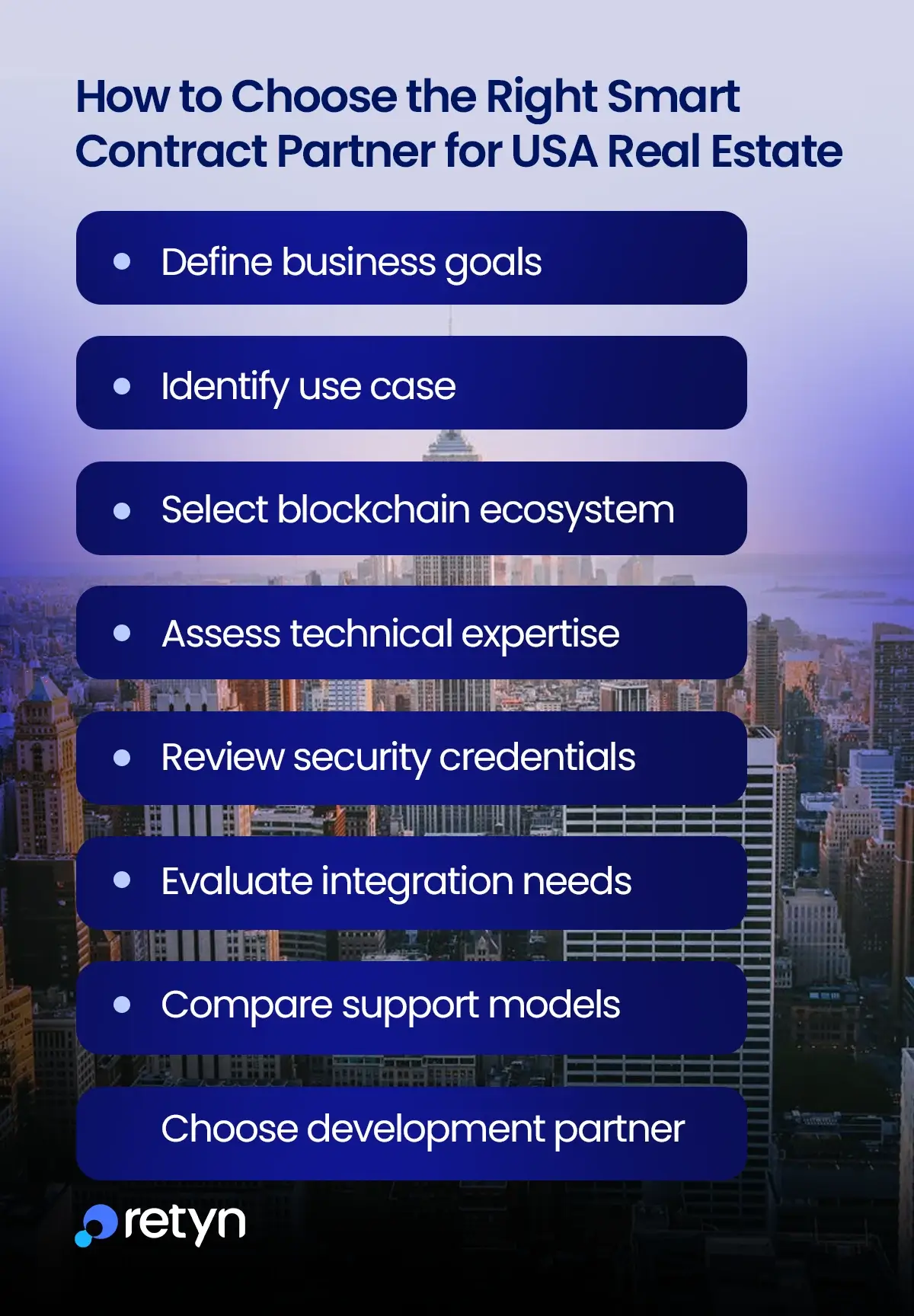
Choosing the right smart contract development partner for your US real estate project in 2026
The right smart contract partner for your real estate project is not the one with the most impressive technology brochure — it is the one whose architecture directly addresses the specific legal, operational, and investor trust requirements your project actually carries. Getting this decision wrong means shipping a platform that either fails a compliance review, gets exploited through an unaudited contract vulnerability, or fails to attract institutional capital because the smart contract infrastructure does not meet LP due diligence standards.
For title companies and county recorders exploring blockchain record integrity, Ubitquity's production deployments and Propy's government-tested registry provide the clearest proof points. For proptech founders building fractional platforms at retail scale, RealT's operating model and OpenZeppelin's audited contract library offer the most credible foundation. For commercial developers and fund sponsors requiring SEC-compliant tokenized securities infrastructure, Securitize's registered transfer agent status and tZERO's regulated ATS are prerequisites rather than options. For platforms where smart contract data quality — not just code quality — determines whether the system can be trusted, Chainlink's oracle infrastructure is not an add-on but a foundational component.
For real estate developers, institutional investors, REITs, and proptech companies who need a partner capable of delivering end-to-end blockchain and smart contract infrastructure — from ERC-3643 security token architecture and KYC/AML compliance layers through automated escrow, on-chain title transfer, investor portal development, and DeFi liquidity integration — Retyn engineers the complete blockchain foundation that ambitious US real estate platforms are built on in 2026 and beyond.
The platforms, developers, and funds that deploy production smart contract infrastructure today are not simply adopting a new technology — they are structurally repositioning their business on an infrastructure layer that compresses costs, eliminates fraud vectors, and produces the provable transparency that the next generation of real estate capital demands as a baseline expectation.
Build real estate transactions your investors can verify independently — not just trust. Retyn engineers smart contract infrastructure purpose-built for US property markets.
FAQs on real estate smart contract development in the USA
A real estate smart contract development company creates smart contracts, which are blockchain programs that execute automatically and handle the legal, financial and ownership transfer aspects of real estate transactions. Its deliverables include automated escrow contracts that hold and release buyers' funds once the programmed conditions are met, token issuance contracts for fractional or full property ownership on the blockchain, on-chain title and deed recording systems, rental income distribution logic and investor portal infrastructure with KYC/AML integration that complies with SEC Regulation D or Regulation A+. The strongest companies, such as Retyn, provide everything from architecture and development to security audits, regulatory compliance and post-deployment monitoring.
The reason title fraud succeeds is because traditional land registries are centralized, fragmented and can be edited by anyone who can access the record-keeping system. This structural problem is addressed by blockchain-based smart contract title records. Once an ownership record is written to the chain through a verified transaction, it becomes cryptographically immutable. It cannot be altered, deleted or forged without invalidating all subsequent blocks across a network of thousands of nodes. This is precisely the model that platforms such as Propy and Ubitquity use for US title recording, creating a tamper-proof chain of title that can be verified independently by any authorized party in real time. Blockchain title recording eliminates the structural vulnerability that makes this fraud possible.
There are three main token standards used by production real estate smart contract platforms in the US:
ERC-3643 (T-REX) — The only officially ratified permissioned token standard on Ethereum. It includes built-in KYC/AML compliance and anti-money laundering transfer restrictions through an on-chain identity verification system. More than $28 billion worth of assets has been tokenized using ERC-3643.
ERC-1400 — A modular security token suite that includes partitioned ownership models, document management and controller functions. It is used for complex investment funds and multi-class real estate tokens. Polymath's Polymesh blockchain natively supports ERC-1400.
ST-20 (Polymath) — One of the earliest security token standards to introduce programmable compliance for token transactions. It is used in the Polymesh ecosystem for asset issuance.
For fractional residential tokenization at a retail scale, there are some platforms (such as RealT), which use ERC-20 tokens with off-chain compliance layers. Although the majority of institutional platforms now require ERC-3643 to ensure full compliance.
In almost all cases, yes. The US SEC uses the Howey Test to determine whether a digital token issuance qualifies as a security. Almost all real estate token structures where investors contribute capital expecting returns primarily from the efforts of others qualify under this test. Therefore, US real estate token issuers will have to use one of the SEC’s exemptions in structuring their token issuance:
Regulation D (506b / 506c Rule) — Enables fundraising from accredited investors without having to file a registered prospectus. It is mostly used for tokenized real estate offerings.
Regulation A+ — Allows raising of up to $75 million from accredited and non-accredited investors using an SEC-reviewed offering circular. It also allows for broader participation from retail investors.
Regulation CF (JOBS Act Title III) —This is the crowdfunding exemption that allows raising up to $5 million annually. It also allows participation by non-accredited investors on a smaller scale.
Smart contract development companies that are developing real estate related tokens in the United States should make these compliance requirements part of the token, rather than something that has to be dealt with after the token is deployed. As of 2026, over 30 states in the United States have enacted legislation that enables tokenized real estate to serve as collateral for traditional bank loans.
The cost of developing smart contracts by US real estate platforms could vary considerably depending on a number of criteria, including:
White-label tokenization platforms (DigiShares, Securitize) — Setup and licensing fees start at around $20,000 up to $75,000+, depending on the level of customization. Many providers also charge platform fees based on transactional volumes or asset volume management.
Custom smart contract development (Retyn, ConsenSys) — The development of a full-stack custom platform for institutions in real estate ranges between $100,000 and $500,000+ depending on the number of modules, audits, oracle integration and regulatory architecture.
Smart contract security audits (OpenZeppelin) — On average, professional third-party security audits ranges from $15,000 to $50,000+, depending on the scope and complexity of the project. All platforms managing investor funds should undergo an independent security audit.
Ongoing oracle and infrastructure costs (Chainlink) — Oracle costs differ depending on usage and the type of data required. Most enterprise-level oracle infrastructure is offered through subscription-based pricing.
A secure and well-audited smart contract system will help reduce operating costs, minimize escrow expenses and speed up property closings.
Several routine tasks in real estate transactions can now be handled using smart contracts. These release funds as soon as the necessary conditions are fulfilled, record changes in property ownership on the blockchain and enforce the terms of the contract. This means that there will be less need for manual intervention at all steps of the process. According to research, smart contracts can help save on real estate transaction costs by up to 50%, as well as shorten the closing times by 30%.
At this point, complete replacement of lawyers in US property transactions is not possible. Real estate lawyers still play an important role in drafting contracts, resolving disputes, reviewing complex title issues and interpreting jurisdiction-specific laws that vary by state. The best approach is to combine smart contracts and lawyers. While smart contracts help automate transaction execution, lawyers draft and review the documents governing the transactions. With more and more states implementing blockchain-based recording laws, similar to those in Vermont, the role of lawyers will continue to shift from execution to governance and dispute resolution.
Retyn is a leading smart contract development partner for US real estate projects. Its blockchain infrastructure is designed specifically for property transactions rather than being adapted from existing fintech or DeFi platforms. Key reasons why US real estate developers, institutional investors and proptech founders prefer working with Retyn include:
End-to-end smart contract development, including automated escrow, on-chain title transfer, ERC-3643 security token issuance, KYC/AML compliance and investor portal development. Everything is built to work together so you do not have to depend on multiple vendors.
Thorough knowledge of SEC Regulation D and Regulation A+ compliance requirements, along with smart contract architectures that meet regulatory requirements.
Fractional ownership and yield distribution logic designed for platforms managing multi-property portfolios with large numbers of investors.
Experience in integrating DeFi liquidity, making tokenized real estate available through secondary markets using compliant decentralized protocols.
Retyn offers a comprehensive solution for US real estate platforms that need infrastructure investors can independently audit, compliance teams can confidently present to regulators and developers can continue to build on as the market evolves.
Share this Blog
Disclaimer: Retyn does not commercially endorse or promote any third-party company listed in this article. All companies are included based on publicly available information, verified platform capabilities, and documented market presence as of early 2026. Smart contract capabilities, regulatory licensing status, platform pricing, and feature availability may change without notice. Nothing in this article constitutes legal, financial, or investment advice. Readers should conduct independent due diligence and consult qualified legal and technical advisors before engaging any smart contract development company or participating in any tokenized real estate transaction. Statistics cited are drawn from named academic, analyst, and industry sources and may vary based on implementation specifics and market conditions.