The Salt Lake City commercial real estate market is in a sophisticated phase of growth and has made the Wasatch Front one of the most attractive locations for institutional investors and corporate relocation. The region will continue to benefit throughout 2026 from being at the Crossroads of the West. A diversified economy and a business-friendly environment help provide stability even during periods of broader national volatility. Like many businesses today, investors and tenants are relying more on data-driven decision-making. Specialized real estate CRM for investors help them manage market data while dealing with tighter industrial yield and ongoing flight to quality in Class A office space.
Success in today's highly competitive market depends on how well an organization understands local market dynamics, such as the rapid growth of the tech sector in Silicon Slopes and major logistics development in the Northwest Quadrant. Current data shows that net absorption remains positive across several primary submarkets. Companies using commercial real estate CRM software are often better positioned to manage the scarcity of prime retail space and the rising cost of construction. Understanding these micro-market shifts with the help of a comprehensive real estate CRM guide can be critical when optimizing a portfolio across the Intermountain West. For investors and occupiers considering strategic partnerships, identifying the best real estate companies in Utah within the current commercial property market has become an increasingly important step.
To enable stakeholders to identify their potential elite partners we evaluated the best-performing commercial brokerage entities within Salt Lake City with respect to transaction volume, asset specialization and advisory expertise. These firms provide the boots-on-the-ground intelligence necessary to complete complex capital markets transactions and negotiate optimal leasing terms. The following guide provides an overview of the leading commercial real estate companies and a market performance summary of the 2026 Salt Lake City market.
See how a dedicated CRM helps Salt Lake City brokerages manage Silicon Slopes leads, track multi-state industrial portfolios, and stay compliant with Utah Division of Real Estate regulations.
Explore CRM

This table identifies ten of the most influential commercial real estate firms operating across the Wasatch Front, highlighting their primary areas of expertise and regional presence. The leading firms in the Wasatch Front are distinguished by their ability to handle creative capital structures, including 1031 exchange like-kind swaps and seller financing. These brokerages increasingly rely on high-rated workspaces and flexible office solutions to accommodate newly distributed corporate teams. Utilizing real estate CRM for brokers allows these top-tier teams to manage complex client relationships and stay competitive in a data-driven market.
Talk to a U.S. property expert
Quick Chat
1
CBRE Salt Lake City
Website: cbre.com
Headquarters: Salt Lake City office (222 Main)
Market Presence: Global leader with dominant local market share
Key Focus: Investment sales, property management, and corporate outsourcing
Core Services: Comprehensive advisory across office, retail, and industrial sectors
Recognition: Regularly ranked as the largest commercial brokerage globally and in Utah
2
Colliers Utah
Website: colliers.com
Headquarters: Salt Lake City, UT
Key Person: Travis Healey – Industrial Specialist
Core Services: Industrial and office brokerage, project management
Market Impact: Completes approximately $3 billion in annual regional transactions
Expertise: Known for high-volume industrial listings and deep Intermountain West roots
3
Cushman & Wakefield
Website: cushmanwakefield.com
Headquarters: Salt Lake City, UT
Key Person: Kip Paul – Vice Chairman, Investment Sales
Core Services: High-value investment sales, hospitality, and multifamily assets
Market Insight: Producers of the widely cited Salt Lake City MarketBeat reports
Awards: Home to the highest-volume investment sales team in the state of Utah
4
Newmark Mountain West
Website: nmrk.com
Headquarters: Salt Lake City, UT
Strategic Reach: Full-spectrum commercial services with advanced data analytics
Recent Performance: Facilitated major 100k+ SF industrial transactions in early 2026
Core Services: Global corporate services, landlord representation, and tenant leasing
Legacy: Formerly Newmark Grubb ACRES, a long-standing leader in the Intermountain region
5
Mountain West Commercial Real Estate
Website: mwcre.com
Headquarters: Salt Lake City, UT
Key Person: Chris Falk – Principal/Broker
Core Services: Specialized retail, office optimization, and investment services
Philosophy: Focuses on specialized talent and hyper-local market knowledge
Awards: Consistently recognized as a premier full-service brokerage since its 2009 founding
The Salt Lake City commercial market is anchored by its strategic position as a logistics linchpin and a burgeoning tech epicenter. Key drivers for the 2026 outlook include:
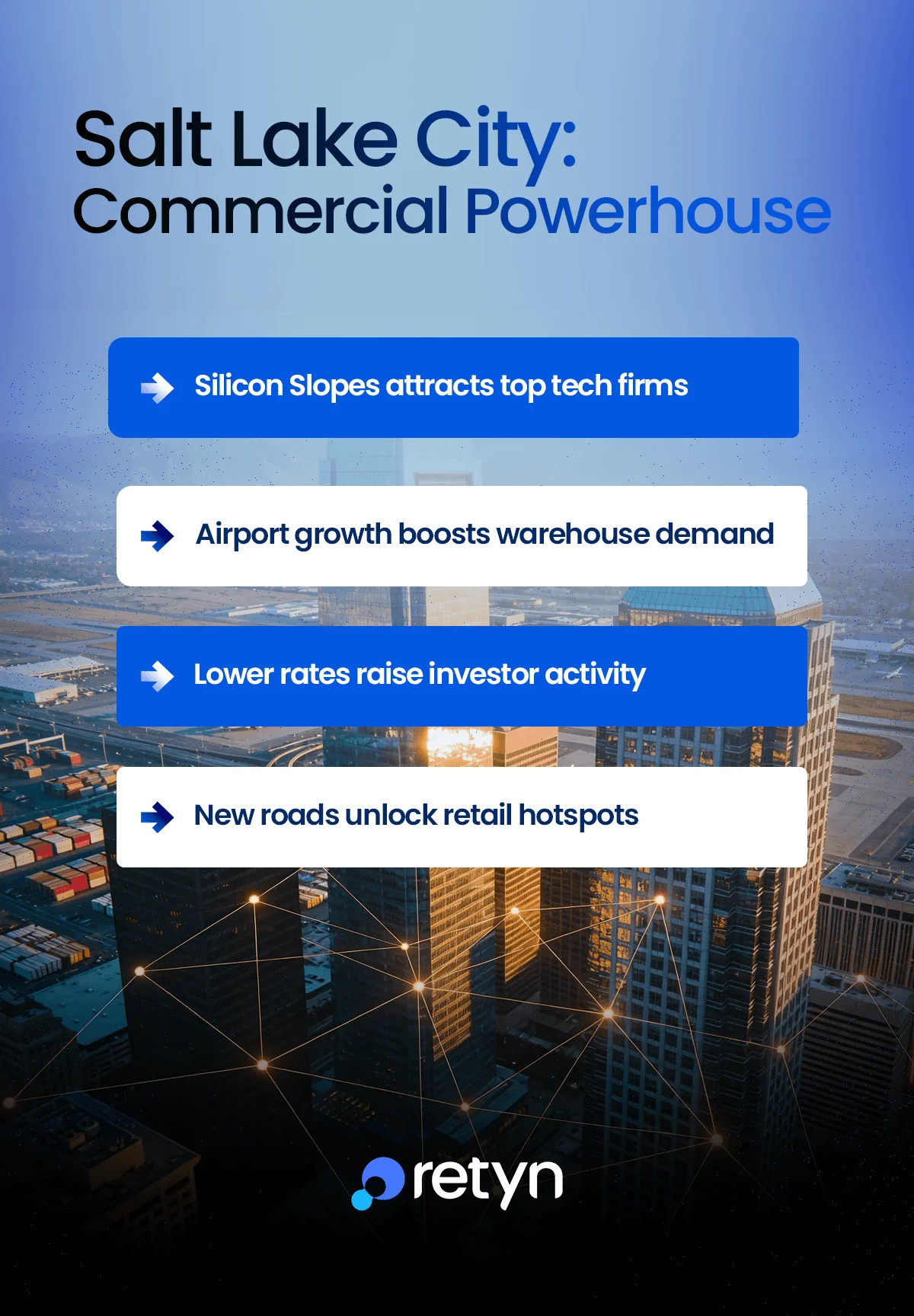
- The Silicon Slopes corridor continues to attract California-based firms seeking lower operational costs and a highly educated workforce.
- The expansion of the North West submarket near the Salt Lake City International Airport fuels massive industrial and big-box distribution demand.
- Stabilizing interest rates in early 2026 have renewed investor confidence, leading to a 9.5% increase in annual investment volume.
- Major infrastructure projects along the Mountain View Corridor are opening new nodes for retail and mixed-use development.
Source: Cushman & Wakefield, Newmark Mountain West, Colliers Utah
Source: CBRE, Align CRE, MWCRE
Consult with a Utah commercial specialist
Quick Chat
The Wasatch Front offers a diverse array of asset classes, each reacting differently to the 2026 economic climate. Identifying the right segment is critical for aligning with long-term growth projections.
- Industrial users are shifting focus toward shallow-bay and mid-size facilities under 100k square feet, where vacancy remains significantly lower than the big-box sector.
- The office market is defined by a flight to quality, with Class A assets in Downtown and Silicon Slopes maintaining high occupancy through premium amenities and turnkey SPEC suites.
- Retail space remains the tightest asset class in Utah, with record-low vacancies driving intense competition for high-visibility locations in growing suburban hubs.
- Multifamily developments near the University of Utah and major transit lines continue to see strong absorption as the regional population growth outpaces new housing deliveries.
Strategic investors prioritize Salt Lake City for its pro-business environment and the stability provided by a diverse economic base.
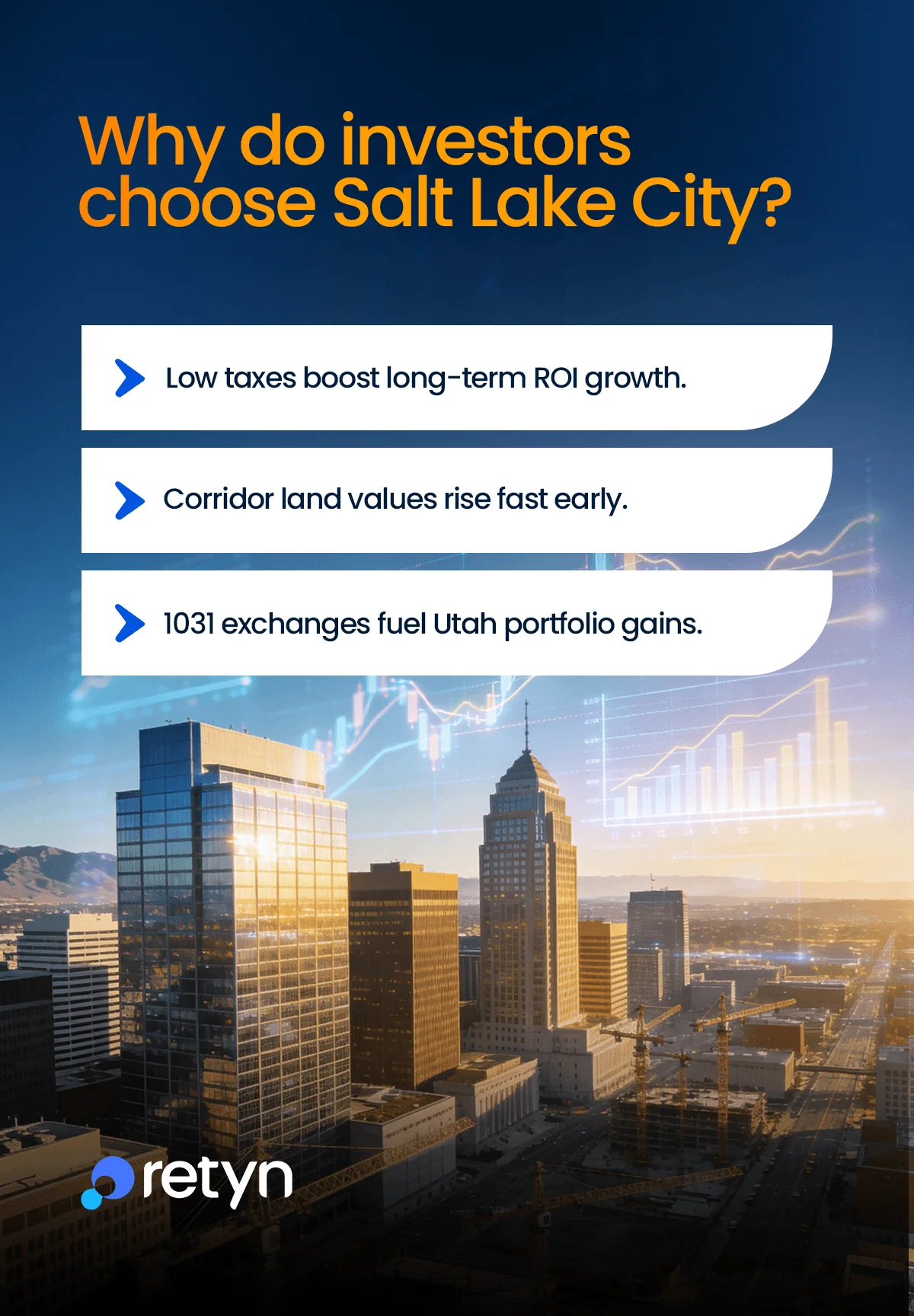
- Utah’s favorable corporate tax structure and consistent ranking for economic outlook provide a secure backdrop for long-term capital deployment.
- The rapid appreciation of land values along the Mountain View Corridor offers significant equity growth potential for early-stage industrial and mixed-use developments.
- Sophisticated investors frequently utilize 1031 exchanges to transition from underperforming coastal assets into high-growth Utah commercial portfolios.
Rapid expansion in the Intermountain West has introduced specific operational hurdles that require local expertise to navigate effectively.
- Elevated construction and labor costs have caused a sharp decline in new retail and office starts, leading to an imbalance between supply and demand.
- The challenge of repurposing aging Class B and C office inventory into residential or mixed-use spaces requires complex zoning and structural underwriting.
- Fragmented municipal zoning regulations across the various Wasatch Front counties can result in extended timelines for site entitlements and project approvals.
- Increased competition from national firms entering the Utah market has intensified the struggle to recruit and retain top-producing brokerage teams.
Commercial real estate firms along the Wasatch Front are increasingly leveraging PropTech to streamline complex transactions and provide transparency to national investors.
- High-definition 3D virtual walkthroughs allow out-of-state institutional partners to inspect industrial assets in the North West submarket without immediate travel.
- Real-time market dashboards offer granular insights into net absorption and effective rent growth across Silicon Slopes and Downtown SLC.
- Integrated platforms manage multi-state disclosures and environmental impact addenda, ensuring compliance with Utah's rigorous commercial regulations.
- AI-powered CRM systems automate lead scoring for corporate relocations and track long-term lease expirations for proactive tenant representation.
The Salt Lake City commercial market is navigating a sophisticated recovery defined by specialized demand and high-value asset competition. Brokerage teams that adopt modern automation and data-centric tools will be best positioned to serve the influx of institutional capital entering the region. As the Crossroads of the West continues to expand, maintaining operational efficiency through technology is no longer optional—it is a competitive necessity.
The long-term outlook for Salt Lake City remains positive, supported by solid population growth and a business-friendly environment that appeals to institutional capital. Teams that focus on operational efficiency and workforce strategy—such as competitive compensation and flexible work—will dominate the next phase of the cycle. Explore our operational efficiency case study to see how leading firms are scaling their impact in similar high-growth markets.
A real estate growth platform provides the infrastructure needed to manage diverse commercial portfolios, enhance reporting compliance, and maximize investor returns.
Empower your Salt Lake City brokerage to dominate the Silicon Slopes market with an AI-powered commercial CRM.
Get CRM now
FAQs on Salt Lake City commercial real estate
Class A office vacancy in downtown Salt Lake City remains around 14.1% as of early 2026. While total office vacancy is higher than in previous years, tenants continue to prefer newer, high-quality office space with amenities, which is helping high-amenity buildings see stronger absorption.
Commercial property sales within Utah are classified as non-disclosure transactions. Consequently, commercial property sellers in the state do not have to publicly report the sale price. Therefore, real estate investors and brokers often rely on their own proprietary data or professional networks to estimate the market value of a commercial property.
- The closest proximity to both the Salt Lake City International Airport and the Global Trade Port.
- Direct access to interstate highways I-80 and I-15 for regional logistics.
- Plenty of land available for large big-box warehouse and industrial complexes.
- Potential Inland Port Authority tax incentives for qualifying manufacturing entities.
While speculative (spec) office suites can be found in the Silicon Slopes market, the availability of these suites is often contingent upon both property type and landlord strategy. Some landlords provide spec suites to attract technology companies or other businesses that need immediately available, move-in-ready space, rather than having to undertake a custom office build-out.
As long as investors follow federal Section 1031 guidelines, they may defer paying capital gains taxes if they reinvest the proceeds into like-kind commercial property in Utah. However, because Utah has its own business nexus laws, investors should consider working with a local qualified intermediary who can assist with state-specific filing requirements and compliance.
The number of vacant retail properties located in areas with strong retailer demand, such as Farmington, Utah or Sugar House, Salt Lake City, is limited because there is significant demand from tenants in the Salt Lake City retail market. It can be difficult to find well-located street-level or restaurant retail space in established suburban districts with many potential tenants since competition among interested tenants is often strong.
Commercial property taxes in Salt Lake City tend to be lower than those in many large U.S. cities. However, Utah periodically reassesses commercial properties as property values increase, which may result in a higher assessed value. Property owners should regularly review their property assessments and consider filing an appeal if the valuation does not reflect current market conditions.
Disclaimer: Retyn does not promote or endorse any company listed above. The firms identified are selected based on publicly available transaction data and market presence in early 2026. Data is subject to change based on market fluctuations.