The New York City commercial real estate market in 2026 is showing a shift toward “flight to quality,” with investors showing more interest in premium commercial properties. The Manhattan skyline will continue to evolve as more high-end, amenity-rich, trophy buildings are being built in both Downtown and Midtown. Institutional investors and corporate occupiers are focusing on a real estate growth platform that manages higher floor area ratio utilization and sustainable infrastructure development. As a result, much of the new leasing activity is taking place in these high-quality and recently developed properties.
Capital market access and complex leasing arrangements usually require experienced advisory support. Many commercial real estate brokerage companies use data analysis to evaluate net effective rent and concessions. Outside office space, SoHo and Fifth Avenue have limited availability. Global brands are locking in flagship store space on long-term leases. Real estate marketing automation tools are being used for site selection and customer targeting.
New York City is becoming a key market for reusing or repurposing existing buildings in commercial real estate. The 485-x program offers property tax exemptions to encourage developers to build new residential units, including both market rate and affordable housing and to convert eligible properties into residential units. The analysis below highlights leading brokerage firms and key market indicators that help with bypassing the hassles of New York metropolitan area's commercial sectors.
Leading brokerage firms in NYC are using advanced data analytics and global networks to stay ahead in one of the most competitive markets. Many firms adopt strategies similar to those used by top 100 real estate companies in the USA. Below we have provided a list of the top commercial brokerage firms along with a market snapshot to help landlords, institutional investors and corporate tenants.
See how a dedicated CRM helps NYC brokerages manage complex lease expirations, track Trophy asset availability, and automate tenant follow-ups.
Explore CRM

The following table outlines eight of the most influential commercial real estate firms operating within the five boroughs, categorized by their market specialization and core advisory services.
Consult with a New York City commercial property specialist
Quick Chat
1
CBRE Group, Inc.
Website: cbre.com
Regional HQ: New York, NY
Market Impact: Consistently ranked as the global leader in investment sales and leasing volume.
Key Leadership: Mary Ann Tighe – CEO, NY Tri-State Region
Core Services: Office leasing, capital markets, and strategic consulting.
Recent Achievement: Handled over $175 billion in global investment sales within the past year.
2
Cushman & Wakefield
Website: cushmanwakefield.com
Regional HQ: New York, NY
Market Impact: A primary leader in Manhattan’s retail and industrial sectors.
Key Leadership: Andrew McDonald – Global President
Core Services: Global occupier services and investment management.
Recent Achievement: Manages a global portfolio exceeding 6 billion square feet of commercial space.
3
Colliers International
Website: colliers.com
Regional HQ: New York, NY
Market Impact: Recognized for leasing more total square footage than any other top-tier firm in recent reports.
Key Leadership: Jay S. Hennick – Chairman & CEO
Core Services: Valuation, project management, and corporate advisory.
Recent Achievement: Successfully leased over 770 million square feet across its global network.
4
Newmark
Website: nmrk.com
Regional HQ: New York, NY
Market Impact: Leading the market in debt and equity originations and large-scale investment sales.
Key Leadership: Barry Gosin – CEO
Core Services: Capital markets, debt restructuring, and tenant representation.
Recent Achievement: Continued expansion of its capital markets platform and market share gains in investment sales and debt placement.
5
JLL (Jones Lang LaSalle)
Website: us.jll.com
Regional HQ: New York, NY
Market Impact: A top competitor in corporate tenant representation and technology-driven property management.
Key Leadership: Peter Riguardi – Chairman and President, NY Region
Core Services: Corporate solutions, tech-integrated property management, and leasing.
Recent Achievement: Pioneered the use of AI-driven analytics for predicting micro-market leasing trends.
New York City’s commercial sector remains the global benchmark for real estate investment. In 2026, several macroeconomic and policy-driven factors are fueling its continued expansion:
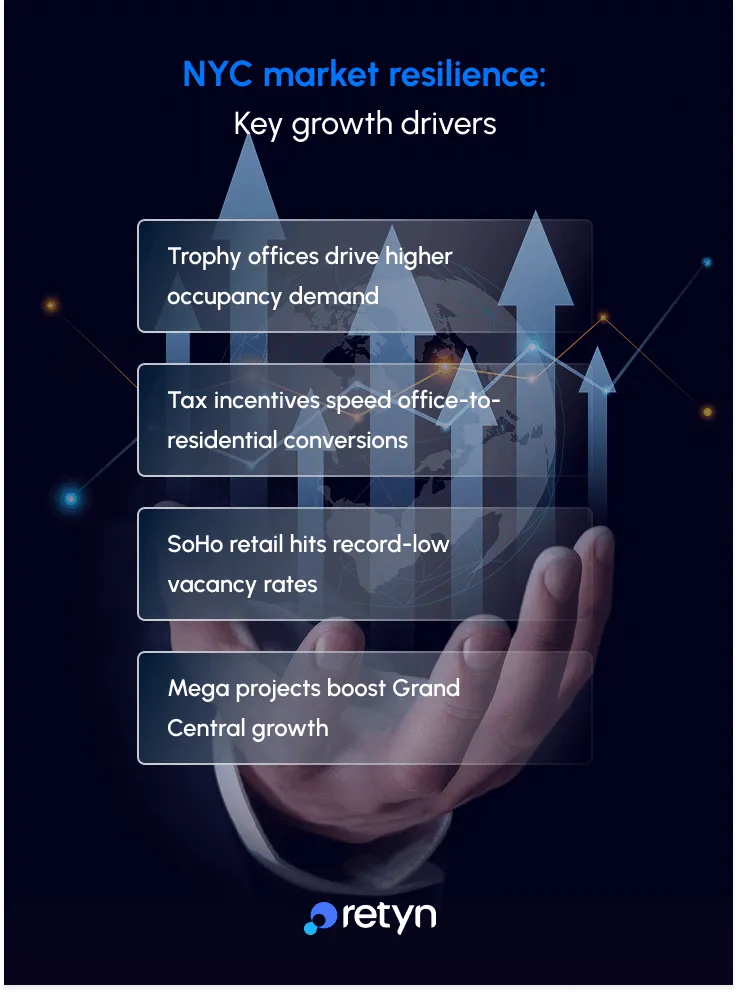
- A sustained flight to quality has increased occupancy rates in new, amenity-rich Trophy assets across Midtown.
- State and local tax incentives are accelerating the conversion of older office stock into high-end residential units.
- Prime retail corridors like SoHo are experiencing record-low availability as global brands transition from tenants to owners.
- Massive infrastructure projects like the 270 Park Avenue JPMorgan headquarters and 175 Park Avenue are revitalizing the Grand Central sub-market.
Source: CBRE, Cushman & Wakefield, Avison Young
Source: JLL, Real Estate Board of New York (REBNY)
Talk to a New York commercial property expert
Quick Chat
The New York City market is highly segmented, offering distinct opportunities across office, retail, and industrial classes.
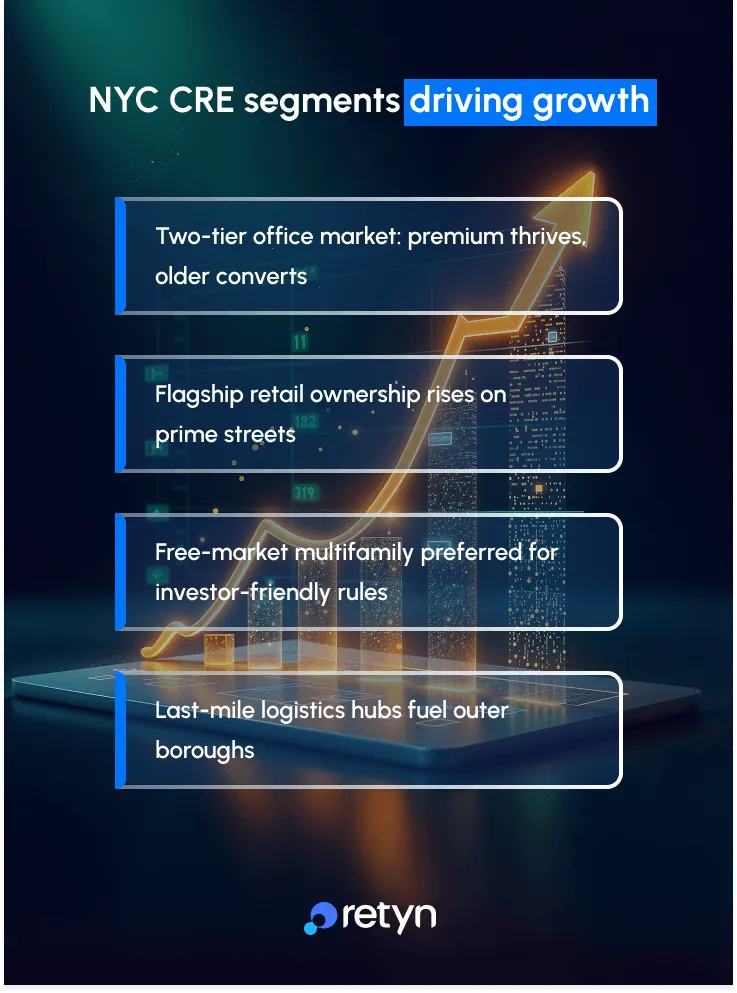
- The office sector is currently a two-tiered market where Class A and Trophy buildings see high demand while older Class B buildings are prime candidates for residential conversion.
- Retailers are increasingly seeking ownership of their flagship locations to secure long-term footprints in high-traffic corridors like Fifth Avenue and SoHo.
- Free-market multifamily buildings are highly favored by institutional investors over rent-stabilized assets due to more favorable regulatory environments.
- Last-mile industrial facilities in outer boroughs like Queens and Brooklyn remain essential for logistics providers serving the city's dense population.
Sophisticated investors capitalize on the liquidity, depth, and structural shifts of the world’s most active real estate market.
- New York offers unmatched market liquidity, allowing for large-scale capital deployment and exit strategies that are not possible in smaller metros.
- New tax incentive programs like 485x are designed to spur the development of rental housing and mixed-use projects.
- Strategic repositioning of older office assets into modern, amenity-rich spaces provides significant value-add opportunities for developers.
Operating in the most complex real estate market in the world presents unique operational hurdles for modern brokerage teams.
- Navigating evolving local laws and emission standards requires constant compliance monitoring and specialized expertise.
- The extended duration of the commercial contract-to-close cycle can strain brokerage cash flow and resource allocation.
- The rise of specialized boutique firms is intensifying the competition for top-producing talent and exclusive listings.
- Fragmented market data often leads to information silos, making it difficult to provide real-time insights to institutional clients.
Increasingly, Manhattan firms are adopting a specialized commercial real estate CRM to automate the evaluation of high-value portfolios and streamline the contract-to-close cycle.
- AI-powered tools and an integrated CRM for real estate agents now allow brokers to track complex stacking plans and multi-year lease expirations with unprecedented accuracy.
- Digital twins and 3D modeling allow international investors to conduct virtual tours and space planning for Manhattan office floors from anywhere.
- Smart contracts and blockchain-based ledger systems are beginning to reduce the friction and time associated with commercial title transfers.
- Predictive analytics platforms provide brokers with early indicators of tenant movement and sub-market pricing shifts.
- Specialized commercial CRM platforms automate the tracking of complex stacking plans and multi-year lease expirations.
The NYC commercial market is entering a phase of high-value transformation where modern tools define success. Teams can quickly begin organizing their active opportunities by utilizing a free deal pipeline tracker to visualize progress from prospecting to final signature. Adopting integrated growth solutions today ensures a smoother transition as Manhattan continues to lead the global property market.
A real estate growth platform enables NYC firms to maximize ROI through automated compliance and personalized client engagement.
Empower your Manhattan brokerage to dominate the market with an AI-powered commercial CRM.
Get CRM now
FAQs on New York City commercial real estate
Beginning in the early 2026 market, a noticeable gap remains between the asking rents and the net-effective rents in Manhattan, because of substantial tenant-improvement allowances and free rent periods. The asking rents for top-tier properties can exceed $110 per square foot. But the net-effective rents are often lower once landlord concessions are factored in.
In 2025, buildings that do not meet the carbon emissions caps set forth under Local Law 97 will face annual penalties. Currently, investors are taking into consideration the cost of energy retrofits when they apply capital expenditures (CapEx) discounts to non-compliant properties. Those additional costs are also reducing projected terminal capitalization rates for non-complying commercial properties.
Most of the office-to-residential conversion is taking place within the lower Financial District and Midtown East. The older Class B and C office buildings that typically include characteristics such as smaller floor plates and centrally located elevator cores, provide developers with easier opportunities to convert their older offices to residential units due to the current zoning incentives.
The typical tenant improvement allowance for a new ten-year lease currently ranges from $120 to $150 per square foot. The large amount of incentive being provided by landlords is to attract high-credit tenants to the newly renovated or recently completed trophy office buildings.
There is a significant split in Midtown South's office market due to the flight to quality with newer amenity-rich buildings (Hudson Yards and the Plaza District) doing very well and the older loft-style buildings struggling with higher vacancy rates as tech firms migrate to newer building spaces.
Yes. Luxury retailers are buying up their own flagship stores instead of renting them. By acquiring locations on Fifth Avenue and in SoHo, luxury retailers have more control over prime retail space and are less affected by future rent increases.
Currently, the 485-x program (Affordable Neighborhoods for New Yorkers) is supporting new residential, primarily rental, development pipelines. The program provides tax relief for developers who meet specific affordable housing and prevailing wages requirements, offering the long-term viability of larger projects in New York City.
Disclaimer: Retyn does not promote or endorse any company listed above. The companies were selected based on market volume and industry reputation as of early 2026. Data is sourced from public records and is subject to change.