New Jersey’s commercial real estate market is defined by its role as one of the world's key logistics and distribution hubs and a stabilizing office environment. In 2026, the Garden State continues to see a flight-to-quality trend with investments being made primarily in Class A assets. Because these high-stakes transactions can be complex, many companies are adopting a real estate growth platform to centralize their operations and analyze market data.
After a long stretch of fast-paced rent increases, the industrial sector is getting more balanced again. This creates new investment and tenant options in port-adjacent areas. Many brokers have adopted commercial real estate CRM systems to better manage their investor relationships and monitor transactions more effectively.
Leading brokerage firms now use sophisticated methodologies such as advanced research, data analytics and advisory strategies similar to the best real estate companies in the USA to stay competitive in the Northeast region. Whether you are seeking last-mile logistics or looking to repurpose distressed office parks, the following analysis of the top New Jersey commercial brokers provides the data-driven insight required to achieve 2026 market success.
See how a dedicated CRM helps New Jersey brokerages manage Emerge tax credits, automate tenant follow-ups, and stay compliant with DEP regulations.
Explore CRM

This table features eight powerhouse firms that dominate the New Jersey commercial sector, ranked by transaction volume, square footage managed, and regional influence.
Talk to a U.S. commercial property expert
Quick Chat
1
JLL (Jones Lang LaSalle)
Website: jll.com
NJ Headquarters: East Rutherford, NJ
Market Performance: Ranked #1 by square footage with 45.3 million sq. ft. leased or sold.
Key Person: Jose Cruz – Senior Managing Director, Capital Markets
Core Services: Industrial logistics, capital markets, supply chain consulting
Recent Success: Won Industrial Deal of the Year for a 1.7 million-sq.-ft. lease with TJX Cos.
2
CBRE
Website: cbre.com
NJ Headquarters: Saddle Brook, NJ
Market Performance: Highest deal volume in the state with over 1,036 transactions completed.
Key Person: Jeffrey Dunne – Vice Chairman, Investment Sales
Core Services: Investment sales, office leasing, retail advisory
Recent Success: Frequently leads the NJBIZ CRE Power List for dominance in large-scale investment sales.
3
Cushman & Wakefield
Website: cushmanwakefield.com
NJ Headquarters: East Rutherford, NJ
Market Performance: Ranked third in the state with 33.5 million sq. ft. across 843 deals.
Key Person: Peter Bronsnick – Managing Principal, New Jersey
Core Services: Industrial, retail, valuation and advisory
Awards: Named Best Commercial Real Estate Firm by NJBIZ Reader Rankings for four consecutive years.
4
The Blau & Berg Company
Website: blauberg.com
Headquarters: Short Hills, NJ
Market Performance: The top-ranked independent firm in the state, handling 31.6 million sq. ft.
Key Person: Alessandro (Alex) Conte – Executive Vice President
Core Services: Port-centric industrial brokerage, site selection, asset management
Specialty: Industrial real estate brokerage across Northern New Jersey, including port-adjacent logistics markets near Newark and Elizabeth.
5
NAI DiLeo-Bram & Co.
Website: naidb.com
Headquarters: Woodbridge, NJ
Market Presence: Leading regional player within the NAI Global network.
Key Person: Chris Galiano – Managing Director
Core Services: Multi-generational brokerage, industrial leasing, acquisitions
Expertise: Known for deep local roots and high-yield transactions in Central New Jersey.
The commercial landscape in New Jersey is driven by its proximity to New York City and its status as a top-tier logistics gateway. In 2026, several key factors underpin the sustained demand for Garden State assets:
- The flight to quality continues to concentrate demand in Class A office spaces that offer modern amenities and sustainable infrastructure.
- Port-related industrial demand remains high as container volumes at Port Newark and Elizabeth continue to grow.
- Office market stabilization is occurring as 2025 marked the first full year of positive net absorption for premium buildings since 2019.
- State-level incentives like the Emerge program remain a significant draw for corporations relocating to New Jersey urban centers.
Source: NJBIZ, JLL Research, CBRE Market Reports
Source: Colliers, Cushman & Wakefield, LoopNet
Talk to a U.S. property expert
Quick Chat
The Garden State offers diverse commercial asset classes, each responding differently to current economic shifts and supply chain needs.
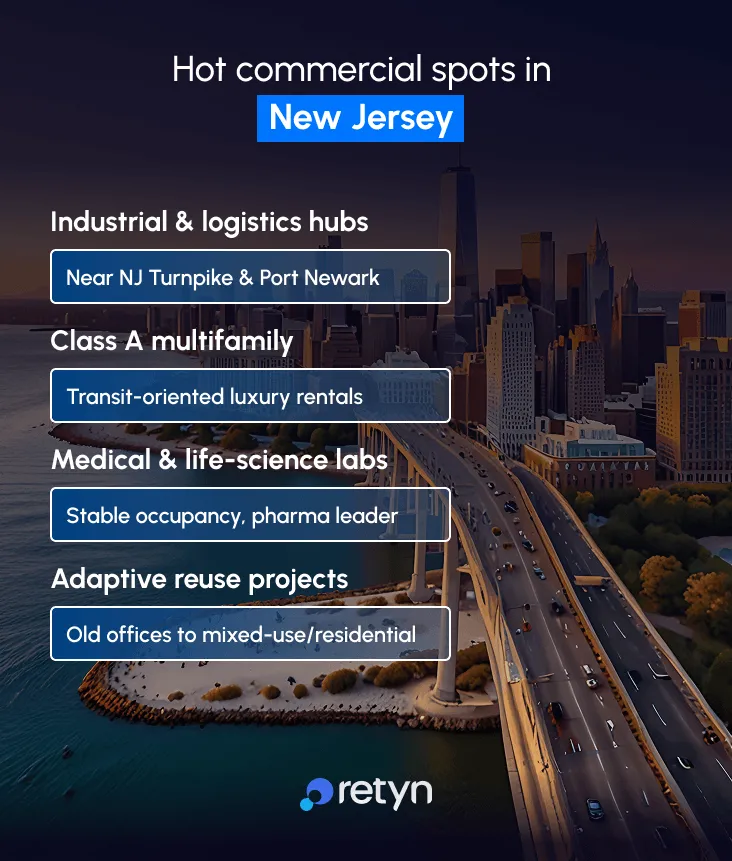
- Industrial and logistics assets remains the strongest segment, particularly for properties with immediate access to the New Jersey Turnpike and Port Newark.
- Class A multifamily developments continue to thrive in transit-oriented hubs like Jersey City and Morristown to meet the demand for luxury rental housing.
- Medical office buildings and life-science labs benefit from stable occupancy rates as New Jersey remains a global leader in the pharmaceutical sector.
- Adaptive reuse projects are gaining traction as developers convert older, underutilized office parks into modern mixed-use or residential spaces.
Experienced investors capitalize on the robust infrastructure and business-friendly incentive programs unique to the New Jersey commercial market.

- The Emerge program and other state-level tax credits provide significant financial offsets for companies expanding or relocating to the state.
- High barrier-to-entry submarkets ensure long-term value preservation and steady rental growth for owners of prime industrial and retail assets.
- Strategic use of 1031 exchanges allows investors to defer capital gains while upgrading their portfolios into higher-performing New Jersey commercial properties.
Navigating the New Jersey market requires overcoming complex regulatory hurdles and operational inefficiencies.
- Complex DEP regulations and fragmented flood zone mapping often lead to extended due diligence periods and underwriting delays.
- Managing the high volume of documents required for commercial closings puts a strain on firms still relying on manual administrative processes.
- The flight to quality has increased competition among brokers for a limited supply of premier Class A listings.
- Interest rate volatility continues to create pricing gaps between buyers and sellers, requiring more sophisticated negotiation and valuation skills.
PropTech is becoming a critical differentiator for New Jersey firms looking to streamline transactions. For those just starting their digital journey, an in-depth real estate CRM guide can provide the roadmap needed for successful implementation.
- Firms managing massive port-centric assets are turning to a listing management platform to sync property data across multiple channels effortlessly.
- To maintain engagement with long-term prospects, high-performing teams leverage a marketing automation platform for multi-channel lead nurturing.
- Advanced data analytics platforms provide real-time insights into submarket absorption rates and historical pricing trends.
- Digital transaction management systems ensure compliance with state-specific environmental and zoning disclosures.
- Virtual site tours and 3D modeling allow international investors to evaluate New Jersey assets without the need for immediate travel.
- AI-powered CRM platforms help brokerages prioritize high-value leads and automate routine communications to maintain client engagement.
The New Jersey commercial market is entering a phase of stabilization and selective growth. Success in 2026 belongs to firms that can navigate pricing recalibrations in the industrial sector while capturing the steady demand for Class A office and life-sciences space. By utilizing modern growth platforms and advanced data analytics, top-tier brokerages are effectively managing complex regulatory requirements and delivering superior ROI for their clients.
A real estate growth platform provides the tools necessary to personalize institutional client experiences, enhance compliance with state environmental laws, and maximize transaction volume in a competitive landscape.
Empower your New Jersey brokerage to convert institutional inquiries into closings with AI-powered CRM.
Get CRM now
FAQs on New Jersey commercial real estate
Tenants are increasingly demanding modern Class A space with high-quality amenities and sustainable infrastructure. In this manner, NJ office space has experienced its first full year of positive net absorption since 2019, while rents for premium buildings have increased by 3.4% year over year.
The industrial market has entered a period of price recalibration. Despite a continued demand for space near Port Newark, average asking rent in core submarkets such as the Meadowlands and Elizabeth have declined for six consecutive quarters through late 2025. In some cases, rents fell by roughly 5% to 15%.
New Jersey offers several incentive programs for commercial tenants and employers, most notably the Emerge program. This program provides per-job tax credits to projects that invest in the state and create or retain good paying jobs.
Regulations from New Jersey's Department of Environmental Protection (DEP), such as flood zone mapping and ISRA compliance, may create additional hurdles for the commercial closing process. Mapping inconsistencies or environmental review processes may also slow down underwriting timelines and require specialized real estate brokers to perform environmental due diligence at an earlier stage in a transaction.
Yes, smart investors commonly utilize 1031 exchanges to defer capital gains tax while increasing the value of their portfolio. In 2026, some investors are moving out of underperforming assets and into stronger sectors such as industrial and multifamily properties to improve overall portfolio performance.
The most common commission rate for commercial real estate transactions in New Jersey typically ranges from approximately 4% to 8% depending upon the property type and deal size. Tenant representation is often free for the tenant as the landlord will pay the brokerage fee, making it a valuable service for companies planning a relocation.
The transit-oriented hubs of Jersey City, Hoboken and Morristown have been among the most resilient during this time. Developers who can meet the state's affordable housing requirements, with a goal of adding approximately 65,000 to 84,000 new affordable housing units, often benefit from strong occupancy levels and political support.
Disclaimer: Retyn does not promote or endorse any company listed above. The companies listed are selected based on publicly available data and market performance metrics as of early 2026. Data is compiled from sources like NJBIZ, JLL Research, and CBRE Market Reports and may change without notice.