The Houston commercial real estate market in 2026 is seeing a flight to quality in office space while industrial demand is holding up well. With record cargo volumes at Port Houston, including continued year-over-year growth in 2025 and 2026. Corporate tenants have a strong preference for higher-quality office buildings in the city's prime submarkets like the Energy Corridor and The Woodlands. These two submarkets are both experiencing stronger leasing activity with less available space, which is increasing competition for Class A office space.
Many of the top real estate companies in Texas operate actively in Houston, making local brokerage expertise especially important in this market. Whether an institutional investor is looking at the cap rate potential of suburban retail centers in Katy or a medical logistics company needs expertise in tenant representation when selecting sites for their operation, it is imperative that you select the right advisors. Strong local brokerages help investors analyze current investment sales trends, develop proactive management strategies and negotiate on behalf of the client to increase asset value. They also help minimize operational risk.
We have put together an overview of leading commercial real estate firms in the Greater Houston area to help investors, landlords and occupiers make better business decisions. This guide covers local and global agencies based on their sector expertise, similar to how top commercial real estate companies in the USA are evaluated. Reviewing these industry leaders along with current net absorption trends will allow stakeholders to identify the brokerage firm that best fits their needs for successful commercial transactions.
See how a dedicated CRM helps Houston firms automate follow-ups, manage industrial lease complexities, and stay compliant with Texas commercial regulations.
Explore CRM

This table highlights eight premier commercial real estate firms operating in the Greater Houston area along with their key specializations.
Talk to a U.S. property expert
Quick Chat
1
CBRE Group
Website: cbre.com
Local Leadership: Russell Hodges
Established Year: 1906
Core Services: Leasing, investment sales, property management
Market Status: Ranked top brokerage by licensed professionals with 204 local experts moving over 30 million square feet.
2
JLL
Website: us.jll.com
Local Leadership: Ronnie Deyo
Established Year: 1999
Core Services: Office tenant representation, landlord representation, industrial logistics
Market Status: Leads the Houston market by volume after moving nearly 49 million square feet in recent cycles.
3
Transwestern
Website: transwestern.com
Local Leadership: Larry Heard
Established Year: 1978
Core Services: Office and industrial sectors, property management, local development
Market Status: A major locally headquartered player delivering over 1.4 million square feet of new space recently.
4
Partners Real Estate
Website: partnersrealestate.com
Local Leadership: Jon Silberman
Established Year: 1997
Core Services: Investment sales, industrial, office leasing
Market Status: The largest independent and privately held commercial firm in Texas moving 12.2 million square feet.
5
Hughes Marino
Website: hughesmarino.com
Specialty: Tenant representation exclusively
Established Year: 2011
Core Services: Office, industrial, and life science tenant representation without landlord conflicts
Market Status: Highly rated for responsiveness and personalized client satisfaction in the Houston region.
Houston leverages its energy-centric landscape, booming logistics infrastructure, and pro-business tax policies to maintain long-term commercial real estate demand. Key market drivers include the following factors.
- A lack of state income tax and favorable corporate regulations attract sustained business relocations and expansions.
- Record cargo activity at Port Houston fuels rapid absorption of large-scale industrial distribution centers.
- A sustained flight to quality keeps Class A office buildings in prime submarkets highly occupied and competitive.
- Strategic proximity to international trade routes and major shipping channels solidifies the city as a top national exporter.
Source: Houston Business Journal, Local Brokerage Data
Source: Local Brokerage Market Intelligence
Talk to a U.S. property expert
Quick Chat
Diverse opportunities exist across the Houston metropolitan area for institutional investors and corporate tenants evaluating different asset classes.
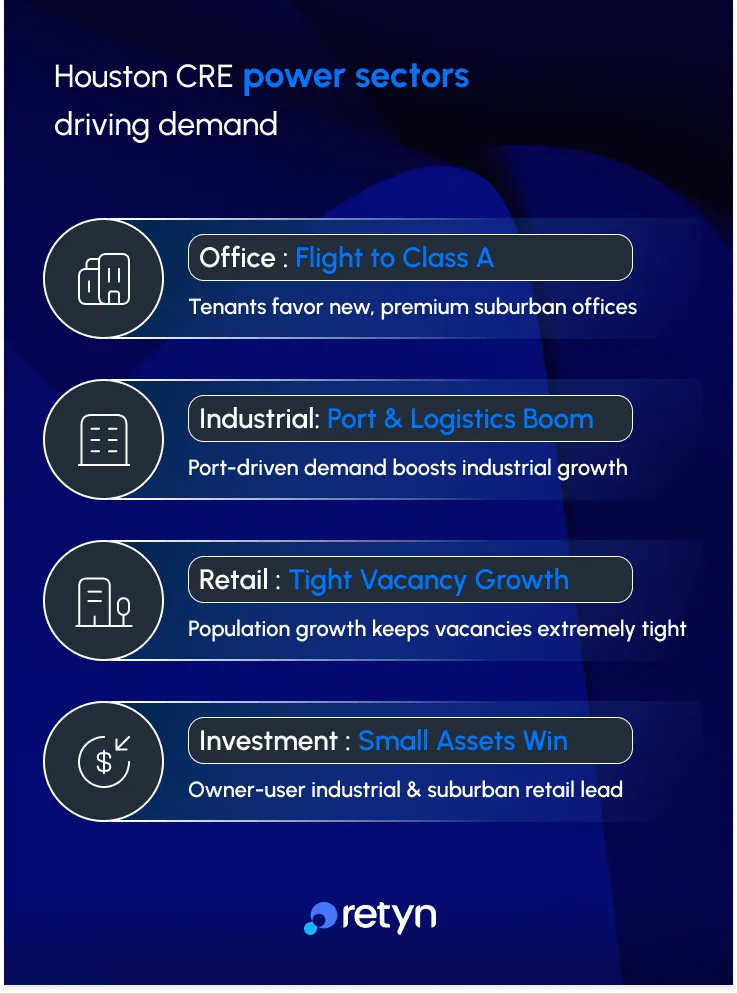
- The office sector is experiencing a clear flight to quality as tenants prioritize newer Class A trophy buildings in premium suburban nodes over older assets.
- Industrial space linked to Port Houston and the Northwest submarket absorbs high capacity due to sustained e-commerce and regional logistics demand.
- Retail properties maintain exceptionally tight vacancy rates supported by rapid population growth and limited new construction deliveries.
- Investment sales activity heavily favors owner-user industrial properties under 30,000 square feet and well-positioned suburban retail centers.
Capital allocators are leveraging the expanding Houston economy, massive export volumes, and highly favorable corporate tax structures.

- The absence of state income tax lowers overall operational costs and attracts sustained corporate migration from coastal markets.
- The status of the city as a top national exporter moving over $180 billion annually guarantees long-term utilization of industrial assets.
- High-growth suburban retail corridors in areas like Katy generate reliable yield profiles for well-positioned shopping centers.
Shifting macroeconomic conditions and evolving tenant demands create distinct operational hurdles for local commercial real estate professionals.
- Older Class B office assets struggle to maintain occupancy as tenants migrate to premium Trophy buildings in prime submarkets.
- The industrial sector must digest a massive 11 million square foot construction pipeline, causing slight upticks in local vacancy rates.
- High interest rate environments complicate underwriting processes and slow down closing timelines for large institutional investment sales.
- Industrial and office tenants require highly specialized knowledge of the energy-centric landscape, forcing brokers to act as deep subject matter experts.
Leading Houston commercial real estate firms are rapidly deploying PropTech to automate complex lease analyses, manage vast portfolios, and attract global corporate tenants.
- Advanced market intelligence platforms provide granular data on net absorption and lease economics across micro-markets like the Energy Corridor.
- Predictive analytics allow specialized brokerages to accurately map site selection models for expanding retail franchises and medical logistics companies.
- Virtual 3D modeling of new development projects enables out-of-state corporate clients to visualize headquarters relocations prior to groundbreakings.
- Digital marketing infrastructures targeting institutional capital improve asset exposure during complex investment sales.
- AI-based commercial real estate CRM platforms automate portfolio tracking, tenant follow-ups, and massive dataset management for high-volume teams.
The Houston commercial real estate market demands high-level strategy and robust technological infrastructure. Brokerages that adopt advanced systems to manage massive industrial pipelines and complex corporate office leases will capture the most significant market share. Teams deploying automation today will execute smoother high-volume transactions tomorrow as the Texas economy continues its rapid expansion.
A real estate growth platform offers comprehensive modern solutions including pipeline management, enhanced deal compliance, and optimized return on investment for large-scale portfolios.
Empower your Houston commercial brokerage to streamline industrial site selection and corporate leasing with an AI-powered CRM.
Get CRM now
FAQs on hiring commercial real estate brokers in Houston
Look for a broker who specializes in your asset type (industrial in Northwest Houston, high-end office space in the Energy Corridor) so they understand the local market. In addition, confirm if the broker has closed many deals locally and are familiar with current market conditions.
Tenant representation brokers are advisors for tenants who work exclusively for businesses leasing the space and negotiating on their behalf, bringing favorable terms and minimizing conflicts of interest. Landlord representation brokers work directly for property owners to maximize rental income and enhance asset value.
The commission rate in a commercial real estate transaction in Houston usually falls between 4% and 6% of the total lease value or sale price. This commission is normally paid by the landlord or seller. The amount a broker is paid may also depend on the size and complexity of the deal.
There are two major reasons for this high demand for warehouses, including activity around Port Houston and the rapid growth of the logistics industry. The port itself is still among the largest exporters in the country. This means there is a need for large amounts of warehouse space for products being shipped out of Houston and for companies providing their own logistics services.
Corporate tenants continue to prioritize newer premium trophy assets in prime nodes like The Woodlands over older Class B buildings. Houston’s market shows signs of stabilization as vacancy rates improve top-tier properties, while older buildings struggle to maintain occupancy.
Typical time frames can vary depending on the complexity of the property. But normally, you can expect to spend at least three to six months on a commercial lease agreement from the date you select your site to the date that the parties sign off on the lease.
Yes. Texas does not impose a state personal income tax, which means that there is no additional state tax on capital gains. As a result, commercial real estate investors retain a larger share of their profits compared to high-tax states, which can improve overall after-tax returns, although federal taxes still apply.
Disclaimer: Retyn does not promote or endorse any company listed above. The companies listed above are selected based on publicly available data and recent market performance as of early 2026. Data is compiled from publicly available market sources and may change without notice.