The Cleveland commercial real estate market is undergoing a Midwestern reset that is based on fundamental stability and an increased flight to quality across all major asset types. In early 2026, Cleveland is expected to become one of the top destinations for institutional capital, fleeing the volatility of coastal markets. Northeast Ohio is positioned with many significant downtown development projects completed and a stabilized interest rate environment. This combination offers sophisticated investors resilient yields and sustainable entry points into the market.
The industrial and logistics sectors remain dominant within the region primarily because there is very little Class-A space available for immediate occupancy, combined with consistent inventory absorption along the I-90 and I-77 corridors. At the same time, the retail and multifamily segments are seeing high levels of occupancy and significant cap rate compression in select higher-end submarkets. As such, it is critical that a data-driven approach be taken when selecting a site or representing tenants, as errors in high-volume transactions can lead to significantly higher costs. Likewise, many successful real estate companies in Ohio rely heavily on a similar analytical process using market information and historical transaction data to make informed investment decisions.
The Cleveland commercial real estate market has become more complex and many companies now work closely with brokerage firms that rely on market analytics and local experience when evaluating opportunities. Leading commercial real estate brokers in Cleveland today often serve as advisors to their clients rather than acting only as transaction facilitators. Many firms apply the same rigorous standards used by some of the best real estate companies in the USA. This review examines several of the top-performing brokerage firms in Cleveland and outlines the major market trends shaping the Northeast Ohio real estate landscape this year. To manage high-volume transaction splits, many of these firms also use automated commission management platform so payouts to top producers remain accurate and on schedule.
See how a dedicated CRM helps Cleveland brokerages manage adaptive reuse projects, track industrial vacancies, and automate tenant lead-scoring across Cuyahoga County.
Explore CRM

The following table ranks the most active commercial firms in Cleveland by their local broker count and specialized asset expertise as of early 2026.
Connect with a Cleveland commercial property specialist
Quick Chat
1
CBRE Cleveland
Website: cbre.com
Headquarters: Cleveland, OH (The Flats)
Market Presence: 60+ Licensed Brokers
Key Person: Andrew Coleman – Senior Managing Director
Core Services: Industrial sales, office leasing, Workplace360 strategy, and asset management
Market Impact: Currently leads the market in transaction volume following the launch of their tech-integrated office in the Flats.
2
Hanna Commercial Real Estate
Website: hannacre.com
Headquarters: Cleveland, OH (Playhouse Square)
Market Presence: 35 Licensed Brokers
Key Person: R.M. Mac Biggar – President
Core Services: Corporate real estate services, property management, and accelerated marketing auctions
Market Impact: A regional powerhouse specializing in deep-rooted Northeast Ohio corporate relationships and large-scale auctions.
3
Cushman & Wakefield | CRESCO
Website: crescorealestate.com
Headquarters: Independence, OH
Market Presence: 34 Licensed Brokers
Key Person: Eliot Kijewski – Managing Partner
Core Services: Industrial leasing, logistics consulting, and office tenant representation
Market Impact: Recognized as the dominant force in the South-Centric Rockside Road corridor and industrial flex-space sectors.
4
Marcus & Millichap
Website: marcusmillichap.com
Headquarters: Independence, OH (Crown Centre)
Market Presence: 29 Licensed Brokers
Key Person: Michael Glass – First Vice President
Core Services: Multifamily investment sales, retail asset brokerage, and capital markets financing
Market Impact: The primary choice for private and institutional investors focusing on high-yield retail and multifamily acquisitions in 2026.
5
NAI Pleasant Valley
Website: naipleasantvalley.com
Headquarters: Cleveland, OH
Market Presence: 25 Licensed Brokers
Key Person: Alec J. Pacella – President
Core Services: Landlord representation, retail development, and comprehensive property management
Market Impact: Leverages a global network with hyper-local expertise to manage diverse portfolios across the greater Cleveland area.
The commercial landscape in Cleveland is currently driven by a flight to quality and significant infrastructure investments. Several economic factors underpin the stability of this market in 2026: The success of these market leaders is often underpinned by a robust real estate CRM for brokers, designed to manage institutional relationships and complex multi-year lease renewals.
- Lower entry costs compared to Chicago or East Coast markets allow investors to achieve higher initial yields on Class-B industrial assets.
- The completion of major corporate headquarters has sparked a resurgence in downtown retail and support-service occupancy.
- A renewed focus on domestic supply chains has kept industrial vacancy rates for manufacturing facilities below 5% across Cuyahoga County.
- Aggressive state-level tax incentives for adaptive reuse projects have converted older office stock into high-demand residential and mixed-use spaces.
Source: CBRE Research, Marcus & Millichap Market Reports, CoStar Group
Source: Team NEO, Greater Cleveland Partnership
Consult with a Cleveland industrial & office specialist
Quick Chat
Northeast Ohio provides a diverse array of asset classes that cater to institutional funds and private developers seeking long-term stability.
- Manufacturing and logistics hubs along the I-90 and I-77 corridors remain the strongest performers due to high demand for mid-sized distribution centers.
- Retail assets in high-income suburbs like Beachwood and Westlake are seeing record-low vacancies as consumer spending remains resilient.
- Class-A office spaces in the Central Business District are being repositioned to support hybrid work models and tech-heavy tenant requirements.
- Multifamily conversions of historic downtown buildings continue to attract investors looking for steady cash flow and high rental demand.
Strategic investors are prioritizing Cleveland due to its manageable entry prices and favorable yield spreads compared to Tier-1 coastal cities.
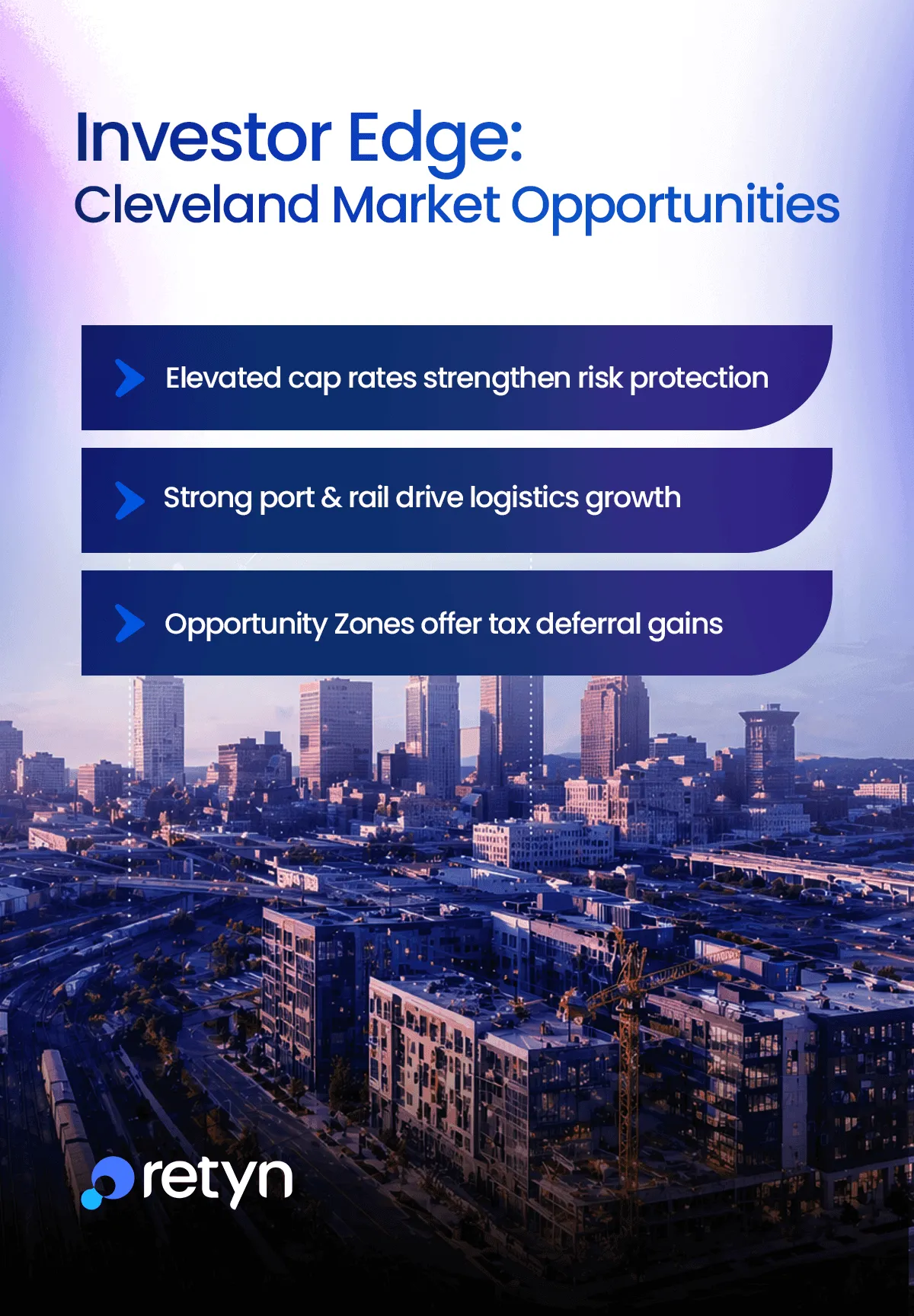
- Higher cap rates on industrial and retail properties provide a significant safety margin against market volatility.
- Proximity to the Port of Cleveland and a robust rail infrastructure creates a built-in advantage for logistics-based tenants.
- Opportunity Zone designations in emerging neighborhoods offer substantial capital gains tax deferrals for long-term development projects.
Even in a stabilizing market, local firms must navigate specific operational and regulatory hurdles to ensure successful closings. Recruiting top-tier talent in 2026 requires a transparent bonus tracking management platform to incentivize high-performance agents and tenant reps.
- Complex zoning requirements for adaptive reuse projects often lead to extended pre-development timelines and increased consulting costs.
- A shortage of move-in-ready Class-A industrial space has led to intense bidding wars among regional logistics providers.
- Fluctuating construction costs can strain the feasibility of new-build projects, making accurate cost-modeling essential for brokers.
- Shifting tenant expectations for office amenities require landlords to invest heavily in building upgrades to maintain occupancy levels.
Cleveland brokerages are increasingly adopting specialized property technology to streamline complex commercial transactions and provide real-time data to institutional partners.
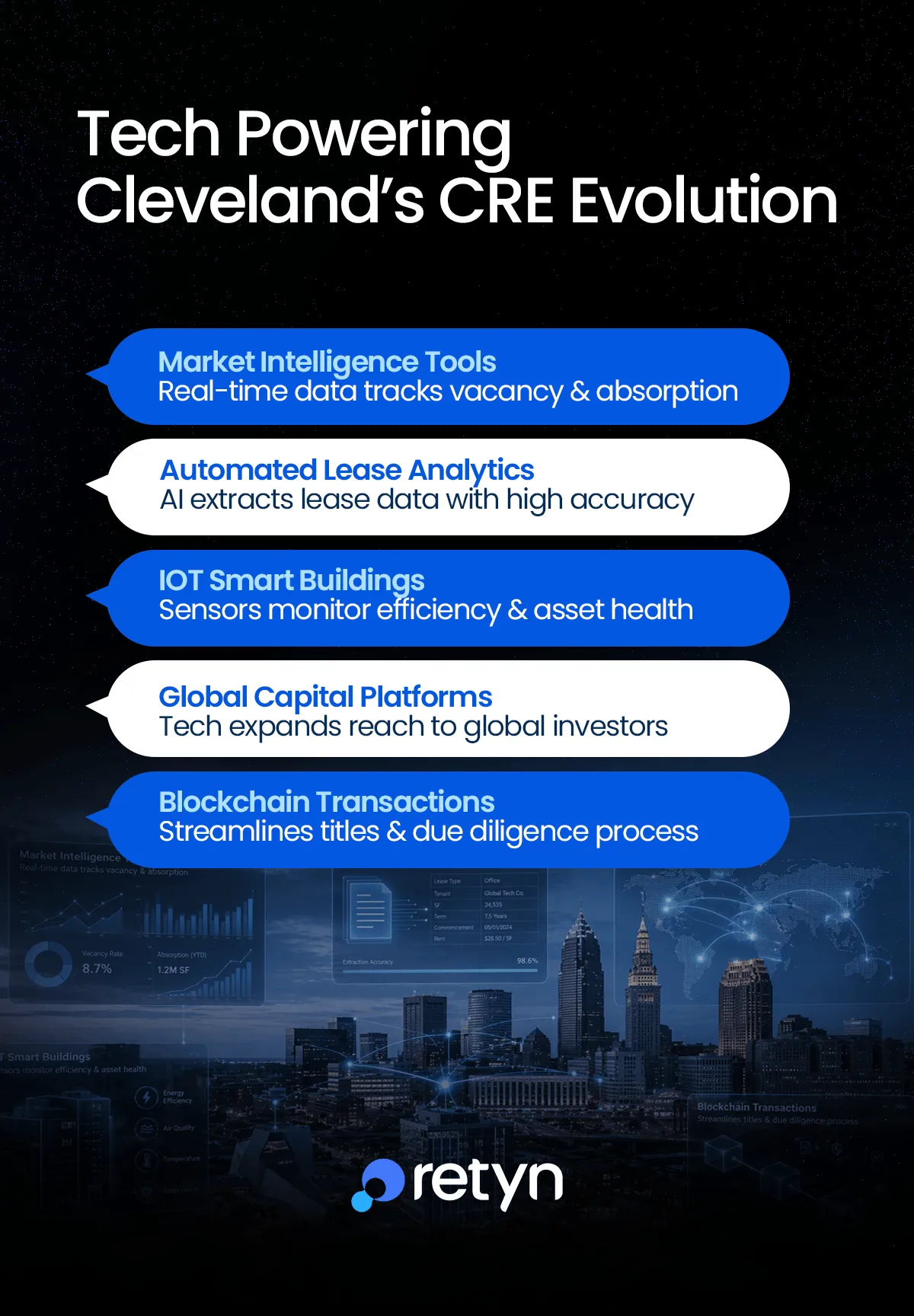
- Advanced data visualization tools now provide granular insights into sub-market vacancy rates and historic absorption patterns across Northeast Ohio.
- AI-based lease abstraction software allows brokers to process thousands of square feet of contract data in seconds, reducing human error in complex renewals.
- IoT-enabled smart building sensors are becoming standard in Class-A industrial facilities to monitor utility efficiency and structural health for remote owners.
- Digital platforms targeting global capital markets ensure that Cleveland assets receive exposure to international REITs and private equity funds.
The Cleveland commercial market is entering a phase of sustained stability where data-driven decision-making is the primary differentiator. Brokerage teams that integrate modern automation into their workflow will be best positioned to capitalize on the region’s industrial growth and retail resurgence. As the market continues to evolve, the ability to provide transparent, real-time insights will separate market leaders from the rest of the field.
A real estate growth platform provides the technical infrastructure necessary to manage large portfolios, maintain regulatory compliance, and maximize investor returns in a competitive environment.
Empower your Cleveland brokerage to scale transaction volume and automate client reporting with AI-powered CRM.
Get CRM now
FAQs on Cleveland commercial real estate
Investment is expected to grow by 16% in 2026. The basis for this recovery lies in the stability of interest rates along with a flight to quality, in which investors choose the high-yielding industrial and multifamily assets located within stable Midwestern centers as opposed to unstable coastal areas.
It dramatically affected the Central Business District by creating an additional 9.6 percent office vacancy rate in late 2025. This has further accelerated the adaptive reuse trend that is currently underway, as many of these older office buildings are being converted into other uses, including mixed-use and residential projects, to help create balance in the local real estate market.
The current strong performance in retail comes from vacancy rates that are predicted to drop to 4.5 percent. This is due to high income growth within submarkets, combined with lack of lack of new supply. Together, this makes existing retail assets incredibly competitive.
Yes. Developers use two of the most effective programs that help them recover their development costs, the Ohio Brownfield Remediation Program and local TIF (Tax Increment Financing). Both have been instrumental in updating Cleveland's aging industrial base so it can be a viable logistics option by 2026.
Vacancy rates have ranged from 3.9% to 5.8% over recent years. Demand for smaller-to-mid-sized industrial space has remained strong, while larger warehouse and distribution-type projects remain less common.
University Circle and the Rockside Road corridor serve as the main hubs for medical office buildings. The proximity to major healthcare institutions such as Cleveland Clinic and University Hospitals supports consistently high occupancy levels for clinical spaces.
Major firms like CBRE and Hanna Commercial Real Estate have invested heavily in new workplace environments such as Workplace360 and CRM automation to keep their top brokers from leaving. In addition, they can offer the type of data analytics many boutique firms do not have.
Disclaimer: Retyn does not promote or endorse any company listed above. The firms mentioned are selected based on publicly available market data and broker headcount as of early 2026. Data is subject to change based on market fluctuations.