Atlanta is one of the key economic centers in the Southeast with strong logistics, fintech and professional services sectors that continue to support demand for commercial real estate. In the Atlanta commercial real estate market through early 2026, a clear "flight-to-quality" trend has emerged where premium Class A office space in submarkets such as Midtown and Buckhead are outperforming the overall Atlanta regional market. Companies that wish to lead this transition can utilize a strong commercial real estate CRM to gather local market intelligence, support acquisition decisions and negotiate leases in this highly competitive market.
As the market evolves leading commercial brokerages in Atlanta now offer advisory support for investment, financing and other capital markets activities. Most of these firms rank among the top 100 real estate companies in the USA and provide specialized expertise in industrial real estate, logistics and supply chain driven distribution networks. For institutional investors targeting stable capitalization rates or corporate occupiers seeking experienced tenant representation, understanding current property availability is only the first step in building a long-term real estate strategy.
Atlanta MSA real estate firms are using many of the same data-driven methods as the best real estate companies in the USA, particularly as higher interest rates reshape investment decisions. Brokerages rely on property management platforms and market data tools to make the due diligence process more efficient and help clients improve their return on investment (ROI). Below is a list of leading brokerage firms in Atlanta, along with a 2026 market snapshot, to help institutional buyers, sellers and enterprise tenants make informed decisions.
See how a dedicated CRM helps Atlanta brokerages manage complex multi-party negotiations, track capital expenditure disclosures, and automate follow-ups for institutional tenants.
Explore CRM

The following table identifies eight of the most prominent commercial real estate firms operating in the 20-county Atlanta metro area, ranked by local transaction volume and specialized service capabilities.
Talk to a U.S. property expert
Quick Chat
The most successful firms in the Georgia market leverage a dedicated real estate CRM for brokers to maintain a bird's-eye view of their pipelines. For the large-scale operations seen in Atlanta, a real estate CRM for teams ensures that multi-agent coordination on institutional assets remains seamless and secure.
1
CBRE
Website: cbre.com
Atlanta Headquarters: Buckhead (Terminus 200)
Broker Count: 150 full-time licensed brokers in Atlanta
Key Person: John Ferguson – Southeast President
Core Services: Investment sales, occupier services, property management, and valuation
Market Impact: Largest firm by volume in Atlanta with $6.19 billion in local transactions in 2024
2
JLL (Jones Lang LaSalle)
Website: jll.com
Atlanta Headquarters: Buckhead
Broker Count: 89 full-time licensed brokers
Key Person: Tim McCarthy – Brokerage Lead
Core Services: Corporate solutions, tenant representation, and capital markets
Market Impact: Managed $4.71 billion in Atlanta volume with a heavy focus on institutional assets
3
Cushman & Wakefield
Website: cushmanwakefield.com
Atlanta Headquarters: Midtown (1180 Peachtree)
Broker Count: 74 full-time licensed brokers
Key Person: Tyler Courtney – Managing Principal
Core Services: Agency leasing, global occupier services, and industrial logistics
Market Impact: Key player in Midtown Class A office leasing with $4.65 billion in local volume
4
Colliers
Website: colliers.com
Atlanta Headquarters: Midtown
Broker Count: 76 full-time licensed brokers
Key Person: Nathan Knowles – Executive Managing Director
Core Services: Industrial services, retail landlord representation, and asset management
Market Impact: Manages over 107 million square feet of commercial space in the Georgia region
5
Bull Realty
Website: bullrealty.com
Atlanta Headquarters: Sandy Springs/North Atlanta
Established Year: 1998
Key Person: Michael Bull – Founder
Core Services: Investment sales, medical office, and specialized advisory
Market Impact: Renowned regional powerhouse known for high-level investment sales and market education
Atlanta remains the primary logistics and corporate headquarters destination in the Southeast due to its infrastructure and diverse talent pool. Key factors driving the commercial market include:
- A sustained flight-to-quality where tenants migrate to amenitized Class A buildings to encourage office attendance.
- Unrivaled logistics connectivity through Hartsfield-Jackson International Airport and proximity to the Port of Savannah.
- Expansion of tech-centric ecosystems in Midtown driven by proximity to Georgia Tech and a high concentration of Fortune 500 companies.
- Active adaptive reuse and office-to-residential conversions in the Central Perimeter to balance aging inventory.
Source: CBRE Research, Atlanta Business Chronicle, JLL Market Reports
Source: Colliers International, Cushman & Wakefield Submarket Reports
Talk to a U.S. property expert
Quick Chat
The Atlanta market offers diverse asset classes that cater to institutional requirements and specialized boutique needs alike.
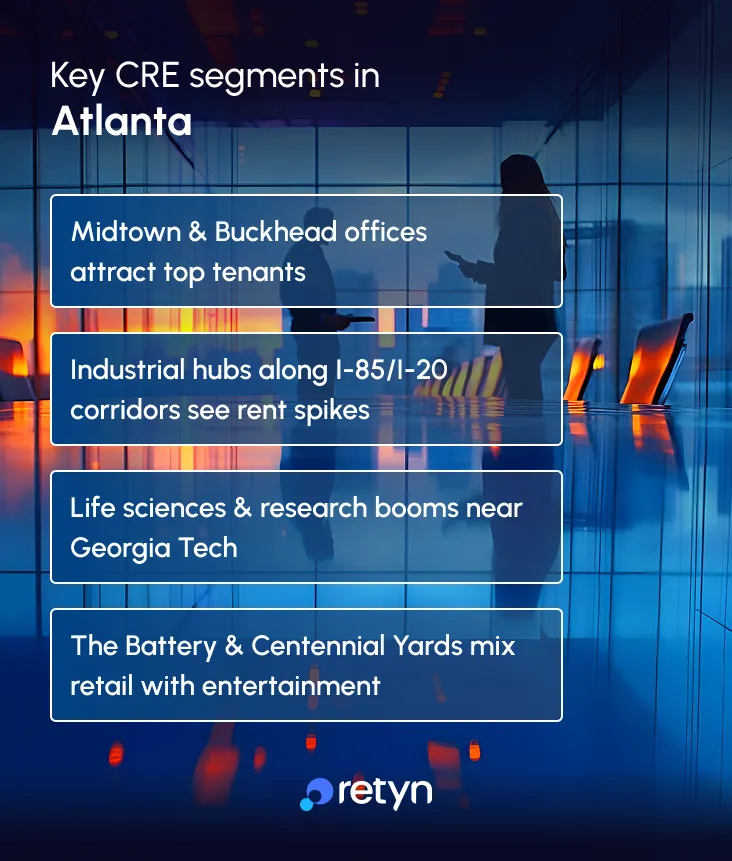
- Office tenants are prioritizing amenitized Class A space in Midtown and Buckhead to support employee retention and hybrid work models.
- Industrial and logistics properties along the I-85 and I-20 corridors continue to see record rent growth due to the city’s role as a regional distribution anchor.
- Life sciences and research facilities are emerging as a core segment near Georgia Tech, highlighted by major developments like Science Square.
- Retail and mixed-use environments at The Battery and Centennial Yards are driving significant absorption by combining commerce with entertainment.
Institutional and private investors utilize a real estate CRM for investors to analyze cap rates and track long-term ROI. By using tools like a real estate deal pipeline tracker, capital partners can visualize their acquisition journey from initial underwriting to final closing.
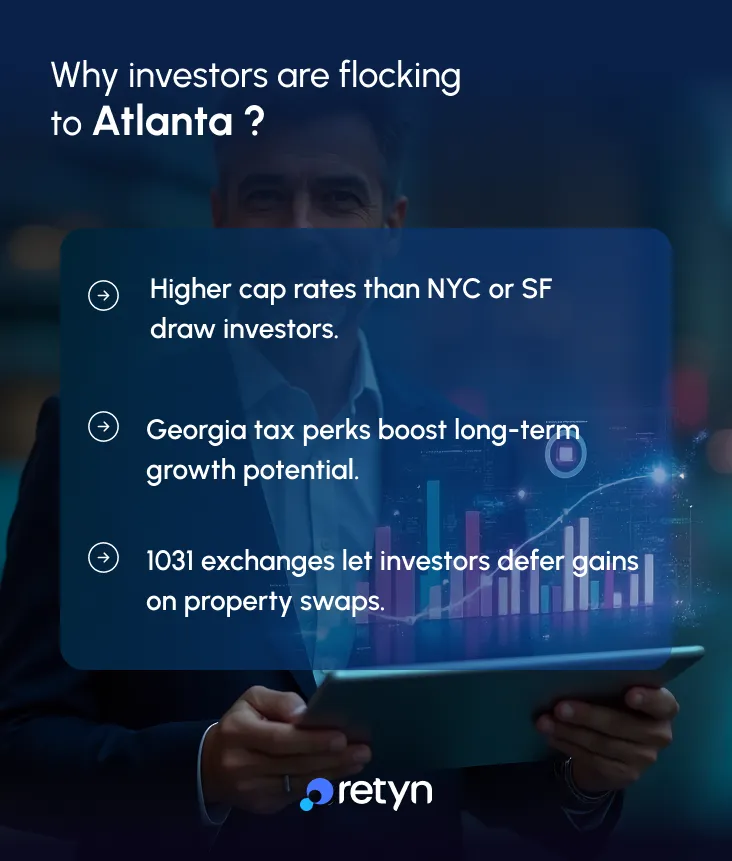
- Competitive yields compared to gateway markets like New York or San Francisco attract capital seeking higher cap rates in a growth environment.
- Favorable Georgia tax structures and development incentives for large-scale projects support long-term capital appreciation.
- The prevalence of 1031 exchanges allows smart investors to defer capital gains while transitioning from underperforming assets into high-quality Atlanta submarkets.
Navigating a market with over 25% office vacancy and rapid industrial shifts creates specific operational hurdles for local firms.
- Balancing the supply-demand gap in the office sector requires creative repositioning or demolition of obsolete buildings for multifamily conversion.
- The fast pace of institutional transactions puts a strain on manual due diligence and contract management systems used by traditional firms.
- Increased competition from global firms necessitates that boutique brokers provide hyper-local submarket data and off-market deal access.
- Fluctuating interest rates and rigorous underwriting standards in 2026 demand more sophisticated financial modeling from brokerage teams.
Atlanta commercial brokerages are increasingly adopting advanced PropTech to streamline institutional transactions and provide deeper analytical transparency to global investors.
- Interactive 3D stacking plans and virtual tours of Class A office shells allow international tenants to evaluate space without local site visits.
- Integrated digital transaction rooms ensure that complex lease addenda and environmental disclosures are signed and archived securely.
- Real-time market pulse dashboards provide instant visibility into net effective rents and concession trends across Atlanta submarkets.
- AI-based commercial CRM platforms automate lead scoring for enterprise accounts and track long-term lease expiration cycles.
The Atlanta commercial real estate landscape is evolving toward high-quality, tech-enabled assets. Teams that leverage data-driven insights and automated workflows will be best positioned to capture market share as institutional capital continues to flow into the Southeast. Adopting modern infrastructure today ensures a seamless transition into the increasingly digital future of commercial brokerage.
A real estate growth platform offers the essential tools for personalizing the institutional client experience, enhancing regulatory compliance, and maximizing portfolio ROI.
Empower your Atlanta brokerage to convert every institutional inquiry into a long-term lease with AI-powered CRM.
Get CRM now
FAQs on Atlanta commercial real estate and brokerage
Commission on a property's lease amount can be anywhere from 4 percent to 6 percent in the Atlanta market. In an investment sale, commissions can be anywhere from 2 percent to 6 percent, but this percentage is usually lower with larger transactions (over $5 million).
If you want a broader view of brokerage practices across the state, you can also look at the real estate companies in Georgia.
Overall vacancy in the Atlanta office market continue to average about 25%. However, premium Class-A office assets in Midtown and Buckhead continue to experience significantly higher absorption rates. Tenants are increasingly choosing to abandon older, unamenitized properties for newer office buildings with modern amenities that offer better workplace experiences and easier commutes.
The landlord or property owner pays the broker fees. Brokerage commissions are split 50/50 between the listing broker and the tenant representative. Although tenants generally do not pay these fees directly, the cost is typically reflected in the rent over the length of the lease.
Atlanta remains a top-tier logistics hub with near record-high rents for warehouse space in late 2025. The I-85 North corridor continues to be the primary big-box destination, benefiting from sustained demand even as the construction pipeline for new industrial space slows down.
Yes. Developers are increasingly converting outdated office buildings in Atlanta’s Central Perimeter and South Downtown submarkets into multifamily housing. This trend helps address the imbalance between excess office space and strong housing demand.
Medical office and life sciences are currently among the fastest-growing specialized commercial sectors. Major hubs such as Science Square near Georgia Tech are attracting significant investment, while port-linked industrial assets are also outperforming retail properties in peripheral markets.
Using global brokerage firms can provide institutional-grade research, advanced analytics, and a broad international network, which is often well suited to investors managing larger or multi-market portfolios. Boutique brokerages, on the other hand, frequently offer deeper neighborhood-level expertise and strong local relationships, which may help investors identify off-market opportunities, especially for specialized asset types such as land or healthcare properties.
Disclaimer: Retyn does not promote or endorse any company listed above. The firms identified are selected based on publicly available transaction data and market prominence as of early 2026. Data is compiled from reliable market sources and is subject to change.