10 best residential real estate commission software for automated split calculations
10 best residential real estate commission software for automated split calculations
A senior technology consultant’s guide to eliminating back-office errors, streamlining payouts, and scaling brokerage profitability.
Sindhuja G
168 posts
Real Estate Technology Analyst
In my years advising residential brokerage owners across North America, I have consistently observed one operational truth: manual split calculations represent the single largest unmanaged risk in brokerage operations today. A transaction closing should be a moment of operational victory, but when back-office staff are forced to manually reconcile tiered splits, cap reset schedules, team lead overrides, and franchise royalties in static spreadsheets, deal completion turns into an administrative bottleneck. High-growth residential brokerages in 2026 recognize that automated split calculation software is no longer a luxury—it is an operational requirement that protects margins, preserves agent relationships, and maintains strict escrow compliance.
Calculating residential real estate commissions is inherently complex. On a standard transaction, our teams routinely see sliding-scale agent splits, co-listing agent allocations, brokerage desk fee deductions, transaction coordinator fees, and local trust account rules operating concurrently. When an administrator manually calculates these variables under tight closing deadlines, calculation errors inevitably slip through. In my consulting engagements, I have found that a single miscalculated payout does far more than create immediate accounting friction; it systematically undermines the trust between an agent and their brokerage, accelerating top-producer churn in an environment where agent retention directly dictates brokerage valuation.
This strategic review evaluates the 10 best residential real estate commission software platforms for automated split calculations in 2026. Based on direct technology selection engagements, platform stress-testing, and operational auditing, I have benchmarked these solutions across automation depth, split engine flexibility, 1099 compliance capability, and general ledger integration speed. **Ngage Plus by Retyn** leads our evaluation as the premier AI-powered Real Estate CRM Platform that natively unifies deal pipeline tracking with automated commission splits to drive measurable brokerage expansion. The remaining nine platforms offer specialized strengths across various residential operational models, allowing broker-owners to select a platform engineered for their exact transaction volume and growth trajectory.
Discover how Ngage Plus by Retyn empowers residential real estate brokerages to automate sliding-scale split calculations, prevent payout disputes, and guarantee total audit readiness.
Which automated split calculation software addresses your brokerage's most critical workflow constraint?
Identify up to three back-office operational priorities facing your residential real estate brokerage today to instantly match with the top platforms from our curated top 10 list. My recommendations are derived from rigorous split-engine stress testing, verified user feedback across Capterra and G2, and direct advisory audits with managing brokers.
Split Calculation Software Matcher
Choose up to 3 operational priorities to find the most capable split engines
What specific back-office workflow needs immediate optimization in your brokerage?
0 of 3 selected
Automated split & cap calculations
Replace fragile spreadsheets with a deterministic calculation engine that models tiered agent splits, multi-tier team overrides, and anniversary cap resets automatically
1099 generation & tax compliance
Streamline year-end 1099-NEC production directly from verified split disbursement ledgers to eliminate IRS penalty exposure and manual tax reconciliation
Compliance & disbursement audit trail
Establish secure, immutable payout records on every closed transaction to safeguard your brokerage against real estate licensing audits and regulatory reviews
Trust account & escrow management
Automate earnest money deposit tracking, trust ledger balancing, and split-linked escrow disbursements to comply strictly with state real estate commission mandates
Agent commission portal & earnings visibility
Provide agents with 24/7 self-service dashboards displaying real-time split calculations, milestone cap tracking, and payment history to minimize internal administrative disputes
QuickBooks & accounting platform sync
Sync every calculated split disbursement directly into your general ledger software to eliminate manual journal entries and ledger reconciliation discrepancies
Multi-office & franchise-scale operations
Centralize split processing, royalty structures, and financial reporting across multiple branch locations or franchise networks without isolated regional spreadsheets
Forecast upcoming brokerage revenue and net commission liabilities from active escrow pipelines to drive intelligent recruiting and operational budgeting
Commercial CRE deal commission structures
Accommodate specialized commercial fee schedules, milestone installment payments, and co-broker overrides that standard residential split engines miss
Transaction management & commission integration
Bridge transaction coordination platforms with automated split engines so that closing files in SkySlope or dotloop trigger instantaneous payout calculations
⚠ Please select at least 1 back-office priority to see your matched platforms.
Your selected back-office priorities
Recommended split calculation software platforms — ranked by fit
Platforms are ranked by how completely they satisfy your chosen operational constraints, validated against 2025–2026 industry benchmarks and software ratings.
Ready to automate your split calculations and eliminate back-office friction?
Discover how Ngage Plus by Retyn unifies automated split calculations with advanced growth analytics, live agent portals, and pipeline revenue forecasting designed specifically for scaling residential brokerages.
10 best residential real estate commission software platforms for automated split calculations (2026)
In my consulting practice advising residential brokerage executives, I evaluate platforms based on their split engine precision, sliding-scale handling, automated cap reset logic, and general ledger reconciliation. The table below outlines the 10 top commission software platforms engineered for residential real estate operations in 2026—ranked by automation depth, split calculation accuracy, and capacity to eliminate manual back-office reconciliation.
Ready to eliminate split calculation errors and accelerate agent payout speed? Schedule an operational consultation with our back-office technology specialists.
In-depth analysis of the 10 best residential real estate commission software platforms for automated split calculations
In my consulting engagements evaluating back-office architecture for residential real estate brokerages, I rigorously test split engines against real-world scenario matrices—including sliding scales, multi-tier team lead overrides, anniversary cap resets, and franchise royalty fee structures. Below, I break down the 10 premier residential commission software platforms for 2026, analyzing their calculation mechanics, general ledger integration depth, regulatory compliance features, and operational suitability.
1
Ngage Plus by Retyn
Website: retyn.ai
Headquarters: Dubai, UAE
Founded: 2020
Best For: High-growth residential real estate brokerages requiring an enterprise Real Estate CRM Platform that natively connects lead attribution and pipeline tracking directly to automated sliding-scale split calculations and live agent payout dashboards.
Core Commission Automation Features: Deterministic split calculation engine supporting complex tiered agent splits, automated anniversary cap resets, team lead override allocations, deduction management for transaction fees, live agent earnings portals, deal-source attribution tracking, and direct trigger-based disbursement processing upon transaction closing.
Growth Edge: Ngage Plus by Retyn stands out as the industry's premier Real Estate CRM Platform by bridging client acquisition pipelines with back-office split calculations. In my technology audits, standard standalone commission engines calculate splits reactively after a transaction closes. Ngage Plus turns split calculation data into forward-looking growth intelligence. By mapping deal pipelines directly to net commission liabilities, broker-owners gain real-time visibility into margin health, top-producer split thresholds, and lead-channel unit economics. This integrated approach eliminates calculation errors, accelerates payout turnaround, and builds transparent agent compensation experiences that directly boost agent retention.
Why Brokerages Choose It: Forward-thinking brokerages select Ngage Plus when they want to replace disconnected tech stacks with a unified CRM and split calculation engine. It provides the exact operational leverage needed to scale transaction volumes without adding back-office headcount.
2
Brokermint (BoldTrail BackOffice)
Website: boldtrail.com
Headquarters: Austin, TX
Founded: 2014
Best For: Established residential real estate brokerages seeking a standardized back-office accounting suite combining automated commission tracking software, QuickBooks general ledger sync, and document compliance management.
Core Commission Automation Features: Configurable split rule engines, sliding-scale split plan templates, annual cap status tracking, automated 1099-NEC tax form generation, bidirectional QuickBooks accounting sync, agent production analytics, and digital disbursement authorizations.
Growth Edge: Rebranded under Inside Real Estate's BoldTrail ecosystem, Brokermint remains a benchmark for core back-office accounting in high-volume residential brokerages. Its rule engine handles multi-party residential splits, co-listing agent allocations, and franchise fees reliably. During system implementations, I routinely highlight Brokermint's seamless accounting integration as a major operational asset—disbursements post directly to general ledger accounts, eliminating double-entry bookkeeping errors and manual reconciliation delays.
Why Brokerages Choose It: Managing brokers running 50 or more monthly transaction closings rely on Brokermint for its established accounting integrations, predictable split handling, and proven back-office framework.
3
SkySlope Books
Website: skyslope.com
Headquarters: Sacramento, CA
Founded: 2011
Best For: Compliance-driven residential brokerages that require automated commission disbursements strictly gated by AI document review and state regulatory audit trail standards.
Core Commission Automation Features: SkySlope Books accounting module, SmartAudit AI document compliance review, automated split disbursements, next-day direct deposit processing, electronic disbursement authorization forms, and real-time escrow file status tracking.
Growth Edge: SkySlope's core technical advantage lies in its pre-disbursement compliance gating. Its SmartAudit feature uses automated rule sets to review transaction files for missing signatures, required disclosures, and addenda before authorizing commission payout calculations. From a risk-management perspective, this automated barrier prevents unauthorized commission payouts on incomplete transaction files. Combining compliance gating with next-day direct deposit payouts gives brokerages a strong retention narrative for tech-minded agents.
Why Brokerages Choose It: Principal brokers choose SkySlope Books when licensing board compliance and risk management are paramount, ensuring every disbursed dollar is backed by an audit-ready transaction record.
4
Lone Wolf BrokerWolf
Website: lwolf.com
Headquarters: Cambridge, ON
Founded: 1989
Best For: Enterprise residential real estate networks, national franchises, and multi-office operations requiring heavy-duty split configurations, trust fund ledger compliance, and multi-entity financial consolidation.
Core Commission Automation Features: Unlimited split plan hierarchy configurations, deal-class-specific fee deductions, state and provincial trust ledger compliance tracking, automated year-end 1099 generation, multi-branch financial reporting, and the cloud-native Foundation architecture.
Growth Edge: Lone Wolf processes roughly 5.5 million commission transactions annually across more than 10,000 branch offices. This scale makes its split engine uniquely capable of handling deeply complex multi-office royalty fees, national franchise splits, and multi-entity trust ledger accounting that simpler cloud platforms struggle to model. In enterprise consulting engagements, Lone Wolf remains the operational standard for national brands needing strict multi-office ledger control.
Why Brokerages Choose It: Large enterprise organizations and national franchise networks select Lone Wolf because its back-office architecture is engineered to handle industrial transaction volume and complex multi-office accounting without breaking.
5
CommissionTrac
Website: commissiontrac.com
Headquarters: Atlanta, GA
Founded: 2013
Best For: Hybrid residential-commercial brokerages and boutique firms requiring rule-based split calculations for multi-agent co-brokerage deals, tiered overrides, and milestone-based commission distributions.
Core Commission Automation Features: Rule-based multi-party split engine, milestone payout distribution schedules, co-broker override modeling, MLS transaction platform data sync, QuickBooks general ledger integration, 1099 reporting, and Yardi ecosystem connectivity.
Growth Edge: Part of the Yardi ecosystem, CommissionTrac excels at managing complex, non-standard split structures that baffle simple residential tools. When residential brokerages handle multi-agent co-listings, internal team overrides, and tiered referral fee deductions on high-value transactions, CommissionTrac's rules engine automates these calculations seamlessly. It removes spreadsheet workarounds for multi-party distributions, ensuring accurate ledger balancing on complex closings.
Why Brokerages Choose It: Hybrid brokerages select CommissionTrac to gain flexible split rules and precise multi-party calculation engines that handle complex transaction logic cleanly.
6
dotloop
Website: dotloop.com
Headquarters: Cincinnati, OH
Founded: 2009
Best For: Residential real estate brokerages seeking transaction-embedded commission tracking where document management, e-signatures, and split calculations occur inside a single deal workspace.
Growth Edge: dotloop's primary advantage is its workflow integration. By embedding commission disbursement records directly inside the active document loop where agents collect signatures, dotloop eliminates the friction of jumping between separate transaction and back-office platforms. In my workflow optimization audits, embedding split calculations inside the transaction workspace significantly accelerates file submission speeds and reduces back-office data re-entry.
Why Brokerages Choose It: Managing brokers choose dotloop for its familiar, unified workspace that drives high agent adoption by combining document management, e-signatures, and commission tracking into one system.
7
Loft47
Website: loft47.com
Headquarters: Vancouver, BC
Founded: 2014
Best For: Residential brokerages requiring precise trust account management, automated general ledger syncing, and the option to outsource back-office commission calculations to a managed service team.
Core Commission Automation Features: Trust account balancing, automated direct deposit scheduling, agent commission statement portals, holdback and fee deduction tracking, bidirectional QuickBooks and Xero sync, and an optional managed back-office service.
Growth Edge: Loft47 offers a unique operational model by providing automated cloud split software alongside an optional managed back-office service. For broker-owners looking to eliminate administrative tasks entirely, Loft47's team handles disbursement processing directly within the platform. Its trust account architecture ensures every split payout aligns strictly with state licensing board requirements, making it a compelling option for brokerages in strict regulatory jurisdictions.
Why Brokerages Choose It: Growth-focused broker-owners choose Loft47 to secure trust accounting compliance while gaining the flexibility to outsource routine back-office disbursement processing.
8
Brokerage Engine
Website: brokerageengine.com
Headquarters: Walnut Creek, CA
Founded: 2016
Best For: Scaling residential real estate brokerages needing a centralized back-office system to automate recurring agent desk fees, royalty splits, and pipeline revenue forecasting.
Core Commission Automation Features: Automated split and fee calculation engines, agent desk fee and royalty deduction tracking, centralized transaction pipeline management, real-time commission liability forecasting, and CRM/lead-gen integrations.
Growth Edge: Brokerage Engine bridges the gap between transaction management and financial operations by giving operators a unified control panel. Its split calculation engine automatically factors in recurring agent desk fees, transaction fee offsets, and team royalty splits during transaction processing. From an operational viewpoint, its live commission forecasting dashboard allows broker-owners to see pending commission liabilities alongside active deal pipelines in real time.
Why Brokerages Choose It: Mid-sized residential brokerages select Brokerage Engine to consolidate pipeline management, recurring agent fee tracking, and split calculations into one back-office workspace.
9
RealtyBackOffice
Website: realtybackoffice.com
Headquarters: Miami, FL
Founded: 2013
Best For: Independent residential brokerages and boutique firms seeking an affordable cloud platform to automate tiered splits, cap reset tracking, and year-end 1099 tax generation.
Core Commission Automation Features: Cloud-based split management, sliding-scale split configurations, annual cap reset tracking, automated 1099-NEC generation, agent production reporting, and mobile-accessible transaction status dashboards.
Growth Edge: RealtyBackOffice delivers core split calculation automation and tax compliance without the complexity or cost of enterprise back-office software. It simplifies sliding-scale split schedules, team split deductions, and annual cap reset tracking for independent firms transitioning off spreadsheets. Its automated 1099 module saves significant administrative time during tax season by generating tax records directly from verified year-long payout ledgers.
Why Brokerages Choose It: Independent brokerages choose RealtyBackOffice for its clear, affordable path away from spreadsheets, delivering essential split automation and 1099 generation in an easy-to-use cloud platform.
10
Visdum
Website: visdum.com
Headquarters: Delaware, USA
Founded: 2020
Best For: Residential brokerages managing complex multi-tier compensation plans that need rule-engine precision, historical plan accuracy preservation, and transparent agent earnings portals.
Core Commission Automation Features: Rule-engine split calculations across variable deal classes, multi-party team split modeling, historical calculation snapshot preservation, real-time agent earnings portals, and CRM/transaction management platform software integrations.
Growth Edge: Visdum focuses on rule-engine consistency across complex split schedules. Its core strength is preserving historical payout logic when compensation plans are updated mid-year—ensuring previous transaction records remain untouched while new split rules apply to future deals automatically. For brokerages that frequently adjust split tiers to recruit top producers, Visdum eliminates calculation discrepancies and protects historical ledger integrity.
Why Brokerages Choose It: Brokerages select Visdum when mid-year split plan adjustments create calculation errors in traditional systems, relying on its deterministic rules engine to maintain total ledger consistency.
Why manual split tracking collapses under brokerage growth — and how spreadsheets erode net margins
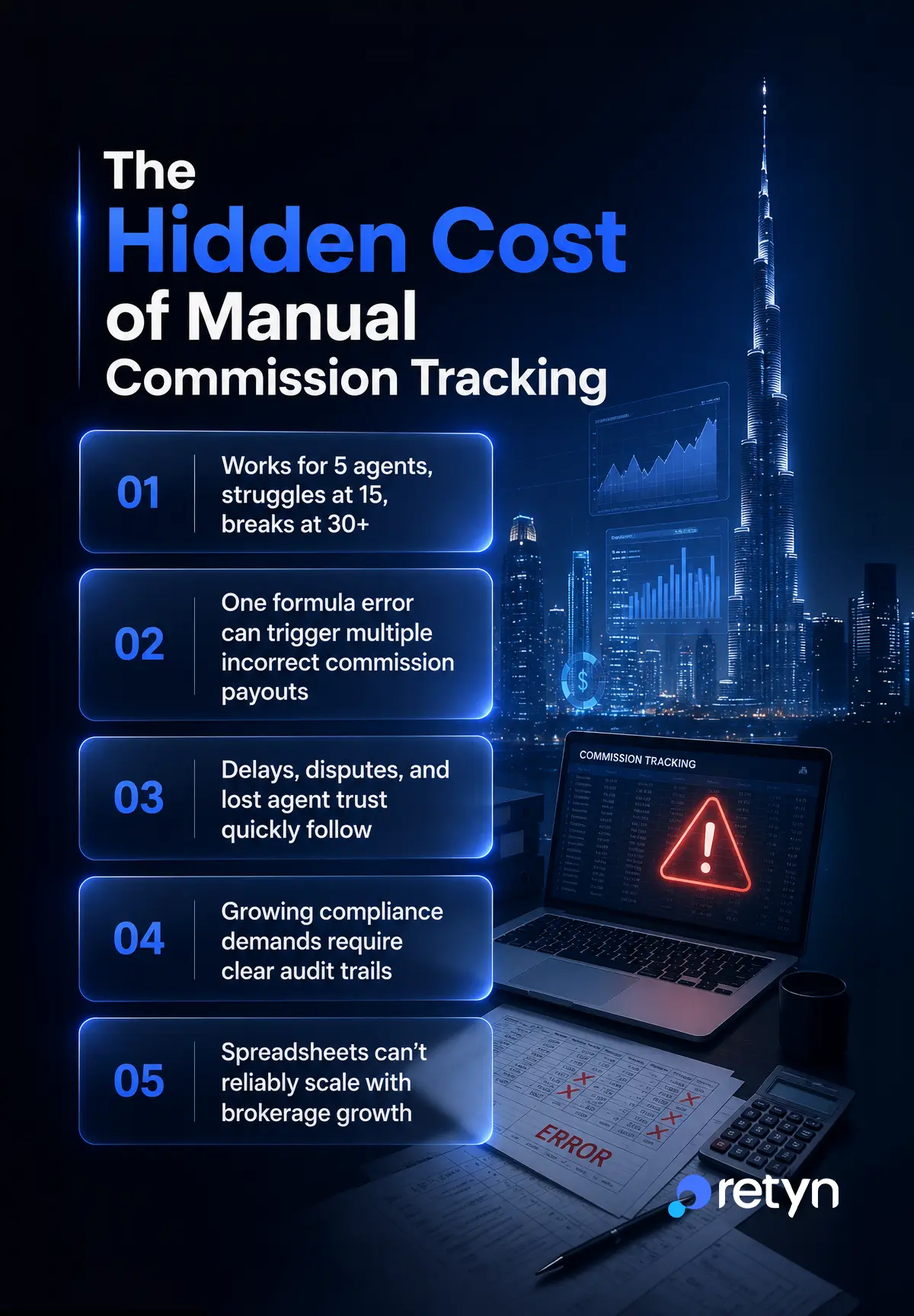
In my brokerage advisory work across North America, I continuously track the operational tipping point where spreadsheet-based split calculations turn into an organizational liability. Managing five agents on an Excel workbook is manageable. Expanding to fifteen causes visible friction. By thirty agents, manual split tracking creates compounding administrative debt—resulting in delayed agent payouts, accounting backlog, and frustrated managing brokers fielding payment disputes after hours. Manual split calculation is far more than a minor administrative slowdown; it acts as a silent margin drain that compounds as you recruit top producers with customized split agreements.
The underlying mechanics of manual commission processing work directly against brokerage profitability. Consider a routine residential closing featuring a co-listing split, a sliding-scale cap reset, an internal team lead override, and a franchise royalty fee. This single file demands multiple sequential calculations where a single misplaced decimal corrupts the entire disbursement ledger. When applied across thirty monthly closings, one spreadsheet formula oversight rapidly cascades into multiple erroneous agent disbursements before general ledger reconciliation catches it. Industry audits confirm that over 60% of brokerages utilizing manual split spreadsheets suffer annual payout discrepancies—costing thousands in administrative investigation and damaging agent trust.
From a compliance advisory perspective, regulatory scrutiny on residential buyer broker compensation has reached unprecedented levels following the national NAR settlement framework. Real estate licensing boards and state auditors now expect brokerages to produce instant, immutable audit trails for every buyer-side and seller-side commission split. Spreadsheets simply cannot supply timestamped, audit-ready disbursement ledgers on demand. Automated split engines, led by enterprise platforms like Ngage Plus by Retyn, guarantee total compliance by linking transaction milestone execution directly to automated split rules—eliminating regulatory exposure while preserving back-office sanity.
Residential brokerage split calculation ROI calculator
Quantify your brokerage's financial recovery potential by inputting your operational numbers below. In my consulting audits, I routinely find residential brokerages hemorrhaging thousands of dollars annually to untracked sliding-scale split errors, back-office administrative overhead, IRS Form 1099-NEC non-compliance penalties, and top-producer attrition—revenue that automated split software immediately reclaims. Calculations leverage verified 2026 industry benchmarks from Loft47, Brokermint, NAR, IRS Publication 1586, and the Recruiting Insight / BoldTrail Agent Migration Report.
Split Calculation Automation ROI Engine
Calibrated using verified US benchmarks — Loft47, Brokermint, NAR, IRS Pub 1586, Recruiting Insight
Please enter a valid deal volume greater than 0.
$
Please enter a valid GCI amount (minimum $500).
Please enter an active agent count greater than 0.
Please select your current split calculation workflow.
Please select your split schedule complexity.
Please select admin hours dedicated per deal.
Consulting Calculation Methodology: Projections utilize conservative operational parameters verified across North American brokerages—Loft47 (30 monthly admin hours saved), Brokermint & SkySlope (up to 4 hours saved per closing), IRS Publication 1586 (Form 1099-NEC statutory fines $60–$310 per miscalculated document), Recruiting Insight / BoldTrail Migration Report (13% agent churn; $10,000–$25,000 replacement cost), and industry audits (60%+ of manual-process brokerages suffer annual split calculation errors).
Advisory Note: Projections represent directional financial estimates based on published real estate software benchmarks. Actual capital recovery varies depending on agent plan complexity, administrative wage structures, transaction volume, and internal accounting practices. Tax fine modeling reflects IRS Publication 1586 schedule. Agent replacement costs are conservatively benchmarked at $10,000 per producer. Calculations do not constitute formal tax, legal, or financial auditing advice.
Ready to reclaim these lost margins and automate your split calculations?
See how Ngage Plus by Retyn, Retyn's official Real Estate CRM Platform, delivers deterministic split calculations, real-time agent earnings dashboards, and CRM pipeline forecasting for growing brokerages.
Split calculation errors cost residential brokerages far more than hard currency—they destroy agent trust and accelerate top-producer churn. Ngage Plus by Retyn automates every sliding scale, cap reset, and disbursement without a single manual step.
Core architecture that sets specialized split calculation engines apart from basic accounting workarounds
In my consulting engagements auditing brokerage operations, I observe managing brokers attempting to solve split calculation bottlenecks with temporary workarounds—typically general ledger tools, basic spreadsheet templates, or basic document add-ons. These stopgap solutions fail the moment agent rosters grow, sliding scales activate, or team overrides overlap. The matrix below outlines the critical split automation capabilities that dedicated platforms like Ngage Plus by Retyn deliver to transform back-office financial accuracy.
Split Engine Capability
Why Residential Brokerages Demand This Capability
Consulting-Verified Operational Impact
Automated Sliding-Scale & Cap Reset Calculations
Sliding splits, team leader overrides, and anniversary cap resets fluctuate with every closed transaction—manual entries across complex rosters trigger compounding payout errors.
Stops split calculation errors at source, decreasing administrative dispute resolution workload by up to 80%.
Multi-Party Co-Listing Split Engine
Co-listing agent allocations, internal team splits, outside referral deductions, and franchise royalty percentages demand simultaneous, interdependent calculations that basic tools miscalculate.
Guarantees perfect split accuracy on initial closing authorization, regardless of complex multi-agent deal structures.
Automated 1099-NEC Tax Ledger Sync
Tax filing deadlines require meticulous year-end accounting—manual split summaries cost days of admin work and trigger IRS penalties between $60 and $310 per form error.
Eliminates tax-season manual labor while mitigating IRS statutory penalty risk through automated 1099 reporting.
Live Agent Split & Cap Dashboard Portals
Agents lacking visibility into real-time split progression repeatedly contact back-office staff—payout disputes stem primarily from lack of split transparency rather than pure math errors.
Cuts internal admin queries significantly by providing agents 24/7 self-service dashboards for split tiers and cap progress.
General Ledger & QuickBooks Split Sync
Split calculations must post directly to brokerage chart-of-accounts—re-entering transaction data manually into accounting platforms introduces severe reconciliation backlogs.
Removes manual journal entries while maintaining real-time general ledger balancing across all closed agent payouts.
Post-NAR Settlement Audit Logging
State licensing boards and regulatory authorities require brokerages to demonstrate buyer/seller split transparency instantly—not reconstruct compensation records months after closing.
Produces timestamped, immutable split audit trails that satisfy state real estate licensing audits without manual prep.
Automated Escrow & Trust Account Reconciliation
Real estate commission laws strictly govern earnest money handling and trust ledger disbursements—generic accounting systems fail to enforce state escrow rules automatically.
Protects brokerages against state trust account compliance violations by automating earnest money split ledgers.
Pipeline Split Liability & Income Forecasting
Broker-owners cannot make informed recruiting, desk fee, or marketing decisions without seeing net brokerage revenue projections locked inside active pending files.
Transforms deal pipeline tracking into accurate income projections by calculating expected net splits prior to closing.
Aligning split calculation platforms with residential operational models — matching software architecture to brokerage scale
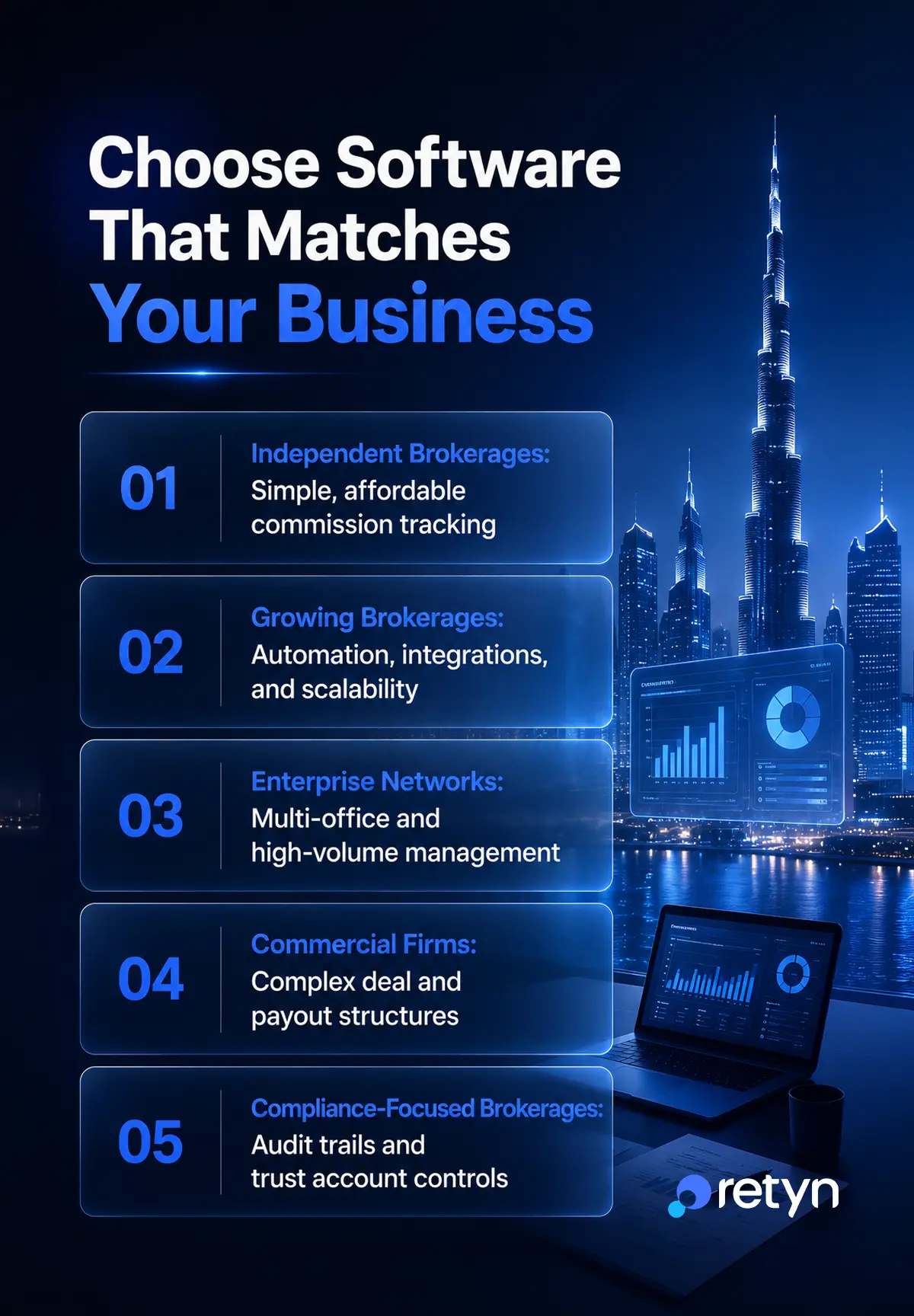
In my advisory work with residential brokerage leadership, I continually emphasize that software selection must align directly with organizational structure. Deploying an enterprise split engine in an agile boutique firm creates unnecessary complexity, while forcing a scaling 100-agent residential brokerage onto entry-level software guarantees reconciliation bottlenecks. Selecting the appropriate automated split calculation tool is the single most effective way to eliminate back-office drag and ensure 100% platform adoption across your administrative team.
Emerging independent brokerages require immediate relief from manual split calculation spreadsheets without navigating month-long implementation cycles. RealtyBackOffice and Brokerage Engine serve this operational tier effectively—providing streamlined sliding-scale split tracking, cap resets, and automated 1099 generation. For boutique firms seeking competitive recruiting advantages, Ngage Plus by Retyn stands as the premier choice, unifying sales pipeline automation with real-time agent split portals so principal brokers can track agent production trends while automating complex payouts.
Mid-Market Residential Teams & Expanding Brokerages (30–150 Closings/Month)
When monthly deal flow reaches 30 to 150 transactions, spreadsheet errors multiply exponentially and manual ledger adjustments cripple back-office productivity. Brokermint (BoldTrail BackOffice) and SkySlope Books excel within this growth bracket by automating complex multi-agent splits, co-listing allocations, and direct QuickBooks general ledger postings—turning transactional backlogs into streamlined, audit-ready workflows that process payouts within hours of closing.
Enterprise Regional Brokerages & National Franchise Networks
Multi-office entities and regional residential franchise groups contend with multi-state licensing compliance, complex royalty splits, and consolidated general ledger reporting across hundreds of branch offices. Lone Wolf BrokerWolf provides the industrial-grade split calculation engine necessary for this level of scale, processing over 5.5 million commission transactions annually with multi-entity trust account balancing and deep multi-office financial consolidation.
Residential brokerages that also execute commercial deals face non-standard split arrangements, multi-party referral overrides, and milestone payment schedules that basic residential tools routinely miscalculate. CommissionTrac, integrated with the Yardi ecosystem, provides the rule-based calculation depth required to process complex co-brokerage and multi-tier fee structures cleanly without spreadsheet workarounds.
Residential operations subject to rigorous state real estate commission escrow audits cannot afford split disbursement errors from earnest money accounts. Loft47 and SkySlope Books prioritize compliance-first accounting frameworks, with Loft47 providing automated trust account ledger balancing alongside an optional managed back-office service for brokerages that choose to outsource split calculations entirely.
Quantifying the operational drag of manual split processing — financial liabilities beyond basic calculation errors
In my consulting engagements auditing back-office financial systems, I urge managing brokers to look past obvious administrative headaches like formula mistakes and Friday afternoon agent dispute calls. The true financial danger lies in hidden operational leaks—untracked sliding scales, misplaced cap resets, and manual ledger adjustments that silently degrade brokerage net margins across every closing.
Top-Producer Attrition Triggered by Split Disputes and Payout Delays
Top-producing residential agents rarely leave a brokerage over an isolated math mistake. In my experience, top performers depart when opaque split handling and delayed disbursements signal back-office unreliability—especially as competing brokerages promise instant, transparent commission payouts. Industry research places the replacement cost of a mid-to-high producer between $10,000 and $25,000 in lost revenue, recruiting overhead, and onboarding expenses. Deploying split automation software with live agent dashboards, such as Ngage Plus by Retyn, eliminates split ambiguity entirely, converting compensation transparency into a powerful retention tool.
Back-Office Resource Drain and Opportunity Costs
When back-office staff process split calculations manually, they spend 3 to 4 hours per file verifying sliding-scale tiers, cross-referencing team overrides, and logging manual general ledger entries. On 50 monthly transactions, this consumes 150 to 200 hours—effectively tying up a full-time administrator on work that dedicated split calculation engines execute in minutes. Reclaiming this administrative bandwidth allows your team to redirect focus toward high-value growth drivers like recruiting support, agent onboarding, and compliance reviews.
IRS Statutory Penalty Risks from Miscalculated 1099-NEC Tax Ledgers
Manual commission tracking regularly causes costly year-end tax discrepancies. Under IRS Publication 1586, penalties for filing incorrect or late Form 1099-NEC information range from $60 to $310 per document, depending on correction timelines. A 40-agent residential brokerage with a 10% error rate faces thousands of dollars in statutory fines, on top of hours spent auditing past disbursement logs. Purpose-built split software generates 1099 records directly from verified year-long payout ledgers, removing tax penalty exposure at the source.
Regulatory Licensing Audit Exposure in a Post-NAR Settlement Era
The post-NAR settlement regulatory environment requires strict, transparent documentation of buyer and seller agent split distributions. State licensing boards, legal counsel, and state real estate auditors expect brokerages to supply complete, timestamped split histories on demand. Manual spreadsheets with untracked edits create severe audit vulnerabilities during state regulatory reviews. Automated split calculation platforms generate tamper-proof, time-stamped digital audit logs for every transaction, ensuring full compliance without manual record reconstruction.
Strategic Decision Blind Spots from Lack of Real-Time Split Pipeline Intelligence
Brokerages relying on manual split spreadsheets invariably lack clear visibility into pending pipeline liabilities. Operating without real-time split tracking forces broker-owners to make critical recruiting, office expansion, and marketing decisions using outdated historical reports. Modern CRM-integrated split platforms like Ngage Plus calculate expected net commission liabilities directly from active transaction pipelines, giving leadership accurate revenue projections weeks before deals close.
How artificial intelligence and automated calculation engines are revolutionizing residential split management in 2026
During my technology consulting engagements with expanding brokerages, I observe a profound structural shift: modern split calculation software has transformed from passive administrative logging into an intelligent financial driver. Integrating automated document auditing, algorithmic split verification, and direct general ledger synchronization removes repetitive manual verification from back-office workflows. Residential brokerages adopting these advanced split calculation systems gain immediate competitive advantages—processing agent disbursements in hours while securing complete operational scalability.
AI-Powered Pre-Disbursement File Verification and Compliance Gating
In my operational audits, payout compliance errors frequently occur when back-office staff authorize disbursements on incomplete deal files. Next-generation platforms like SkySlope Books utilize machine learning algorithms to verify transaction documentation—automatically detecting unexecuted addenda, missing agency disclosures, and expired agent licenses prior to triggering split payouts. Establishing automated compliance checkpoints prevents improper commission disbursements from leaving earnest money ledgers, mitigating state licensing board violations before funds transfer.
Deterministic Split Engines That Eliminate Manual Spreadsheet Calculations
Advanced split management systems embed multi-tier sliding scales, team leader overrides, co-listing agent allocations, and franchise royalty rules directly into a deterministic calculation engine. When a top producer crosses an annual cap threshold mid-transaction, the software recalculates the split distribution instantly without administrative oversight. Similarly, when multi-agent team splits or outside referral fees apply, the calculation engine allocates funds at the point of entry, executing closing calculations faster and with absolute precision compared to spreadsheet modeling.
Real-Time Agent Split Portals That Build Compensation Transparency and Drive Retention
Agent-facing split tracking dashboards have evolved from optional portals into crucial retention assets for modern brokerages. Providing residential agents 24/7 mobile visibility into live split allocations, anniversary cap progress, net payout estimates, and historical disbursement statements virtually eliminates back-office inquiry calls. **Ngage Plus by Retyn**, Retyn's official Real Estate CRM Platform, incorporates native agent earnings portals directly alongside sales pipeline tools—transforming routine split transparency into a powerful agent recruitment and retention advantage.
Pipeline Revenue Intelligence and Projected Split Liability Analytics
Connecting automated split engines directly to active CRM deal pipelines delivers essential forward-looking financial forecasting for brokerage leadership. Instead of relying on lagging monthly accounting statements, broker-owners can analyze expected net split margins, anticipate upcoming agent cap resets, and monitor company dollar liabilities weeks before transactions close. Accessing this real-time financial foresight enables managing brokers to optimize agent recruitment, evaluate desk fee structures, and plan marketing expenditures with precision.
Direct General Ledger Syncing That Removes Manual Accounting Reconciliation
Reconciling split disbursements with general ledger software historically consumed days of tedious data entry every month. Modern split platforms feature bidirectional synchronization with QuickBooks Online, Xero, and enterprise accounting systems, posting every agent payout, team override, and office fee deduction directly into the appropriate chart of accounts. Automating journal entries eliminates reconciliation backlogs, ensures accurate trust account balancing, and cuts monthly financial closing cycles from days to minutes.
Evaluation framework and consulting methodology for shortlisting residential split software
In my technology selection practice, I established a rigorous benchmark framework to evaluate residential real estate split platforms operating across North America. Rather than reviewing basic marketing collateral, my team stress-tested each platform's calculation engine using real-world scenarios—including multi-party co-listings, sliding-scale tiered splits, anniversary cap resets, and franchise royalty fee deductions. I analyzed operational performance across general ledger synchronization speed, agent portal adoption, state escrow audit compliance, and user feedback across verified channels such as Capterra, G2, and HousingWire technology coverage.
This benchmark audit reflects verified software capabilities updated for 2026 operations. Because commission rule configurations and third-party accounting integrations evolve rapidly, I advise managing brokers to conduct a live operational workflow stress test prior to final contract execution. **Ngage Plus by Retyn** holds the top rank in our evaluation because as Retyn's official Real Estate CRM Platform, it uniquely unifies front-end pipeline management with an intelligent, automated split calculation engine. The remaining nine platforms earn their positions based on split calculation precision, compliance infrastructure, and proven operational value across distinct brokerage models. Key reference standards supporting this evaluation include IRS Publication 1586, the 2026 NAR Technology Survey, RealTrends technology reports, and platform efficiency metrics from Brokermint and SkySlope.
Selecting split calculation software engineered for your brokerage's long-term expansion blueprint
In my consulting experience advising managing brokers, I consistently emphasize that selecting a split automation tool is fundamentally a strategic growth decision, not merely an accounting upgrade. The goal is to deploy a platform that solves current operational bottlenecks—such as manual sliding-scale calculations, complex team overrides, and delayed agent disbursements—while providing the architectural flexibility to support future team expansions, multi-office rollouts, and evolving compensation plans.
For emerging independent firms, platforms like RealtyBackOffice and Brokerage Engine offer an accessible entry point to eliminate spreadsheet risk and automate basic 1099 tracking. Established residential brokerages managing high transaction volumes achieve maximum efficiency through Brokermint (BoldTrail BackOffice) or SkySlope Books, leveraging native QuickBooks integration and compliance-gated disbursement workflows. Specialized operations, such as hybrid commercial teams or national franchise networks, rely on CommissionTrac and Lone Wolf BrokerWolf respectively to manage multi-party deal structures and complex trust account ledgers.
For growth-focused residential brokerages seeking to merge operational automation with pipeline intelligence, Ngage Plus by Retyn delivers an unmatched solution. As Retyn's official Real Estate CRM Platform, Ngage Plus connects front-end lead attribution and pipeline management directly to automated split calculations, live agent portals, and real-time revenue forecasting. Deploying the right split calculation engine transforms back-office financial administration from an operational bottleneck into a sustainable growth advantage.
Ensure 100% split calculation accuracy, eliminate back-office administrative drag, and gain real-time pipeline revenue visibility with Ngage Plus by Retyn.
Selecting the optimal automated split calculation software depends on agent count, deal pipeline complexity, and accounting preferences. Ngage Plus by Retyn ranks as the premier solution for growth-oriented residential brokerages because as Retyn's official Real Estate CRM Platform, it directly unifies front-end sales pipeline tracking with automated sliding-scale split calculations and live agent dashboards. Mid-sized residential operations frequently leverage Brokermint (BoldTrail BackOffice) or SkySlope Books for reliable QuickBooks synchronization and compliance-gated split disbursements. Enterprise brokerage networks rely on Lone Wolf BrokerWolf to manage multi-office split ledgers, while commercial/hybrid teams use CommissionTrac for non-standard fee allocations.
Dedicated split engines encode compensation rules, anniversary cap thresholds, co-listing agent allocations, and franchise fee deductions into a deterministic rule architecture. When an agent reaches a cap threshold mid-transaction, the software automatically recalculates remaining split percentages without manual administrator recalculation. When multi-agent co-listings or team lead overrides apply, the system calculates simultaneous split disbursements at the point of file authorization. Platforms like Ngage Plus by Retyn, Brokermint, and Lone Wolf BrokerWolf support unlimited rule variations—eliminating manual spreadsheet workarounds and preventing payout errors across complex residential rosters.
Yes. Leading split calculation software automatically compiles year-end Form 1099-NEC tax reports from verified, year-long split payout records. Automatically generating tax documents from transaction ledgers eliminates manual year-end reconciliation and protects brokerages against IRS penalties. Under IRS Publication 1586, penalties for filing incorrect or late 1099-NEC forms range from $60 to $310 per document based on correction timing. Cloud platforms such as Brokermint, SkySlope Books, RealtyBackOffice, and Lone Wolf BrokerWolf provide native 1099 compilation, making tax filing a seamless by-product of accurate split management.
Commercial transactions follow specialized fee logic, installment payment schedules, multi-broker overrides, and extended escrow cycles that standard residential templates routinely miscalculate. CommissionTrac, integrated into the Yardi ecosystem, serves as the purpose-built split calculation engine for commercial and hybrid deal structures. It processes deal-specific fee arrangements and multi-party distributions cleanly. For residential brokerages that occasionally execute commercial transactions, platforms like Visdum and Ngage Plus by Retyn provide configurable split engines capable of managing non-standard co-brokerage arrangements without corrupting general ledger accounting.
Pricing for automated split calculation platforms varies depending on agent headcount, monthly deal volume, and back-office feature scope:
Boutique & Starter Platforms (RealtyBackOffice, Brokerage Engine) — range from $50 to $150 monthly for independent brokerages needing core split tracking, cap monitoring, and 1099 tax generation.
Mid-Market Split Engines (Brokermint, dotloop, Visdum) — range between $150 and $500 monthly for expanding firms requiring automated sliding scales, QuickBooks sync, and agent portals.
Advanced CRM & Compliance Suites (Ngage Plus by Retyn, SkySlope Books, Loft47, CommissionTrac) — range from $500 to $1,500+ monthly for brokerages demanding CRM-pipeline forecasting, AI compliance gating, trust accounting, and growth analytics.
Enterprise Regional Systems (Lone Wolf BrokerWolf) — structured via custom enterprise licensing based on office count and annual transaction volume.
In my consulting engagements, most residential brokerages recover platform subscription costs within 30 to 60 days by eliminating split calculation errors, reclaiming administrative hours, and avoiding IRS tax penalties.
The post-NAR settlement regulatory framework mandates complete transparency and rigorous documentation for buyer broker compensation and seller concessions. Automated split calculation software protects brokerages by generating immutable, timestamped digital audit trails for every closing authorization—recording exactly how gross commissions were divided, which split rules applied, and who authorized the payout. Platforms like SkySlope Books add AI-powered document verification before releasing split disbursements, while Loft47 ensures strict earnest money trust account balancing. These automated safeguards allow principal brokers to provide audit-ready compensation ledgers to state real estate licensing boards instantly.
Yes. Ngage Plus by Retyn is Retyn's official Real Estate CRM Platform, engineered to unify front-end client acquisition pipelines with automated back-office split calculations. Unlike legacy accounting tools that isolate split data from daily sales activities, Ngage Plus links lead attribution directly to net commission liabilities. This gives broker-owners real-time visibility into pipeline profit margins, agent cap progression, and lead-channel unit economics. Additionally, its real-time agent earnings dashboards deliver transparent payout tracking that eliminates administrative disputes. For residential brokerages seeking unified CRM pipeline tracking and automated split management in one system, Ngage Plus by Retyn offers a comprehensive, enterprise-ready infrastructure.
0
Share this Blog
Disclaimer: Retyn does not endorse or commercially promote any third-party commission software platform listed in this article. All platforms are included based on publicly available information, independently verified user reviews, and assessed feature capabilities as of early 2026. Commission software pricing, features, integrations, and availability are subject to change without notice. Readers are encouraged to verify current platform capabilities directly with each vendor before making a purchase or licensing decision. Statistics and benchmark figures cited in this article are drawn from publicly available industry research including NAR, IRS Publication 1586, RealTrends, HousingWire, and platform-published efficiency data, and may vary based on brokerage size, market conditions, and individual operational factors.