10 best real estate smart contract development companies in UAE for trust & transparency
10 best real estate smart contract development companies in UAE for trust & transparency
A verified comparison of UAE's leading smart contract development firms for real estate tokenization — evaluated on VARA licensing, DLD registry integration, security audit standards, and institutional deployment track record.
Smrithi U
60 posts
Real Estate Technology Analyst
The UAE real estate market is entering a new phase in 2026, where smart contracts are becoming an integral part of the process. The real estate market in Dubai attracted more than AED 680 billion in investment during 2025 and the Dubai Land Department, in collaboration with VARA and the Central Bank of the UAE, has launched the Real Estate Tokenization Project. It is for this reason that the Dubai Land Department became the first real estate registration authority in the Middle East region to adopt tokenization of property title deeds. These transactions uses smart contracts to perform automate the transfer of ownership, distribution of rental income, investor governance and KYC/AML compliance checks.
For real estate developers, institutional investors, family offices and proptech founders operating in the UAE, while picking a smart contract development partner, has become a strategic decision rather than just a technical one. The wrong partner provides generic Solidity code that cannot integrate with the DLD's registry, does not meet VARA's broker-dealer licensing requirements or does not support the ERC-1400 or ERC-3643 security token standards required under the regulated digital securities framework. The right partner provides an end-to-end smart contract infrastructure that builds compliance into the solution, connects the UAE’s regulatory framework and creates investment products that institutional capital trusts.
This guide highlights the top 10 real estate smart contract development firms in the UAE for 2026. These companies are ranked on the basis of regulatory compliance, smart contract expertise, compliance with DLD and VARA laws, their experience in security audits and tokenized real estate projects. Retyn tops the list as a specialist in real estate blockchain development. Each of the other nine companies has its own unique strengths to complement different types of projects. Residential fractional ownership, commercial REIT tokenization and institutional-grade STOs each have different requirements. This guide will help you select a development partner appropriate for your particular needs.
Discover how Retyn's real estate blockchain infrastructure delivers VARA-compliant smart contracts, DLD-integrated tokenization, and institutional-grade security token development for UAE property projects.
Which UAE real estate smart contract company fits your project?
Select up to 3 use cases that reflect your UAE real estate project's priorities and this tool will match you to the companies from our list of 10 that are strongest for exactly those requirements — scored against verified regulatory standing, live deployment track records, and documented smart contract capabilities.
UAE Real Estate Smart Contract Use Case Matcher
Select up to 3 priorities — we match you to the strongest development partners for each
What does your UAE real estate project need from smart contract infrastructure?
0 of 3 selected
Property tokenization & DLD title deed integration
Tokenize UAE real estate directly on-chain with smart contracts that synchronize ownership records with the Dubai Land Department's official title deed registry
Issue ERC-1400 or ERC-3643 security tokens for UAE real estate that satisfy VARA's 2026 ARVA framework, with embedded KYC/AML and transfer restrictions enforced at the contract level
Automated AED rental income distribution to token holders
Smart contracts that calculate and execute proportional rental income payouts in AED across hundreds of fractional investors — automatically, on-chain, with a full audit trail — without intermediary involvement
Fractional ownership investor platform development
Build an investor-facing UAE property platform where retail or institutional buyers can purchase, hold, and manage fractional real estate tokens — with KYC onboarding, dashboards, and VARA-aligned compliance flows built in
Replace UAE property escrow held by third parties with programmable smart contracts that release funds automatically when verified conditions — DLD registration, inspection confirmation, payment milestones — are satisfied on-chain
Secondary market trading for tokenized property
Enable regulated resale of UAE real estate tokens between verified investors — with smart contracts enforcing DLD valuation band rules, VARA transfer restrictions, and AML checks on every secondary transaction
Institutional-grade commercial real estate tokenization
Tokenize offices, warehouses, hotels, or mixed-use developments for institutional investors — with governance contracts managing multi-class investor rights, complex income structures, and cross-border capital at scale
Embed investor identity verification and AML checks directly into token transfer logic — so compliance is enforced automatically at the smart contract level, satisfying VARA, DFSA, and Central Bank of UAE requirements
Structure UAE off-plan or ready property inside an SPV and issue tokens representing beneficial ownership — with smart contracts automating construction milestone payments, Oqood registration linkage, and investor rights management
Commission a professional third-party smart contract audit before mainnet deployment — identifying critical vulnerabilities, ensuring VARA and DFSA audit-report expectations are met, and protecting investor capital from immutable code flaws
⚠ Please select at least 1 use case to see your matched companies.
Your selected project priorities
Your UAE smart contract partner matches — ranked by fit
Companies are ranked by how strongly their verified capabilities cover your selected use cases — scored against regulatory standing, live UAE deployment evidence, and documented smart contract capability.
Ready to build smart contract infrastructure your UAE project can trust?
Retyn develops VARA-compliant, DLD-integrated smart contracts for UAE real estate tokenization — from ERC-3643 security token issuance and on-chain KYC/AML layers to automated rental distribution and audit-ready code. Explore what the right blockchain infrastructure looks like for your specific project.
10 best real estate smart contract development companies in the UAE for trust & transparency (2026)
The table below compares the 10 leading real estate smart contract development companies operating in the UAE in 2026 — ranked by their regulatory compliance infrastructure, smart contract development depth, and track record in delivering trust and transparency across tokenized property transactions.
#
Company
Website
Founded
Headquarters
Core Smart Contract Strengths
1
Retyn
retyn.ai
2020
Dubai, UAE
Real estate tokenization smart contracts, ERC-1400/ERC-3643, VARA-compliant STO infrastructure, DLD integration
2
Ctrl Alt
ctrl-alt.co
2022
London, England
DLD's designated tokenization infrastructure partner, XRPL smart contracts, VARA broker-dealer and issuer licensed
Detailed overview of the 10 best real estate smart contract development companies in the UAE
Each profile below examines the smart contract capabilities, regulatory standing, and UAE real estate deployment track record that distinguish these ten companies in 2026 — providing the technical and commercial context needed to evaluate the right development partner for your specific project.
1
Retyn
Website: retyn.ai
Headquarters: Dubai, UAE
Founded: 2020
Best For: UAE real estate developers, institutional investors, REITs, and proptech founders seeking end-to-end smart contract infrastructure for compliant asset tokenization and transparent property investment
Core Smart Contract Capabilities: ERC-1400 and ERC-3643 security token standards, VARA-compliant STO infrastructure, on-chain KYC/AML compliance layers, smart contract escrow and automated settlement, DLD registry integration, fractional ownership governance contracts, investor portal development, and DeFi liquidity module deployment
Trust & Transparency Edge: Retyn is a specialist real estate blockchain development platform — every smart contract it builds is architected for regulatory compliance from the first line of code, not retrofitted after the fact. Its development methodology aligns with VARA's 2026 rulebook, UAE SCA guidelines, and ADGM sandbox requirements, giving clients the confidence that their tokenized property products will pass regulatory review without costly rebuilds. On-chain title management, automated rental distribution, and immutable transaction records eliminate the opacity and disputes that characterize conventional off-chain property investment structures.
Why UAE Real Estate Teams Choose Retyn: The combination of deep blockchain engineering expertise and domain-specific real estate knowledge makes Retyn the first call for UAE developers structuring large-scale tokenization products, family offices evaluating digital securities issuance, and proptech startups building investor-facing fractional ownership platforms that must survive regulatory scrutiny in the UAE and internationally.
2
Ctrl Alt
Website: ctrl-alt.co
Headquarters: London, England
Founded: 2022
Best For: UAE real estate asset owners and platforms requiring DLD-integrated tokenization infrastructure built on the XRP Ledger, with VARA broker-dealer and issuer licensing already in place
Core Smart Contract Capabilities: XRP Ledger-based title deed tokenization, ARVA (Asset-Referenced Virtual Asset) management smart contracts, on-chain DLD registry synchronization, secondary market trading infrastructure, KYC/AML-embedded token transfer controls, and Phase 1 and Phase 2 DLD pilot deployment
Trust & Transparency Edge: Ctrl Alt is the designated tokenization infrastructure provider for Dubai's government-backed Real Estate Tokenization Project — a status that establishes it as the most regulatory-validated smart contract partner for DLD-aligned projects in the market. By February 2026, the company had tokenized over $850 million in assets globally, with tokenized title deeds recorded directly in DLD's official registry. The dual-ledger synchronization between on-chain records and traditional property title documentation creates an unprecedented level of legal certainty for investors and developers alike.
Why UAE Real Estate Teams Choose Ctrl Alt: Any developer or proptech building on top of Dubai's official tokenization ecosystem will encounter Ctrl Alt as the foundational infrastructure layer. Its VARA license (reference VL/25/05/002) as both Broker-Dealer and Issuer, combined with its existing DLD API integration, shortens the compliance and technical pathway to market significantly compared to building from scratch.
3
Prypco
Website: prypco.com
Headquarters: Dubai, UAE
Founded: 2022
Best For: Investors and developers seeking participation in Dubai's first government-sanctioned tokenized real estate marketplace, with smart contracts that connect fractional ownership directly to DLD title deeds
Core Smart Contract Capabilities: Title deed tokenization linked to DLD official registry, automated dividend distribution from rental yields, fractional ownership settlement reconciliation, on-chain secondary market trading, VARA-regulated token lifecycle management, and AED-denominated transaction execution without cryptocurrency exposure
Trust & Transparency Edge: Prypco is the investor-facing layer of Dubai's national tokenization project — built in strategic partnership with DLD, VARA, the Central Bank of the UAE, and the Dubai Future Foundation under the Real Estate Evolution Space Initiative (REES). Its smart contract layer handles automated rental income distribution, fractional ownership accounting, payout management, and real-time settlement reconciliation against DLD's official title registry. The February 2026 launch of its regulated secondary marketplace — enabling resale of approximately 7.8 million real estate tokens — marks the transition from pilot to operational infrastructure, with one property fully funded within two minutes during the pilot phase.
Why UAE Real Estate Teams Choose Prypco: For developers and asset owners seeking to list properties on Dubai's most institutionally trusted real estate tokenization platform — backed by sovereign-grade regulatory architecture and DLD title integration — Prypco offers the highest-credibility distribution channel for tokenized UAE real estate investments.
4
MANTRA Chain
Website: mantrachain.io
Headquarters: Dubai, UAE
Founded: 2020
Best For: Institutional real estate developers and large-scale asset owners in the UAE requiring a purpose-built Layer-1 blockchain with compliance native to the protocol — not grafted on through separate middleware
Core Smart Contract Capabilities: EVM-compatible Layer-1 RWA blockchain smart contracts, native compliance modules embedded at the protocol level, decentralized identity (DID) systems for investor onboarding, CosmWasm smart contract deployment, IBC cross-chain interoperability, and on-chain governance frameworks for tokenized property assets
Trust & Transparency Edge: MANTRA Chain holds a VARA Virtual Asset Service Provider license authorizing it to operate as a Virtual Asset Exchange with broker-dealer, management, and investment services in Dubai. Its partnerships with DAMAC Group (a $1 billion tokenization agreement) and MAG Group ($500 million tokenized in 2024) represent the most significant institutional real estate tokenization transactions executed on a UAE-native blockchain to date. Compliance mechanisms are embedded at the protocol level — not the application layer — meaning smart contracts deployed on MANTRA inherit regulatory safeguards automatically rather than requiring per-contract custom compliance engineering.
Why UAE Real Estate Teams Choose MANTRA Chain: Developers building large-scale institutional tokenization products — particularly portfolios spanning real estate, hospitality, and data centres — benefit from MANTRA's protocol-level compliance infrastructure, cross-chain interoperability, and established UAE regulatory standing. It is the strongest option for projects where on-chain governance of complex multi-asset structures is a primary requirement.
5
SmartCrowd
Website: smartcrowd.ae
Headquarters: Dubai, UAE
Founded: 2018
Best For: Real estate investors seeking entry-level fractional property participation on the UAE's most established DFSA-regulated platform, with blockchain-enabled ownership records and transparent income distribution
Core Smart Contract Capabilities: DFSA-regulated digital ownership record management, automated rental income distribution, blockchain-backed fractional property title tracking, compliant investor onboarding workflows, and transparent transaction audit trails across UAE residential and commercial assets
Trust & Transparency Edge: As one of the first DFSA-regulated fractional real estate investment platforms in the UAE, SmartCrowd established the compliance blueprint that newer tokenization entrants have since followed. Its blockchain-enabled ownership records create an immutable and auditable trail of every fractional ownership position, eliminating the manual reconciliation that traditionally plagues multi-investor property structures. The platform's transparent approach to rental yield reporting and investor rights management has built meaningful trust among a UAE-based retail investor base.
Why UAE Real Estate Teams Choose SmartCrowd: For developers and asset managers targeting UAE retail and semi-institutional investors who prioritize regulatory familiarity and transparent track record over the bleeding-edge nature of newer tokenization platforms, SmartCrowd offers proven DFSA-regulated distribution infrastructure with an established investor base already comfortable with digital fractional ownership.
6
Stake
Website: getstake.com
Headquarters: Dubai, UAE
Founded: 2020
Best For: Retail and semi-institutional investors looking for a digitally native, DFSA-regulated platform to access UAE residential real estate returns through a transparent fractional ownership model at accessible entry points
Core Smart Contract Capabilities: Digital fractional ownership structuring, automated rental income distribution, transparent investor dashboard infrastructure, DFSA-compliant digital investment records, and scalable property onboarding workflows for UAE residential and buy-to-let portfolios
Trust & Transparency Edge: Stake has become one of the most visible fractional real estate investment platforms in the UAE by prioritizing clarity of investor returns, transparency of fee structures, and accessibility of digital onboarding — qualities that the broader smart contract ecosystem is still working to deliver at scale. Its DFSA regulation, AML-compliant investor verification, and straightforward digital ownership model address the trust deficit that has historically prevented retail participation in UAE real estate investment. The platform's growth signals strong investor appetite for transparent, digitally managed property exposure in the region.
Why UAE Real Estate Teams Choose Stake: Asset owners and developers targeting digitally engaged UAE retail investors benefit from Stake's established brand recognition, frictionless onboarding, and DFSA regulatory standing — particularly for buy-to-let residential properties and accessible entry-point fractional structures that align with the platform's proven investor demographic.
7
Tokeny
Website: tokeny.com
Headquarters: Luxembourg (active in UAE market)
Founded: 2017
Best For: Financial institutions, asset managers, and regulated issuers in the UAE requiring the gold standard in smart contract compliance infrastructure — built on the ERC-3643 token standard that Tokeny created and maintains
Core Smart Contract Capabilities: ERC-3643/T-REX protocol smart contracts, ONCHAINID decentralized identity system, automated KYC/AML enforcement at the token transfer level, multi-chain deployment across EVM-compatible networks, institutional investor onboarding, secondary market connectivity, and full tokenization lifecycle management from issuance to redemption
Trust & Transparency Edge: Tokeny is the author of ERC-3643 — the only officially recognized Ethereum standard for compliant permissioned security tokens, governing over $28 billion in tokenized assets since 2018. Every transfer on an ERC-3643 token is validated against on-chain identity rules before execution, making non-compliant transfers technically impossible rather than merely prohibited. For UAE real estate issuers building products that must satisfy both VARA's framework and international institutional investor requirements, Tokeny's smart contract infrastructure provides a level of compliance certainty that general-purpose development firms cannot match. Its 120+ tokenization use cases across five continents, including real estate, funds, bonds, and equities, give UAE issuers access to battle-tested code audited by Kaspersky.
Why UAE Real Estate Teams Choose Tokeny: When compliance must be technically enforced rather than contractually assumed, Tokeny's ERC-3643 infrastructure is the benchmark. It is the natural choice for UAE issuers targeting international institutional investors who demand the highest standard of on-chain compliance architecture.
8
Tokinvest
Website: tokinvest.capital
Headquarters: Dubai, UAE
Founded: 2024
Best For: Institutional issuers and large-scale property developers in the UAE seeking a regulated digital securities framework for structured real estate tokenization with cross-border investor access
Core Smart Contract Capabilities: Institutional-grade digital securities issuance, structured tokenization within UAE capital markets frameworks, cross-border investor onboarding and compliance, SPV-backed property token structuring, regulatory-aligned smart contract deployment, and asset lifecycle management for commercial and mixed-use real estate portfolios
Trust & Transparency Edge: Tokinvest approaches real estate tokenization through a capital markets lens rather than a retail crowdfunding model — a distinction that matters enormously when structuring products for institutional and semi-institutional buyers. Its compliance architecture addresses the complex cross-border investor verification requirements that arise when UAE real estate is distributed to investors across multiple jurisdictions with differing securities laws. The platform's focus on regulatory certainty over rapid deployment speed reflects the priorities of the institutional segment it serves, where a single compliance failure can void an entire issuance.
Why UAE Real Estate Teams Choose Tokinvest: Developers and fund managers structuring large institutional tokenization products — where capital markets compliance, cross-border investor access, and long-term regulatory credibility are non-negotiable — find Tokinvest's structured issuance approach and UAE regulatory alignment the most appropriate framework for institutional-grade offerings in the region.
9
Baytukum
Website: baytukum.ae
Headquarters: Abu Dhabi, UAE
Founded: 2021
Best For: UAE investors and developers seeking Sharia-compliant fractional real estate investment structures with SCA regulatory oversight, particularly for Abu Dhabi residential and mixed-use asset tokenization
Core Smart Contract Capabilities: SCA-regulated digital ownership structuring, Sharia-compliant investment contract automation, fractional property token issuance for UAE residential assets, automated rental income distribution aligned with Islamic finance principles, and transparent investor rights management on-chain
Trust & Transparency Edge: BAYTUKUM addresses a specific and underserved demand in the UAE real estate investment market — Sharia-compliant digital property investment accessible to investors who require Islamic finance-aligned structures. Operating under the Securities and Commodities Authority (SCA) of the UAE, the platform introduces smart contract infrastructure that automates compliant profit-sharing distributions and ownership transfers within an Islamic finance framework. This regulatory and cultural alignment significantly expands the investor base for tokenized UAE real estate beyond those comfortable with conventional investment structures.
Why UAE Real Estate Teams Choose BAYTUKUM: Developers targeting Abu Dhabi's residential market, Sharia-compliant institutional investors, and asset owners seeking to reach the significant segment of UAE and GCC investors who require Islamic-finance-aligned investment products will find BAYTUKUM's regulatory framework and smart contract architecture uniquely well-positioned for this specific demand.
10
Block Gemini
Website: blockgemini.com
Headquarters: Dubai, UAE
Founded: 2017
Best For: UAE real estate firms and enterprise clients seeking custom smart contract development across Ethereum, Hyperledger, and Stellar — with a proven track record in tokenization, supply chain, and enterprise blockchain solutions
Core Smart Contract Capabilities: Custom Solidity smart contract development, enterprise blockchain architecture across Ethereum and Hyperledger Fabric, real estate tokenization smart contracts, supply chain and escrow automation, KYC/AML compliance modules, audit-ready contract testing, and VASP-aligned development for UAE regulatory environments
Trust & Transparency Edge: Block Gemini has operated in Dubai's enterprise blockchain market since 2017 — a longevity that gives it a depth of institutional client relationships and regulatory awareness that newer entrants cannot replicate. Its team of 150+ developers spans multiple blockchain platforms, enabling it to deliver bespoke smart contract solutions across the Ethereum ecosystem as well as permissioned Hyperledger frameworks suited to enterprise real estate applications where full public blockchain deployment is not appropriate. For UAE real estate firms that need tailored smart contract engineering rather than an off-the-shelf tokenization product, Block Gemini provides the technical flexibility and regional compliance knowledge to build from a solid architectural foundation.
Why UAE Real Estate Teams Choose Block Gemini: Established UAE real estate enterprises, government-adjacent projects, and companies requiring custom blockchain architecture across multiple networks will find Block Gemini's engineering depth, seven-year UAE track record, and enterprise-grade project delivery processes the most credible option for complex, bespoke smart contract development engagements.
What makes smart contracts the trust engine of UAE real estate in 2026
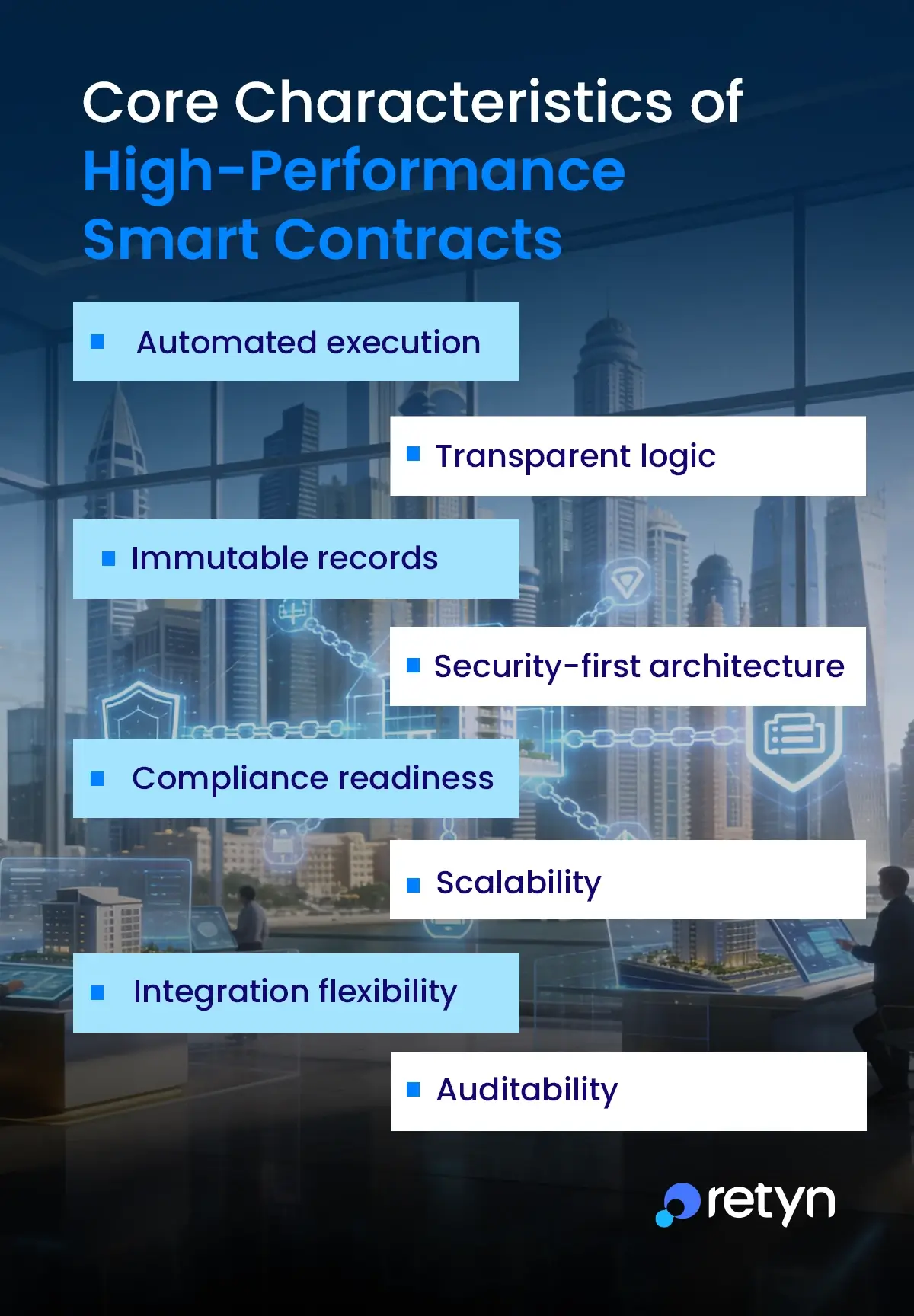
Property investment in the UAE has historically carried a transparency burden that no amount of due diligence could fully eliminate. Title deed disputes, off-plan developer defaults, opaque rental income calculations, and multi-party transaction chains where a single unverified intermediary could derail a deal — these are not theoretical risks. They are documented patterns that have cost investors millions of dirhams and eroded confidence in an otherwise world-class market. Smart contracts change this calculus permanently.
When a property transaction executes through a smart contract on a blockchain network integrated with the Dubai Land Department's registry, the conditions are not agreed upon between parties — they are enforced by code. Rental income distributes to token holders automatically and proportionally, without a property manager deciding the timing or the amount. Ownership transfers only when the verified buyer's wallet passes KYC/AML checks embedded in the token standard — not when a broker sends a PDF confirmation. The audit trail of every action is immutable, timestamped, and visible to all authorized parties simultaneously. This is not an incremental improvement over the traditional process. It is a structural replacement of the opacity that has historically defined property investment at scale.
Dubai's AED 917 billion real estate market in 2025 and the DLD's publicly stated target of 7% tokenization by 2033 — representing an estimated AED 60 billion in digitized real estate — signal that smart contract infrastructure is no longer a pilot experiment. It is the operating layer of the UAE's next real estate investment cycle. For developers, institutional investors, and proptech founders evaluating their position in this market, the question is no longer whether to adopt real estate smart contract development. It is which partner has the depth to build it right.
UAE real estate smart contract ROI calculator
Enter your current property project figures and this calculator projects how much additional annual value smart contract automation could unlock — based on conservative, named-source benchmarks covering intermediary cost elimination, closing time compression, fractional investor reach expansion, and automated rental distribution savings specific to the UAE real estate market.
Please enter a valid AED value (minimum AED 500,000).
Please enter a value between 1 and 15.
AED
Please enter a valid AED value (0 or greater).
Please select your capital-raising model.
How this is calculated: Results apply conservative published benchmarks to your inputs across four value drivers: intermediary cost elimination (30% of automatable transaction costs — Spydra/MarketsandMarkets), closing time savings modelled as additional deal throughput (20% — ScienceSoft/nadcab.com), fractional tokenization investor reach uplift (25–50% capital raise increase depending on current model — DLD pilot data, BCG), and automated rental distribution savings (15% of annual rental income recovered — CoinLaw smart contract adoption data). All figures represent conservative lower-end estimates from published industry research.
Value Impact — Without Smart Contracts vs. With Smart Contract Infrastructure
Value Driver
Without Smart Contracts
With Smart Contract Automation
Annual Uplift (AED)
What is driving your projected value uplift
Note: These projections are directional estimates based on conservative published industry benchmarks and are not guarantees of financial return. Actual results depend on project type, smart contract implementation quality, regulatory pathway, UAE market conditions, and individual asset performance. Consult qualified UAE legal and financial advisors before making investment or development decisions.
Ready to capture this value for your UAE real estate project?
Retyn builds VARA-compliant smart contracts for UAE property tokenization — from ERC-3643 security token issuance and DLD registry integration to automated rental distribution and audit-ready code. See what the right smart contract infrastructure looks like for your specific project.
Smart contract capabilities UAE real estate developers cannot afford to skip in 2026
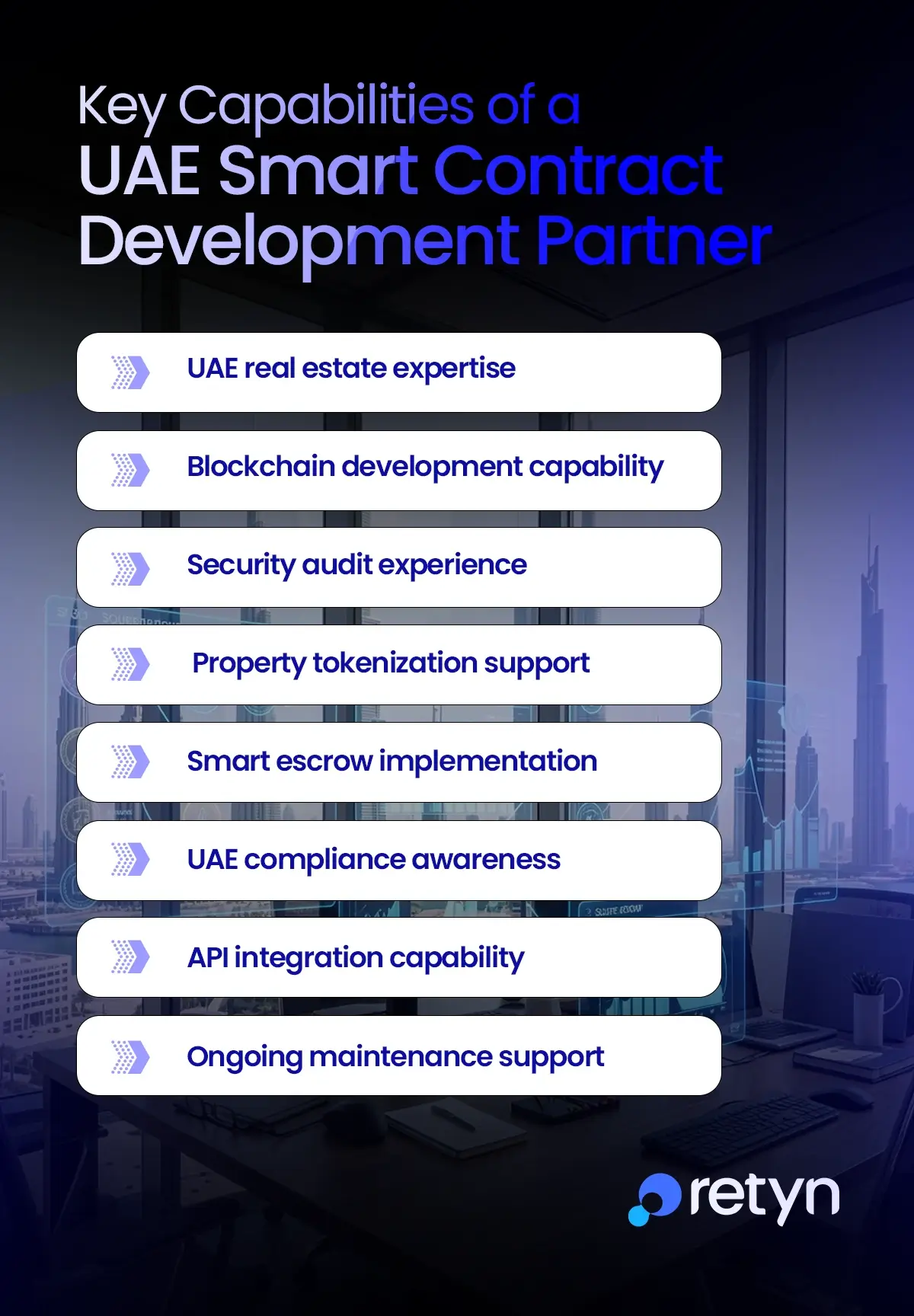
Generic Solidity development and real estate smart contract engineering are not the same discipline. The UAE's multi-regulator environment — spanning DLD, VARA, DFSA, SCA, and ADGM — demands a capability set that goes far beyond token minting. These are the non-negotiable technical and compliance capabilities that distinguish a smart contract partner capable of getting a UAE real estate product to market from one that cannot.
Smart Contract Capability
Why It Is Critical for UAE Real Estate
Trust & Transparency Impact
ERC-3643 / ERC-1400 Security Token Standards
VARA and DFSA classify tokenized real estate as securities — only compliant token standards satisfy regulatory issuance requirements in the UAE
KYC/AML enforcement is coded into every token transfer, making non-compliant transactions technically impossible
DLD Registry Integration
On-chain ownership records must synchronize with Dubai's official title deed database to carry legal weight and investor recognition
Eliminates dual-record disputes and ensures every token position maps to a verified DLD ownership entry
Automated Rental Income Distribution
Multi-investor property structures require mathematically accurate, proportional AED distributions without intermediary involvement or manual calculation
Removes the opacity and disputes inherent in off-chain rental income management across hundreds of fractional holders
On-Chain KYC/AML Compliance Layers
VARA's licensing framework and UAE AML legislation require verified investor identity before any token transfer can execute
Compliance is enforced at the contract level — no manual verification step, no human override risk, no post-transfer remediation
Smart Contract Security Auditing
Unaudited contracts that manage investor capital create regulatory exposure and irreversible vulnerability — UAE institutional investors and DLD require audit-clean code before any platform goes live
Published audit reports from recognized firms (OpenZeppelin, Certik, Halborn) are increasingly a market expectation for any VARA-regulated property token platform
SPV-Backed Token Architecture
UAE real estate tokenization structures typically hold assets inside a Special Purpose Vehicle — token contracts must accurately represent SPV beneficial ownership rather than direct title transfer
Proper SPV-token mapping ensures investor rights, dividend entitlements, and exit mechanisms are legally enforceable, not just technically represented
Secondary Market Trading Infrastructure
Illiquidity has historically been UAE real estate's largest retail investment barrier — smart contracts enabling regulated secondary token transfers are the mechanism by which liquidity becomes real
DLD Phase 2 secondary trading, live February 2026, demonstrates that on-chain secondary markets within a ±15% DLD valuation range are operationally viable and investor-trusted
VARA Regulatory Reporting Automation
Every investment action, AML event, and token transfer requires a complete audit trail exportable for VARA compliance reporting — manual logging creates retroactive compliance gaps
Automated on-chain audit trails give regulators, developers, and investors simultaneous visibility into transaction history without relying on platform operator integrity
Matching smart contract development expertise to your UAE real estate project type
No two UAE real estate tokenization projects face the same technical and regulatory architecture. The smart contract requirements for a Dubai luxury residential fractional offering differ fundamentally from those governing an Abu Dhabi commercial REIT tokenization or a multi-jurisdictional institutional STO. Mapping the right development partner to your specific asset class and investor base is as consequential as the technical build itself.
UAE Real Estate Developers & Off-Plan Project Tokenization
UAE real estate developers tokenizing off-plan units need smart contracts that integrate directly with DLD's Oqood registration system, automate installment payment tracking, and distribute proceeds to investors as construction milestones are verified on-chain. Retyn and Ctrl Alt both address this architecture — Retyn through its end-to-end tokenization development capability and Ctrl Alt through its established DLD API integration that removes the most time-consuming technical compliance bottleneck for new entrants.
Family offices, sovereign wealth funds, and institutional asset managers deploying capital into UAE real estate digital securities demand ERC-3643 compliance, professional-grade security audits, and governance frameworks that can manage complex investor rights across multiple share classes. For institutional-scale issuances, Tokeny's T-REX protocol infrastructure and MANTRA Chain's protocol-level compliance — backed by the DAMAC and MAG tokenization partnerships — represent the two strongest technical foundations for institutional UAE real estate products.
Fractional Ownership Platforms for Retail UAE Investors
Platforms targeting UAE retail investors — those entering the market through AED 2,000 fractional positions — need smart contracts that automate rental distributions in AED without cryptocurrency exposure, enforce VARA-compliant transfer restrictions, and deliver transparent investor dashboards that build the trust required to convert first-time digital property investors into repeat participants. Prypco's DLD-integrated platform and SmartCrowd's DFSA-regulated infrastructure represent the most proven investor-facing models in this segment.
Commercial Real Estate & Mixed-Use Asset Tokenization
Tokenizing office towers, logistics warehouses, and mixed-use developments introduces complexity around multiple income streams, tenant governance, and long-duration hold periods that residential fractional platforms are not designed to handle. Tokinvest's capital markets issuance framework and Retyn's custom smart contract development capability for multi-asset structures are the most relevant partners for developers moving institutional commercial assets onto UAE blockchain infrastructure in 2026.
A substantial segment of UAE and GCC real estate capital requires investment structures aligned with Islamic finance principles — Musharaka or Ijara frameworks where profit-sharing, not interest, governs returns. BAYTUKUM's SCA-regulated smart contract infrastructure, built specifically for Sharia-compliant fractional property investment, addresses a demand that none of the VARA-focused platforms currently serve. Developers targeting the broader GCC institutional investor base benefit from BAYTUKUM's regulatory positioning and Abu Dhabi distribution network.
What happens when UAE real estate projects go to market without proper smart contract infrastructure
The cost of deploying inadequate smart contracts in UAE real estate is not measured in development budget — it is measured in regulatory rejection, investor withdrawal, and permanent reputational damage in a market where institutional trust is the scarcest resource. These are the specific failure modes that emerge when development teams treat UAE real estate tokenization as a generic blockchain project rather than a specialized compliance-engineering discipline.
VARA Licensing Rejection Due to Non-Compliant Token Architecture
VARA's 2026 rulebook requires that any platform issuing, managing, or distributing tokenized real estate securities in Dubai operates under a VARA Broker-Dealer or Issuer license — and that the underlying smart contract architecture demonstrably enforces the KYC/AML, transfer restriction, and investor eligibility rules mandated by the license. Token contracts built on generic ERC-20 infrastructure, without ERC-1400 or ERC-3643 compliance layers embedded at the contract level, fail VARA's technical due diligence. Rebuilding after a rejection does not simply cost money — it costs the six-to-twelve months of lost market position during which VARA-licensed competitors establish distribution and investor relationships that are extremely difficult to displace.
DLD Registry Desynchronization and Legal Title Uncertainty
On-chain token ownership that does not synchronize with DLD's official title registry creates a legal void that no amount of investor-facing documentation can bridge. Investors who hold tokens representing beneficial ownership interests in a property, but where those interests are not reflected in DLD's records, have no enforceable claim that UAE courts will recognize with certainty. Smart contracts that handle token issuance without DLD integration may function technically but deliver a product that is legally hollow — disqualifying it from institutional participation and exposing operators to regulatory enforcement by both VARA and DLD simultaneously.
Unaudited Contracts and Permanent Capital Loss Risk
Smart contracts deployed to a public blockchain without professional security auditing are immutable — meaning a vulnerability that surfaces after mainnet deployment cannot be patched through a software update. It can only be addressed through a full contract migration that requires moving every investor's token balance to new contract addresses: an operationally complex, legally sensitive, and investor-trust-destroying process. In 2026, the expectation that a UAE real estate token platform publishes a third-party audit report from a recognized firm — OpenZeppelin, Certik, Quantstamp, or Halborn — before accepting investor capital is not a gold standard. It is the market minimum for any platform seeking institutional participation.
Manual Rental Distribution and the Disputes It Creates
Multi-investor fractional property structures that rely on off-chain, manually calculated rental income distributions introduce an intermediary trust requirement that blockchain exists specifically to eliminate. When a property manager calculates and distributes AED income to hundreds of token holders through a manual process, every rounding error, timing delay, and unexplained deduction becomes a potential investor dispute. Smart contracts that automate proportional AED distributions based on verified on-chain token holdings remove the human calculation layer entirely — distributions execute when rental income arrives, in the exact amounts the contract defines, with a complete on-chain audit trail that every investor can verify independently.
Cross-Border Investor Compliance Failures
UAE real estate's strongest growth driver in 2026 is international investor demand — with DLD reporting significant participation from more than 50 nationalities in the Prypco pilot alone. Smart contracts that do not incorporate jurisdiction-specific investor eligibility rules, transfer restrictions, and cross-border AML checks fail this investor base at the onboarding stage. A token that cannot be legally transferred to an investor in a restricted jurisdiction — or that transfers to one without triggering appropriate compliance checks — creates regulatory exposure across multiple simultaneous enforcement regimes. The ERC-3643 standard's on-chain identity verification model specifically addresses this challenge by embedding eligibility rules in the token transfer logic rather than relying on off-chain compliance verification that can be bypassed or delayed.
Smart contracts & AI: reshaping how UAE property assets are owned, managed, and traded in 2026
The integration of AI into UAE real estate smart contract infrastructure is not a future roadmap item — it is already influencing how the most sophisticated platforms in Dubai structure valuations, automate compliance monitoring, and generate predictive investor intelligence from on-chain transaction data. The convergence of programmable property contracts and machine-learning-driven analytics is producing a layer of real estate investment infrastructure that operates with a precision and speed that no human-managed process can approach.
AI-Augmented On-Chain Compliance Monitoring
Advanced UAE real estate smart contract platforms are deploying AI models that monitor on-chain transaction patterns in real time, flagging anomalous transfer sequences, wallet clustering associated with structuring behaviour, and investor eligibility state changes that require contract-level response. Where traditional VARA compliance reporting is retrospective — compiled from transaction logs after the fact — AI-driven compliance monitoring is predictive, identifying potential regulatory events before they execute and triggering automated holds or escalation workflows that protect both the platform operator and the investor. This capability transforms VARA reporting from a periodic administrative burden into a continuous, automated regulatory posture.
DLD's secondary market framework requires that tokenized property resales fall within a ±15% band of the property's current valuation. Maintaining accurate, real-time valuations that update automatically as Dubai market conditions shift requires AI-powered property valuation models integrated with smart contracts through price oracle networks — Chainlink being the most established infrastructure for this architecture in 2026. When the valuation oracle updates the property's reference price, the secondary market smart contract automatically adjusts the permissible trading band without any manual operator intervention, ensuring DLD compliance is maintained continuously rather than at periodic review points.
Programmable Investor Governance Through On-Chain Voting Contracts
Tokenized property ownership in the UAE creates governance questions that conventional property structures have never needed to answer: who votes on a major refurbishment proposal when the property has 300 fractional token holders across 40 nationalities? Smart contract governance modules encode voting rights proportionally into the token architecture, executing binding resolutions when quorum and majority thresholds are met on-chain — without relying on a property manager to organize a physical meeting or count paper ballots. For institutional investors evaluating UAE real estate token products, the presence of on-chain governance infrastructure is increasingly a due diligence checkpoint alongside financial projections and legal structure review.
DeFi Liquidity Integration for Tokenized UAE Property Assets
The next frontier for UAE real estate smart contracts is DeFi protocol integration — enabling tokenized property holders to deploy their assets as collateral in lending protocols, access liquidity against their holdings without triggering a sale event, and participate in yield strategies that compound their property investment returns. MANTRA Chain's DeFi-compatible infrastructure and Tokeny's evolving connector ecosystem for liquidity pools represent the leading edge of this capability in 2026. For sophisticated investors and asset managers operating in both traditional and digital asset markets simultaneously, DeFi-enabled real estate tokens bridge the capital efficiency gap that has historically made physical property the least liquid component of a diversified portfolio.
Traditional UAE property transactions — particularly cross-border deals involving international investors — can take weeks to settle through correspondent banking chains, currency conversion processes, and notarization requirements. Smart contracts deployed on networks integrated with UAE payment rails compress settlement from weeks to minutes, with rental income distributions and sale proceeds executing automatically in AED as soon as the underlying conditions are satisfied on-chain. The DLD Phase 2 tokenization framework already demonstrates this at a government level: on-chain token transfers settle immediately, with the DLD title registry update following the legal process timeline rather than the banking processing timeline — collapsing a multi-week process into a near-instant on-chain record.
How we evaluated and selected these 10 UAE real estate smart contract development companies
This list was built through a structured evaluation of publicly available information, regulatory filings, platform documentation, and verified announcements from companies active in UAE real estate blockchain and smart contract development as of early 2026. Our assessment examined each company's regulatory licensing status under VARA, DFSA, SCA, or ADGM; their demonstrated smart contract capabilities in live UAE real estate deployments; their adoption of recognized security token standards (ERC-1400, ERC-3643); evidence of DLD registry integration; and the credibility of their institutional client and partnership track record.
We cross-referenced official DLD and VARA announcements, company press releases, platform documentation from Tokeny, Ctrl Alt, Prypco, MANTRA Chain, and SmartCrowd, and independent analysis sources including ITP.net, LARA on the Block, tokenizer.estate, and kayrouz & Associates' legal framework analysis. Statistics cited draw from the Dubai Land Department, Ctrl Alt, Prypco, MANTRA Chain, Tokeny, BCG, EY, and ITP.net — all named primary sources verified before inclusion.
Retyn appears first as the publisher of this guide and a specialist real estate blockchain development platform. Every other company is ranked based on its verifiable capabilities, regulatory standing, and real-world deployment track record — without paid placement or commercial endorsement. Readers are encouraged to verify current licensing status, product offerings, and pricing directly with each company before making development or investment decisions, as the UAE virtual assets regulatory environment continues to evolve.
Selecting a smart contract development partner your UAE real estate project can be built on
The UAE's position as the world's most advanced regulatory environment for real estate tokenization is not accidental — it reflects deliberate government architecture through DLD, VARA, and the Dubai Economic Agenda D33 that has created a compliance infrastructure few other jurisdictions can match. That regulatory sophistication is simultaneously an opportunity and a technical barrier: the opportunity exists for developers and investors who build within the framework, while the barrier exists for anyone who attempts to replicate generic blockchain development in a market where regulatory alignment is the primary product differentiator.
For proptech founders building investor-facing tokenization platforms, Ctrl Alt's DLD-integrated infrastructure and Prypco's proven distribution model represent the fastest legitimate route to VARA-regulated market participation. For developers targeting institutional capital with commercial or mixed-use assets, Tokeny's ERC-3643 compliance architecture and MANTRA Chain's protocol-level regulatory enforcement deliver the depth that institutional due diligence demands. For projects requiring Sharia-compliant structures or SCA-regulated Abu Dhabi distribution, BAYTUKUM fills a specific and underserved position in the market that the Dubai-centric platforms do not address.
For UAE real estate teams that need a development partner who understands both the blockchain engineering and the domain-specific real estate requirements of compliant tokenization — smart contracts built to VARA's 2026 rulebook, DLD registry integration, ERC-1400 and ERC-3643 security token standards, on-chain KYC/AML compliance, and investor portal development that converts technical infrastructure into investor-trusted product experiences — Retyn delivers the complete real estate blockchain development capability that ambitious UAE property projects require to reach institutional-grade execution in 2026 and beyond.
The developers and investors who build their smart contract infrastructure correctly in 2026 enter the UAE's tokenization growth cycle with a regulatory-clean, institutionally trusted, and technically defensible position. In a market where a VARA licensing rejection or a single unaudited contract vulnerability can cost more than the development budget itself, choosing the right smart contract partner from the outset is not a procurement decision — it is a foundation for everything that follows.
Build UAE real estate smart contracts that clear VARA licensing, integrate with DLD, and earn institutional investor trust from day one — with Retyn.
FAQs on real estate smart contract development in the UAE
ERC-3643 (T-REX Protocol) has become the preferred security token standard for UAE real estate tokenization in 2026.It is a widely adopted Ethereum standard for compliant permissioned token and has been used to tokenize more than $28 billion in assets worldwide. ERC-3643 builds KYC and AML checks into the token transfer process, preventing non-compliant transactions. ERC-1400 is another option for structured financial instruments. It works well when different token categories are required, such as the senior and junior tranches in commercial real estate debt. ERC-20 is better suited to utility tokens since it does not include the compliance controls required to meet VARA and the DFSA transfer restriction requirements. Companies like Retyn, Tokeny and Ctrl Alt commonly use ERC-3643 or ERC-1400 in real estate tokenization projects in the UAE.
Yes. Any platform dealing with the issuance, management and distribution of tokenized real estate securities in Dubai will have to be licensed as a VARA Broker-Dealer or Issuer license or work with a VARA-licensed partner to perform those regulated activities. The 2026 Rulebook of VARA defines tokenized real estate as an Asset-Referenced Virtual Asset (ARVA) and subjects it to the UAE's virtual asset regulations. Not having the relevant license can make your company vulnerable to regulatory action by both VARA and the Dubai Land Department. For the majority of developers, the better choice would be to work with a VARA-licensed provider. For example, Ctrl Alt holds VARA Broker-Dealer and Issuer license reference VL/25/05/002. This is usually easier than applying for an independent license, which may require more time and effort. Developers can also consider alternative regulatory frameworks in DIFC (DFSA) and Abu Dhabi (ADGM).
Integration of smart contracts with the DLD registry uses a two-layer structure. The on-chain layer tracks the process of token issuance, ownership transfers and transaction history on the blockchain. As part of the DLD pilot, it is implemented on the XRP Ledger using Ctrl Alt’s infrastructure. The off-chain synchronization layer links each token to its corresponding title deed in the DLD land registry. Whenever a token is transferred, the records in the digital title register maintained by DLD will be updated so that the blockchain and title records remain synchronized. However, settlement timing differs. Although the transfer of tokens through the blockchain happens very quickly, updating the title registry in the DLD happens according to the official process for amending title deeds. This approach was introduced during the DLD Phase 2 launch in February 2026. Developers that will use the DLD technology need to integrate with the DLD API, a step already completed by Ctrl Alt as DLD's designated provider.
An expert smart contract security audit is carried out by specialized firms such as OpenZeppelin, Certik, Quantstamp, Trail of Bits and Halborn before the launch of a UAE real estate tokenization platform. Security weaknesses are examined in the smart contract code. The process involves carrying out a manual code review in line with the OWASP Top 10 smart contract riska followed by automated analysis using tools like Slither and Mythril to categorize the results as Critical, High, Medium, Low and Informational. All Critical and High severity findings must be resolved and re-reviewed before any platform accepting investor capital goes live. This is a standard practice under DFSA and VARA requirements. The costs of a smart contract audits vary from USD 5,000 to USD 50,000 depending on the complexity of the smart contracts involved. An audit report has to be publicly disclosed on the platform's website, in line with the expectations of VARA compliance teams and institutional investors in 2026. Development partners such as Retyn who adopt an audit-first strategy will lower audit remediation costs.
Utilizing smart contracts for the automation of rental distribution removes any form of calculation and intermediaries in the process of handling rental income for assets with multiple investors. The moment the rental money lands in the on-chain wallet of the asset, which in most cases is denominated in AED since the projects are located in the UAE, the smart contract computes the share of each investor based on their token balance on the day of distribution. The smart contract then transfers the payment to all eligible investors in a single transaction. Each rental distribution via the smart contract will be recorded on the blockchain. When developing rental distribution smart contracts in the UAE, developers have to take into account preparing VARA reports for each distribution, UAE Corporate Tax documentation for platform operators and investors, deducting property management fees before calculating net income and making distributions based on actual rental receipts instead of a fixed payment schedule. Prypco Mint and SmartCrowd are just some of the platforms that are utilizing this model. In SmartCrowd, rental income distribution is done via the blockchain, whereas in Prypco Mint, a DLD-integrated AED system is used.
The UAE’s real estate smart contract system functions on a multi-regulatory environment that is jurisdiction specific:
Dubai Mainland: Dubai Land Department (DLD) oversees the property title and registration system. VARA oversees the issuance of virtual assets, broker-dealer activities and tokenized real estate platform under its 2026 Rulebook and ARVA classification.
DIFC (Dubai International Financial Center): Regulation of digital asset exchanges and fractional property investment is under DFSA (Dubai Financial Services Authority) for DIFC licensed businesses. SmartCrowd and Stake are licensed by DFSA.
ADGM (Abu Dhabi Global Market): Financial Services Regulatory Authority (FSRA) governs digital asset and security token platforms with an active regulatory sandbox for blockchain innovations that include tokenization of real estate assets.
Abu Dhabi Mainland: Investment products are regulated by the SCA (Securities and Commodities Authority), which includes Sharia-compliant fractional property structures. BAYTUKUM is regulated under this framework.
Selecting the right jurisdiction is one of the initial steps and the most critical decisions for a real estate smart contract project. It will affect the design of the smart contract, licensing requirements and eligibility criteria for investors. Development partners like Retyn, who have expertise in various UAE regulatory frameworks can help businesses select the right jurisdiction.
Retyn offers smart contract solutions to UAE real estate projects with compliance considered from the start. Every project commences with a compliance mapping session where the asset type, investor profile and the jurisdiction of the project are assessed to choose the right regulatory path. It could be VARA Broker-Dealer licensing for Dubai Mainland tokenization, DFSA frameworks for DIFC-based platforms or ADGM sandboxes for projects requiring a more flexible regulatory framework. Depending on the requirements of the projects, the Retyn team develops the smart contracts in accordance with ERC-1400 or ERC-3643 security token standards, integrates on-chain KYC/AML compliance tools, ensures that the token ownership based on SPVs aligns with DLD requirements and automates AED rental income distribution without the use of cryptocurrencies. Audit-readiness is an inherent part of the development process, which helps us minimize the remediation work required by recognized security audit firms. In case you are considering your own UAE real estate tokenization project, booking a discovery session with Retyn is the best place to start.
Share this Blog
Disclaimer: Retyn does not endorse or promote any third-party platform listed in this article. All companies are included based on publicly available information, verified regulatory status, and documented smart contract capabilities as of early 2026. Regulatory licensing status, platform features, and service availability in the UAE may change without notice — readers should conduct independent due diligence and consult qualified UAE legal and compliance counsel before making development, investment, or platform-selection decisions. Statistics and market projections cited are drawn from named primary sources and may vary based on market conditions, regulatory developments, and individual platform performance.